Limb Symmetry Index Calculator
Compare left-right strength, jump, and range-of-motion scores with weighted symmetry logic and practical return-to-training flags.
📌Presets
Presets fill realistic left-right values across force, jump or hop output, ROM, and confidence settings.
⚙Calculator
Limb symmetry snapshot
Enter left-right values to calculate a weighted symmetry score.
📊Symmetry Snapshot
📑Reference Tables
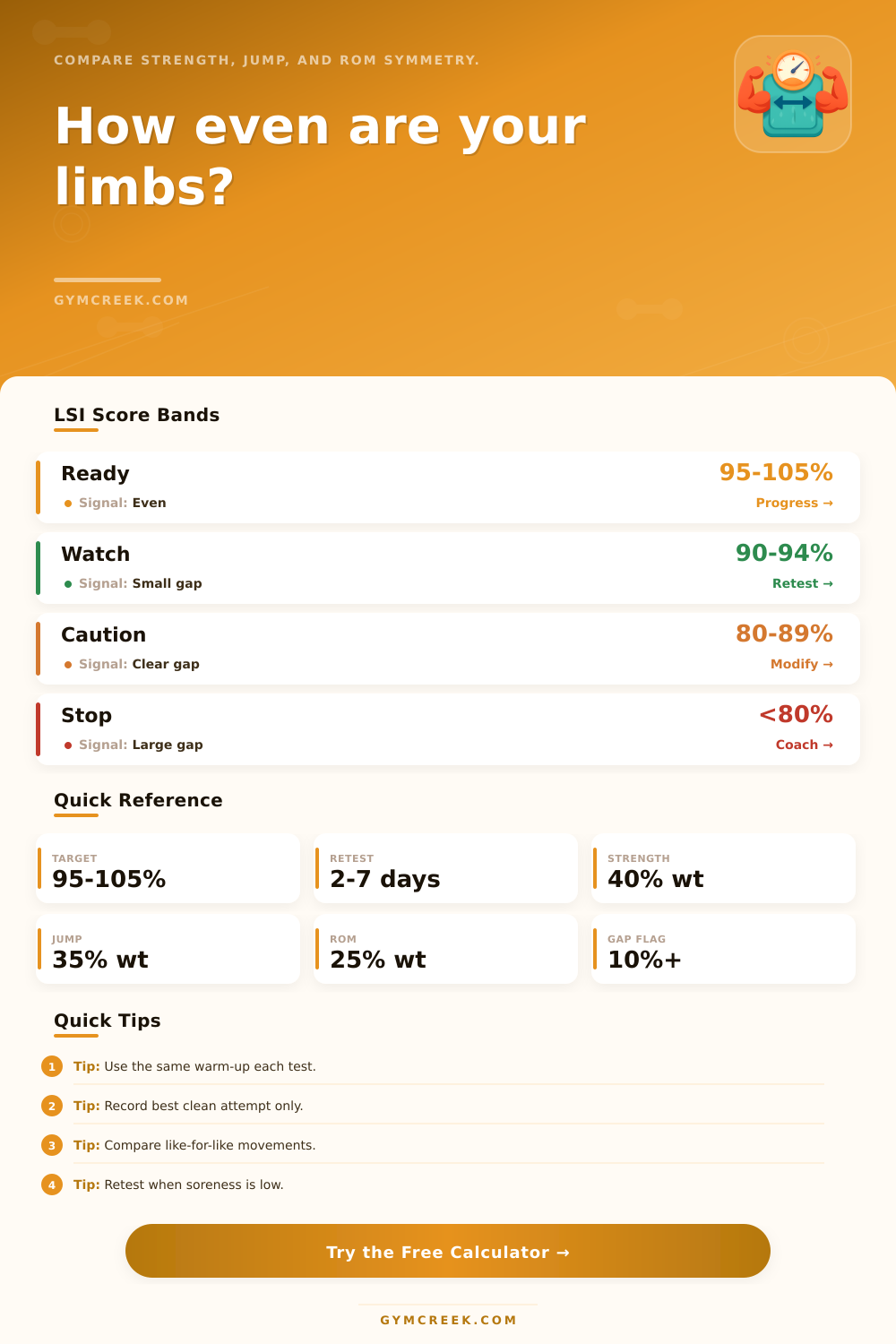
| Band | Composite LSI | Signal | Training use |
|---|---|---|---|
| Ready | 95-105% | Balanced output | Progress load with normal checks |
| Watch | 90-94% | Small side gap | Retest and cap aggressive jumps |
| Caution | 80-89% | Clear asymmetry | Modify volume or intensity |
| Stop | Below 80% | Large deficit | Get qualified review |
| Test lane | Best input | Formula | Common flag |
|---|---|---|---|
| Strength | Force, torque, load | Lower divided by higher | Gap over 10% |
| Jump or hop | Height or distance | Control-adjusted ratio | Step landing |
| ROM | Joint angle | Smaller divided by larger | Pain difference |
| Composite | All three lanes | Weighted average | Weakest lane limits |
| Scenario | Typical target | Retest timing | Notes |
|---|---|---|---|
| Return to running | 90% plus | 2-7 days | Pair calf and hop tests |
| Field sport | 95% plus | 3-7 days | Add cutting tasks separately |
| Strength block | 90-95% | 1-2 weeks | Track load and RPE |
| Mobility retest | 95% plus | Daily to weekly | Use same angle setup |
| Formula part | What it does | Why it matters | Output |
|---|---|---|---|
| Raw LSI | Lower over higher | Standardizes sides | Percent |
| Known side LSI | Target over other | Tracks involved side | Percent |
| Landing penalty | Subtracts control loss | Stops messy reps scoring high | Adjusted jump |
| Confidence score | Checks attempts, pain, rest | Grades test quality | Low to high |
💡Tips
Until now, you may have focused on personal bests. Then you turns around and want to go in another direction, and that’s when the hidden deficit come out. Yes, you may be able to make high jump with your strong side, but what if it takes the other leg just a few centimeters longer? Every time you pivot or cut something, you put yourself at risk of injury.
So what do we use? We use the Limb Symmetry Index, which show how balanced your sides are. It gets rid of the vanity of absolute strength. Instead, it allows you to see gap between left and right. And that gap matter. Asymmetries create opportunities for injuries.
How to Check Your Leg Balance and Avoid Injury
To use it, you enter in your best clean reps for range of motion, jump and strength. But the real work happen in how honest you are about those inputs. Because here’s the deal: The calculator does the math for you. But it depends on your honesty in entering those scores. And most folks thinks they’re fine because the involved side feels better. Feeling good doesn’t equate to being strong enough, though. Actualy numbers will tell.
So input your right and left values exactly as performed during a controlled test. Don’t average it out with a bad attempt in order to make number look better. Only input best clean rep, but maintain the measurement method on each side. For example, if you went for a 1-rep max on one leg and did a 5-rep set on the other, then your comparison is more worthless than it should of been. The system assume like-for-like effort in order to judge true mechanical output of each limb.
Three separate lanes make up tool because weightlifting is part of balance, too. Base power to move is measured as strength, plus your ability to transfer that power on the ground, which is measured as jump metrics. Joint mobility let you bear the load and avoid compensating for it, which is measured as range of motion. Dragging down the composite score usually mean your weak point lives in one of those lanes.
And the page has a handy reference table that spells it all out, breaking the results into bands. If you’re above the red line in the ready zone, you can continue progressing with normal checks; drop under and signal shifts to stop or caution. These are not suggestions; they are flags telling you to either modify volume or get a qualified review before things go sideways.
Those numbers only make sense in the context of your particular situation. So someone recovering from a calf strain may have different goals different than an athlete building up for an explosive race as a sprinter. Setting the context on the test will favors things to match what your sport requires. For example, if you play some sort of field sport then jumping symmetry becomes more important than straight lifting ability. Game conditions don’t usually require slowly controlled lifts but rather reaction and explosion. Stepping out or wobbling around on your foot after hopping down means a quick drop in your score as it isn’t as big a penalty to land outside the box a bit if your body hasn’t quite trusted that foot yet.
Never assume you’re balanced if you are equally weak. Since symmetry depends on your strength, compare it as a ratio against absolute strength standards to see if you are truly strong or just evenly weak.
Re-test often but don’t test foolishly. Give yourself 2-7 days for recovery while maintaining progress by not waiting too long. Test after a good warmup and when you aren’t too sore. The same muscle feel different cold vs. Primed, which will wreck your data.
You’re not going for perfection here; there’s no such thing in human biology. Instead, you are closing the gaps and knowing what those gaps is. This allows you to close them safely and move freely without having to hide from them. You’ll learn where they are and how to fix ‘em. The calculator takes care of the coefficients, so all you have to do is do the work. Close the gap, trust the process, get back to movin like a complete athlete again.