Limb Length Lifting Calculator
Compare torso, femur, tibia, and arm proportions to estimate lifting leverages, setup bias, range of motion demands, and goal-specific adjustments.
📌Leverage Presets
Each preset loads a complete body-proportion and setup scenario for a different lift and training goal.
⚙Calculator Inputs
Limb leverage snapshot
Enter your measurements to see which lift setup your proportions tend to favor.
📊Proportion Metrics Grid
📑Reference Tables
| Segment | Short Bias | Average Zone | Long Bias |
|---|---|---|---|
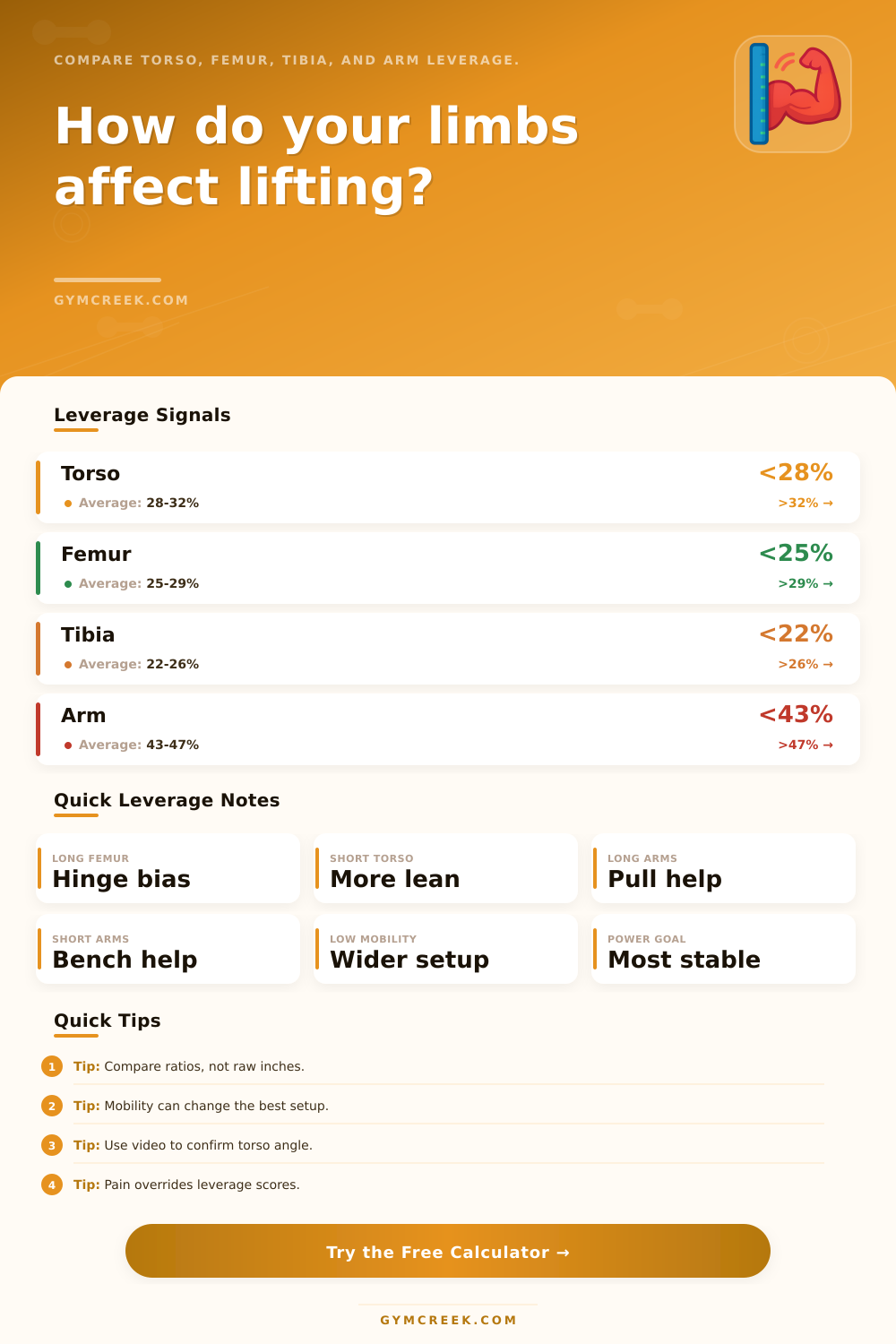
| Torso to height | Under 28% | 28% to 32% | Over 32% |
| Femur to height | Under 25% | 25% to 29% | Over 29% |
| Tibia to height | Under 22% | 22% to 26% | Over 26% |
| Arm span to height | Under 98% | 98% to 103% | Over 103% |
| Lift | Helpful Proportion | Common Challenge | Setup Lever |
|---|---|---|---|
| Back squat | Long torso or short femur | Long femur torso lean | Stance width and bar position |
| Deadlift | Long arms or short torso | Short arms add start range | Hip height and stance |
| Bench press | Short arms and stable torso | Long arms increase range | Grip width and arch tolerance |
| Overhead press | Short arms and good mobility | Long arms extend lockout path | Grip width and rib control |
| Stance or Grip | Best Use | Watch Point | Likely Tradeoff |
|---|---|---|---|
| Narrow | Short femur or high mobility | Knee travel and depth | More ankle demand |
| Medium | Balanced proportions | Even foot pressure | Most neutral option |
| Wide | Long femur or long arms | Hip comfort | Less knee travel |
| Low-bar or wide grip | Strength bias | Shoulder and elbow comfort | Less range, more control need |
| Goal | Leverage Priority | Range Priority | Practical Choice |
|---|---|---|---|
| Max strength | Highest stable load | Legal or consistent depth | Use the strongest repeatable setup |
| Hypertrophy | Target muscle tension | Controlled full range | Favor joint-friendly positions |
| Power | Fast bar path | Moderate and crisp | Choose the least sticky setup |
| Technique rebuild | Simple positions | Repeatable reps | Pick the setup you can own |
💡Leverage Tips
Before the bar goes anywhere, a lift’s feel is shaped by limb length. Two lifters might have same body height and lift the same weight, but one hinges hard at depth while the other squats up as straight as possible. Typicaly, it comes down to arm-to-leg ratios (femur to tibia to torso). These interact with your grip or stance and the type of lift you are testing.
Torso length establish the starting point for forward lean in a hinge or squat. If your torso is longer compared to your legs, then there’s greater distance between hips and the bar. To maintain center of mass over the midfoot, that means traveling further forward. And that means an increase in moment arm at the lower back. This explains why starting position in a conventional deadlift feels heavier to some athletes different than their numbers would suggest. For shorter torsos, it reverses the image. Hips take more vertical path and you’re often more upright through the bottom of squat.
How Your Body Shape Changes Your Lift
In addition to the hip, another consideration is length of femur and tibia together with one another. They’ll influence how much ankles must move and how far knees travel. Longer legs increases ankle demand. A longer femur also forces the knees further forward unless you lower bar on your back or widen your stance. Because longer tibias increase the amount of ankle dorsiflexion required, some lifters feel like they’re pinched at the bottom despite their mobility appearing sufficient on paper.
With these four measurements, calculator does the rest for you. It will show you whether your stance is helping or hindering the proportions you actualy have. On pulls and presses, arm span is most important. In both cases, longer arms change your range, they shorten it in a deadlift but lengthen it in a bench press. That’s why some folks who crush the deadlift has trouble bringing their chest up without over-stressing their shoulders. Conversely, shorter arms do exact opposite. A conventional deadlift feels like it starts further away, but you gain an advantage on the bench. Once you see those ratios, grip width options makes more sense.
The tape measure doesn’t show mobility or technique consistency, but it does affect everything those numbers imply. Long femurs don’t always require wide stances if you have good hip and ankle mobility to handle them. Technique can take what’s not perfectly optimized into something you could of repeatedly execute while fatigued.
How much wiggle room for range the tool is set for depends on your goals. If one person has an irritated shoulder and is trying to rebuild, they’re solving a different problem than a powerlifter grinding towards a total. Bodies are different but solution is the same so the recommendations differ. Where it gets valuable is to use results as a hypothesis instead of a conclusion.
Record what it recommends for your bias and go run through some reps. Watch your joints and pay attention to how bar path looks on a couple of warm up sets. Sometimes tinkering with bar height, stance width or just a bit of each is good enough without chasing that perfect ratio. The proportions aren’t moving; however, how you fit the lift around those proportions can adjust based off what you want to do and experience.