Leg Workout Calories Burned Calculator
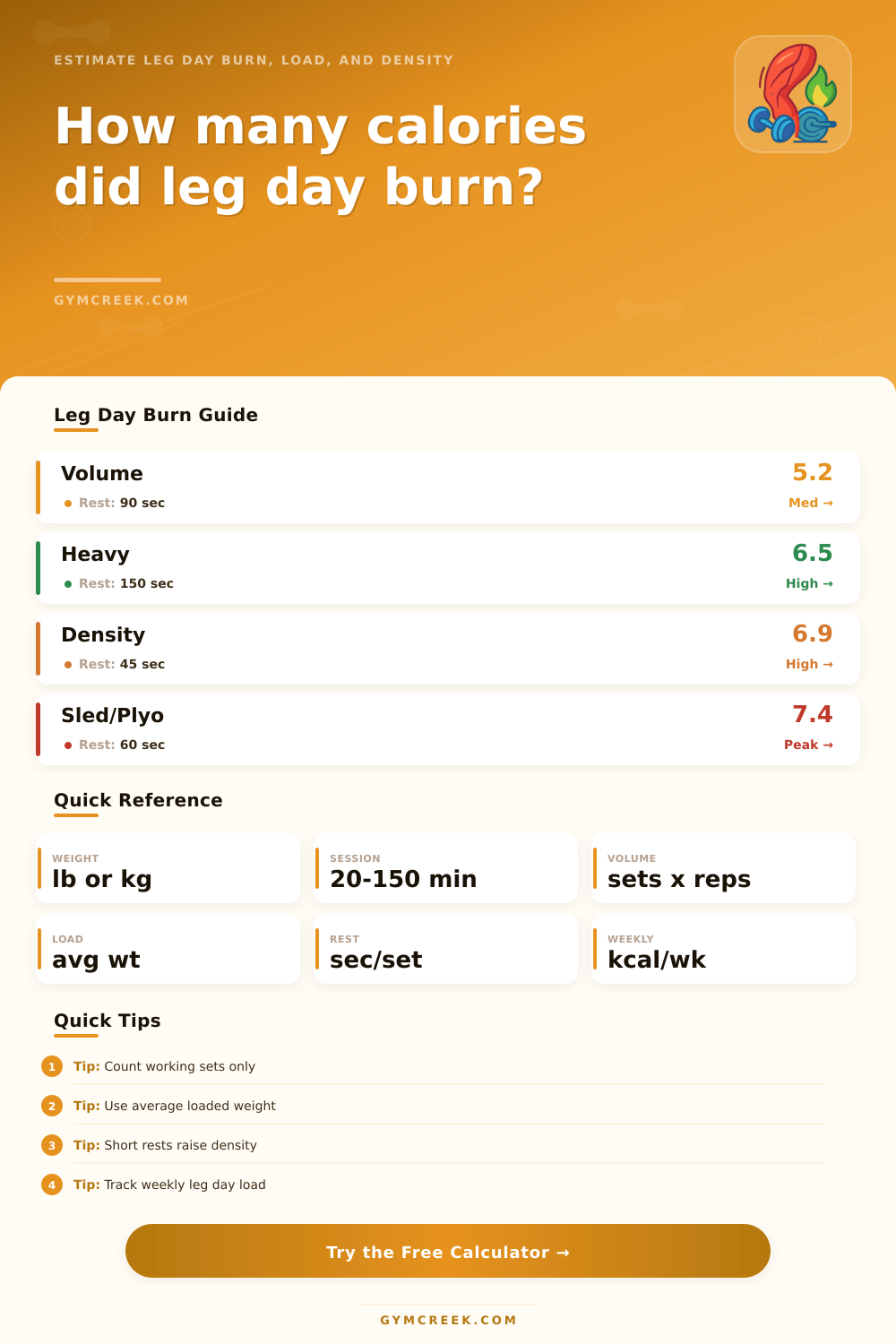
Estimate leg day calories, volume load, training density, afterburn, and weekly burn from body weight, session length, squat, hinge, lunge, rest, intensity, and sled or plyometric work.
📌Leg Day Presets
Presets load realistic leg day setups. You can adjust any field and calculate again.
⚙Calculator Inputs
Leg workout calorie snapshot
Enter your leg day setup to estimate calories, load, density, afterburn, and weekly burn.
📊Metrics Grid
📑Reference Tables
| Session style | Typical volume | Rest range | Training read |
|---|---|---|---|
| Beginner machine day | 8 to 12 sets | 75 to 120 sec | Moderate burn with controlled technique practice. |
| Hypertrophy squat day | 12 to 18 sets | 60 to 120 sec | High volume load and steady leg density. |
| Heavy strength session | 8 to 14 sets | 150 to 240 sec | High force output with lower calories per minute. |
| Sled or plyo finisher | 10 to 18 sets | 30 to 90 sec | Raises MET load and afterburn after lifting work. |
| Load intensity | Base MET | Afterburn | Best use |
|---|---|---|---|
| Light technique or pump work | 4.2 | 4% | Skill practice, rehab-style loading, or easy accessories. |
| Moderate hypertrophy loading | 5.4 | 7% | Most repeatable muscle-building leg days. |
| Heavy strength loading | 6.3 | 9% | Hard sets with long rests and high mechanical tension. |
| Near-max effort loading | 7.0 | 11% | Very demanding sessions with high nervous-system fatigue. |
| Pattern | Volume math | Model factor | Why it matters |
|---|---|---|---|
| Squat pattern | Sets x reps x load | 1.00 | Most direct loading for quads, glutes, and trunk bracing. |
| Hinge pattern | Sets x reps x load | 0.95 | Hinges often move heavy loads but with shorter rep paths. |
| Lunge pattern | Sets x reps x 2 legs x load | 0.72 | Single-leg work uses less external load but high local fatigue. |
| Add-on work | MET bump, not load | 0.15 to 0.55 | Sled and plyo work mainly changes metabolic demand. |
| Metric | Formula | Output | Use |
|---|---|---|---|
| Active calories | MET x 3.5 x kg / 200 x min | kcal | Standard exercise energy estimate. |
| Afterburn | Active kcal x EPOC percent | kcal | Post-session oxygen cost estimate. |
| Volume load | Load x reps x pattern factor | lb or kg | Approximate external work volume. |
| Leg density | Volume load / session minutes | load/min | Shows how much work was packed into the session. |
💡Tips
To determine the energy expenditure for a leg days, there are specific ways to calculate the variable involved in leg day training. Training can often make a leg day feel difficult on one week and easy on the next, even with the same exercises. This can be caused by the variable of the intensity of the load, rest periods, and the length of the session altogether.
Each of these variable must be understood to calculate the number of calories that are burned during a leg day session. The first variable to consider is you’re weight. Your body weight will determine how much energy is required to perform leg day exercises.
How to Calculate Calories Burned on Leg Day
The length of the session is another important variable to consider. This will determine how long your heart rate are elevated during your leg day session. The average external load that you use for exercises like squats and lunges is another important variable to consider.
Finally, the length of your rest periods is a crucially important variable to take into account, as the density of your session will impact the number of calories that are burned both during and after your session. Training level is a variable that impact the energy expenditure for a leg day. Individuals who are just starting to train will expend more energy for their leg day than an individual who has training experience.
This is because a beginner will have to recruit more muscle fibers to move the barbell. The calculator account for this difference in training levels. Additionally, sled and plyometric work will increase the heart rate without significantly increase the total weight that is moved, so lifting movements are separated from sled and plyometric work.
Volume load and session density are two different variables that can be used to describe a leg day session. Volume load describes the total amount of work that is produced during a leg day. However, volume load does not necessarily indicate a high burn of calories.
For example, a leg day that features heavy weights and long rest periods may have a high volume load. However, the heart rate may remain low. On the other side of the spectrum, a leg day that features a moderate load of weights with short rest periods may have a lower volume load than a strength day with long rest periods.
However, it may be more metabolically costly. Density is the amount of load that you move in a session per minute. Density will help to explain why two leg day sessions with the same load may have different expenditure of energy.
The weekly burn estimates will help you to figure out how many leg days that you would like to perform each week. For example, you may choose to perform two leg days each week or three. If you choose to perform three dense leg days each week, your training intensity may have to be lowered.
This is to allow your body time to recover from the intense workouts. The burn estimates will allow you to test these option and determine which training schedule is best for your body. The reference tables will provide information regarding how various intensities or add-on exercises will change your metabolic rate and afterburn percentage.
These tables allow you to understand how a session close to your maximum strength and long rests will be different than a moderate leg day with sled pushes included. While you should not memorize the coefficients, you should be able to recognize the information in the tables. As with any calculation, it is possible that you may make some mistake when entering information into the calculator.
One mistake may be counting warm-up sets as sets that are used during your training. Warm-up sets are not part of your working volume. Another possible mistake is using only the heaviest single set of weights instead of the average load that you lifted during your leg day.
Underestimating the importance of rest periods is yet another mistake that can be made when entering data into the calculator. It is important that you enter your number as honestly as possible. Finally, there are other recovery costs for leg day that cannot be accounted for in the calorie calculations for leg day sessions.
For example, heavy work on hinge exercises tax your lower back and nervous system. While taxing your lower back and nervous system may have beneficial effect for your leg day, it can also have detrimental effects on your sleep and your performance. Similarly, performing high-repetition lunges can lead to local fatigue, which can impact your ability to perform other physical activities.
While the calculator will provide an estimate for the number of calories that are burned during your leg day, you must use your judgment regarding your bodys recovery from that type of exercise. The purpose of this type of calculation is to help individuals understand how their body react to the variables in their leg day routine. Once you understand how each of these variable affects your body, you can make adjustments to each of them.
For example, you can reduce the number of rest periods between sets or you can incorporate sled day into your routine during weeks when your body is well-rested. By understanding these variable and the effects that they can have on your body, you can make more informed decisions regarding your training routine for leg day.