Leg Press Actual Weight Calculator
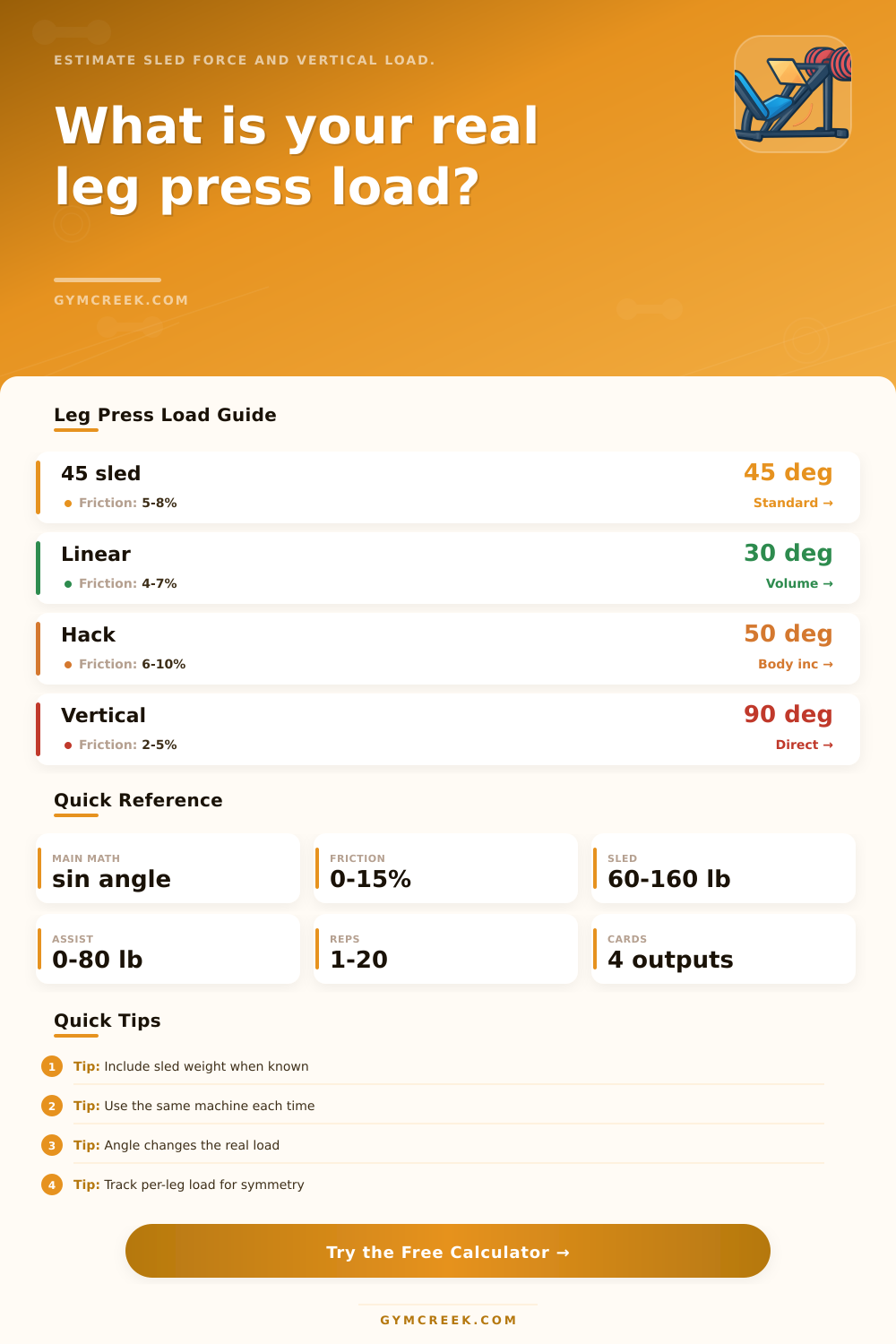
Convert plate load into actual leg press resistance using sled angle, sled weight, machine type, friction or counterbalance, reps, bodyweight contribution, and effective vertical force.
📌Leg Press Presets
Presets use realistic sled weights, angles, plate loads, friction estimates, bodyweight contribution, and rep targets so you can compare machines without treating every plate stack as the same load.
⚙Calculator
Leg press load snapshot
Enter the machine setup to convert plate load into actual sled-path and vertical-equivalent force.
📊Load Metrics
📑Reference Tables
| Sled angle | Gravity factor | 400 lb plates feel like | Interpretation |
|---|---|---|---|
| 20 degrees | 0.34x | 137 lb before sled | Low-angle linear path |
| 30 degrees | 0.50x | 200 lb before sled | Moderate incline |
| 45 degrees | 0.71x | 283 lb before sled | Common sled press |
| 60 degrees | 0.87x | 346 lb before sled | Steep hack style |
| 90 degrees | 1.00x | 400 lb before sled | Vertical path |
| Machine | Typical angle | Friction range | Bodyweight handling |
|---|---|---|---|
| 45-degree sled | 40 to 45 degrees | 5% to 8% | Body usually fixed |
| Linear leg press | 25 to 35 degrees | 4% to 7% | Body fixed, lower angle |
| Hack squat press | 45 to 55 degrees | 6% to 10% | Some body mass moves |
| Vertical leg press | 80 to 90 degrees | 2% to 5% | Plates are near direct |
| Horizontal stack | 0 to 10 degrees | Cable dependent | Use stack rating carefully |
| Input | What it means | Effect | When to adjust |
|---|---|---|---|
| 0% friction | Ideal low-drag rails | Minimum estimate | Very smooth carriage |
| 5% friction | Typical smooth sled | Small load increase | Most modern sleds |
| 10% friction | Noticeable rail drag | Moderate increase | Older or heavy rails |
| Assist value | Counterbalance help | Subtracts resistance | Spring or cable assist |
| Body share | Mass moving with sled | Adds resistance | Hack-style machines |
| Metric | Formula | Inputs | Output |
|---|---|---|---|
| Moving load | plates + sled + body share | Machine and athlete | Total mass on path |
| Sled force | load x (sin A + mu x cos A) - assist | Angle and friction | Path resistance |
| Vertical equivalent | path force x sin A | Path force and angle | Vertical force |
| Rep-max actual | actual x (1 + reps / 30) | Reps plus RIR | Estimated max |
| Per-leg share | actual / working legs | Stance style | Single-leg comparison |
💡Tips
Many who look at the weight plates on a leg press exercise believe that the weight on those plates is the only important factor in leg press exercises. However, the leg press machine itself contain many different variable that change the amount of force that is transmitted to the legs. These different variables include the angle of the sled on the leg press machine, the weight of the sled on that leg press machine, the friction of the leg press machine rails, the movement of the body weight of the individual perform the exercise, the number of repetitions performed, the level of effort that is use during the exercise, the stance on the leg press machine, and even more specific factors like whether the exercise use single-leg or double-leg exercises.
These different variables can make it difficult to accurately compare the performance of leg press machines of different makes and models. One of the main variables within the leg press exercise is the angle of the sled of the leg press machine. Leg press machines that has forty-five degree angles utilize the force of gravity in providing a partial assist to the muscles of the legs during exercise.
Why the Leg Press Feels Different
In contrast, vertical leg press machines do not include a partial assist from the force of gravity to the legs. As a result, a four hundred pound load will feel lighter on a forty-five degree leg press machine than on a vertical leg press machine. As a result, individuals may feel that they are stronger at one gym than another, but they may not be aware of the different angles of the leg press machines at those two gyms.
Another variable in the leg press is the weight of the sled. Many leg press machines has heavy sleds that the legs must move. If the weight of the sled is not accounted for, an individual’s logs for their leg press exercises will be inaccurate.
The weight of the sled can change from leg press machine to leg press machine. In addition, many leg press machines incorporate spring or other counterweights that reduce the total weight that the individual’s legs must move. Another factor that may impact the strength of the leg press machines are the factors relating to friction.
Leg press machines that are new will have less friction on the rails than older leg press machines. Because friction works in a direction that is perpendicular to the force of gravity, friction will interact with the angle of the sled. As a result, a leg press machine with high friction will feel as if it has more weight than a leg press machine with low friction.
In addition to the factors mentioned, the body weight of the individuals that perform leg press exercises may contribute to the force that must be exerted. For example, hack-style leg press allow for the mass of the individual’s torso to move with the leg press machine. The amount of body weight that move with the exercise may vary with the specific design of the leg press machine.
Additional factors include the number of repetitions performed during a leg press exercise. For example, performing six repetitions of a certain weight is not the same as performing twelve repetitions of that same weight. An estimated maximum of the number of repetitions that can be performed can be used to compare the effort of different repetition ranges, or to calculate the amount of weight that would be required for a target number of repetitions to be performed.
The stance on the leg press machine and the type of exercise that is performed (single-leg or double-leg) are additional variables in the leg press exercise. For example, leg press exercises with narrow stances will place different forces on the legs than exercises with wide stances. Additionally, single-leg exercises will allow more force to be placed through each leg than double-leg exercises, and individuals may make adjustments to the stances on the leg press machine to accommodate these differences in force.
These variables is additionally important in the case of addressing imbalances between an individual’s left and right leg. The tables that are included on this page help to indicate the gravity factors for different angles of leg press machines. These tables also provide information regarding the way that the different leg press machines handle friction and body weight.
Individuals can use these tables to review the specifications of their own leg press machines and to ensure that thirty-degree and fifty-degree leg press machines, for instance, are not being treated as if they are the same exercise. In addition to the variables that can be calculated, the placement of the feet on the leg press machine and the depth of the seat on the leg press machine can also affect the strength of a leg press exercise. Unfortunately, these factors cant be included in the tables or other mathematical calculations of the strength of the leg press exercise.
Thus, individuals should use the same leg press machine to perform their exercises over a period of time. If they must use a different leg press machine, the calculations for those variables should be calculated once for that specific leg press machine. Individuals should treat the leg press exercise with the same importance as the bench press or squat exercise.
For instance, when the strength of those exercises is calculated, the weight of the barbell used for bench press exercises is accounted for. The same type of calculations should be made for the leg press exercises. By accounting for the specifics of a leg press exercise, the logs that individuals create for those exercises will accurately reflect the strength of there legs.