Leg Length Discrepancy Calculator
Compare true leg length, apparent leg length, side difference, and percentage asymmetry from left and right measurements.
📌Presets
Each preset loads realistic side measurements and recalculates true, apparent, and asymmetry outputs.
⚙Calculator
Leg length discrepancy snapshot
Enter left and right measurements to compare side differences.
📊Metrics Grid
🎯Comparison Targets
📑Reference Tables
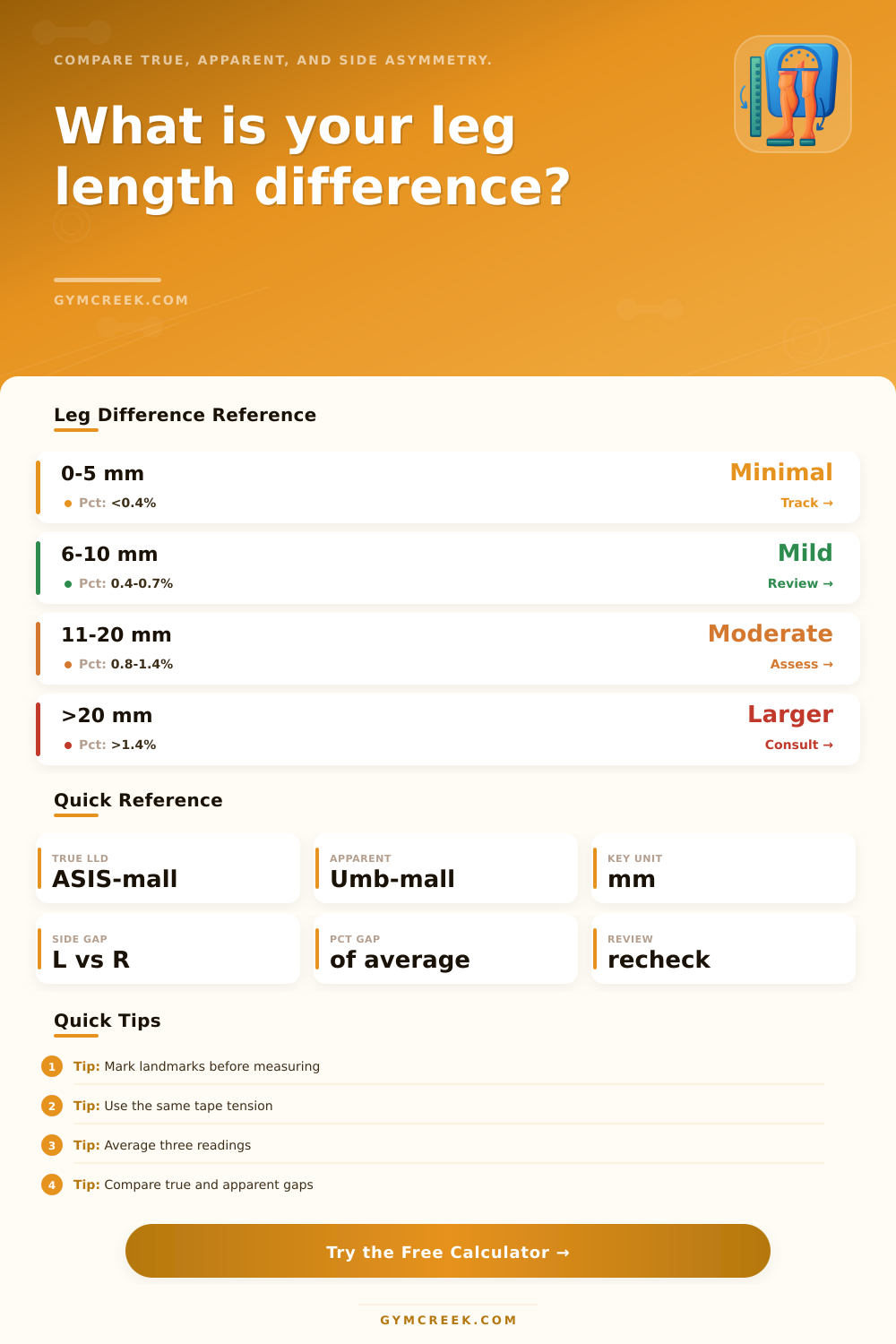
| Difference | Metric range | Common label | Typical next step |
|---|---|---|---|
| Minimal | 0 to 5 mm | Often within error | Repeat measure |
| Mild | 6 to 10 mm | Small discrepancy | Compare symptoms |
| Moderate | 11 to 20 mm | Clear side gap | Professional review |
| Larger | Over 20 mm | Marked difference | Clinical consult |
| Measure | Landmarks | Reflects | Use |
|---|---|---|---|
| True length | ASIS to malleolus | Bone length | Structural check |
| Apparent length | Umbilicus to malleolus | Pelvis and posture | Functional check |
| Side difference | Left minus right | Shorter side | Direction |
| Percent asymmetry | Gap / average | Relative size | Scale by body |
| Scenario | True gap | Apparent gap | Interpretation |
|---|---|---|---|
| True only | Higher | Similar | Structural signal |
| Apparent only | Low | Higher | Functional signal |
| Both match | Higher | Higher | Mixed or consistent |
| Both small | Low | Low | Within tolerance |
| Formula | Variables | Output | Note |
|---|---|---|---|
| True difference | |L true - R true| | Length gap | Structural |
| App difference | |L app - R app| | Length gap | Functional |
| Percent gap | Gap / average | Percent | Body scaled |
| Reliability | Gap vs tolerance | Low to high | Screening |
💡Tips
Your hip bones aren’t parallel when you look at yourself in the mirror. You’re walking with bit of a shuffling gait, and one shoulder seem to be sagging down. The thing that confuses you is that both legs actualy feel even length to you.
Most cases of leg length discrepancy is not simply “my tibia is too short.” It’s usually a combination of functional change to the pelvis (as well as structural) which make it hard to untangle without some help. The one that most folks latch onto is the true/apparent length issue. True length is measured from hip joint to ankle bone, so it’s a measurement of your actual bone structure. Apparent length take into account position of your spine and pelvis, measuring from the belly button down. Even when two legs has the same exact bone structure, they can appear differently in length if one has poor posture or tight muscles.
How to Check Your Leg Length Difference
They assume a postural tilt mean there’s a bone problem or they think that a real discrepancy doesn’t matter because it feels functional. And that makes a difference. Fixing a muscle imbalance with a lift in your shoes could of making things worse. Not addressing a true discrepancy result in chronic knee pain.
After you take those key measurements, plug them into the calculator. To do this, you’re measuring the distance from inside of ankle bone to the top of the front hip (the prominent bony point). Using a firm tape measure (one that doesn’t sag) and marking these points with a pen helps ensure accuracy. This is where consistency is essential. The more you pull the tape taut on one side versus the other, the quicker it introduce error rather than gaining precision. Take three readings then average them to help even out any minor inconsistencies.
With those numbers, the tool calculate the asymmetry between the two sides and provides it as a percentage. That percentage helps put the gap into context relative to your overall body size. In isolation, ten millimeters can sound like a lot. But if you’re a tall athlete, it might be well within normal variance. If you’re a shorter person, then it might mean a bigger proportional change. The page has a clear reference table that lays all this out. It classifies small differences as minor issues to watch and larger differences as something to discuss with a professional. You don’t have to remember any of these thresholds but having them there with you will help you avoid freaking out about tiny differences while also ignoring meaningful differences.
Because growth plates close at different ages during adolescence, this is another reason why a child’s height might seem inconsistent but corrects itself over time. It may even stabilize in the late teens. In adulthood, functional changes often present after years of repeating the same movement pattern, say, through weightlifting or running. Your pelvis will respond to that stress, adapting to accommodate it. That adaptation then cause what appears to be a structural difference but is really just a length difference.
It’s about figuring out what that number means for how you move, and not just finding one. What if there’s a little structural difference that responds better to exercise different than orthotics? What if there’s a big functional tilt that should of be dealt with through physical therapy in order to get your hips back into balance? Your numbers are only a starting point (and even then they’re only a snapshot of a single moment), but your day-to-day habits and symptoms adds context. Let them be a jumping-off point for conversations with clinicians or trainers, not the conclusion.
Standing straight up on two feet means having bones of equal length, yes, but it also means having a symmetrical body that functions well. Knowing precisely where you are now is half the battle in getting the balance right.