Leg Curl to Deadlift Calculator
Compare hamstring curl strength with deadlift capacity using machine type, reps, body weight, ROM, tempo, RPE, and deadlift 1RM.
📌Presets
Presets load realistic curl and deadlift profiles, then recalculate the comparison instantly.
⚙Calculator
Hamstring-to-pull snapshot
Enter your curl set and deadlift max to compare the strength signal.
📊Metrics Grid
📑Reference Tables
| Current Metric | Your Value | Reference | Read |
|---|---|---|---|
| Curl to deadlift | --- | 26-37% | Calculate |
| Curl to body weight | --- | 45-85% | Calculate |
| Required curl | --- | By style | Calculate |
| Supported deadlift | --- | Compare 1RM | Calculate |
| Curl/DL Ratio | Status | What It Suggests | Best Next Check |
|---|---|---|---|
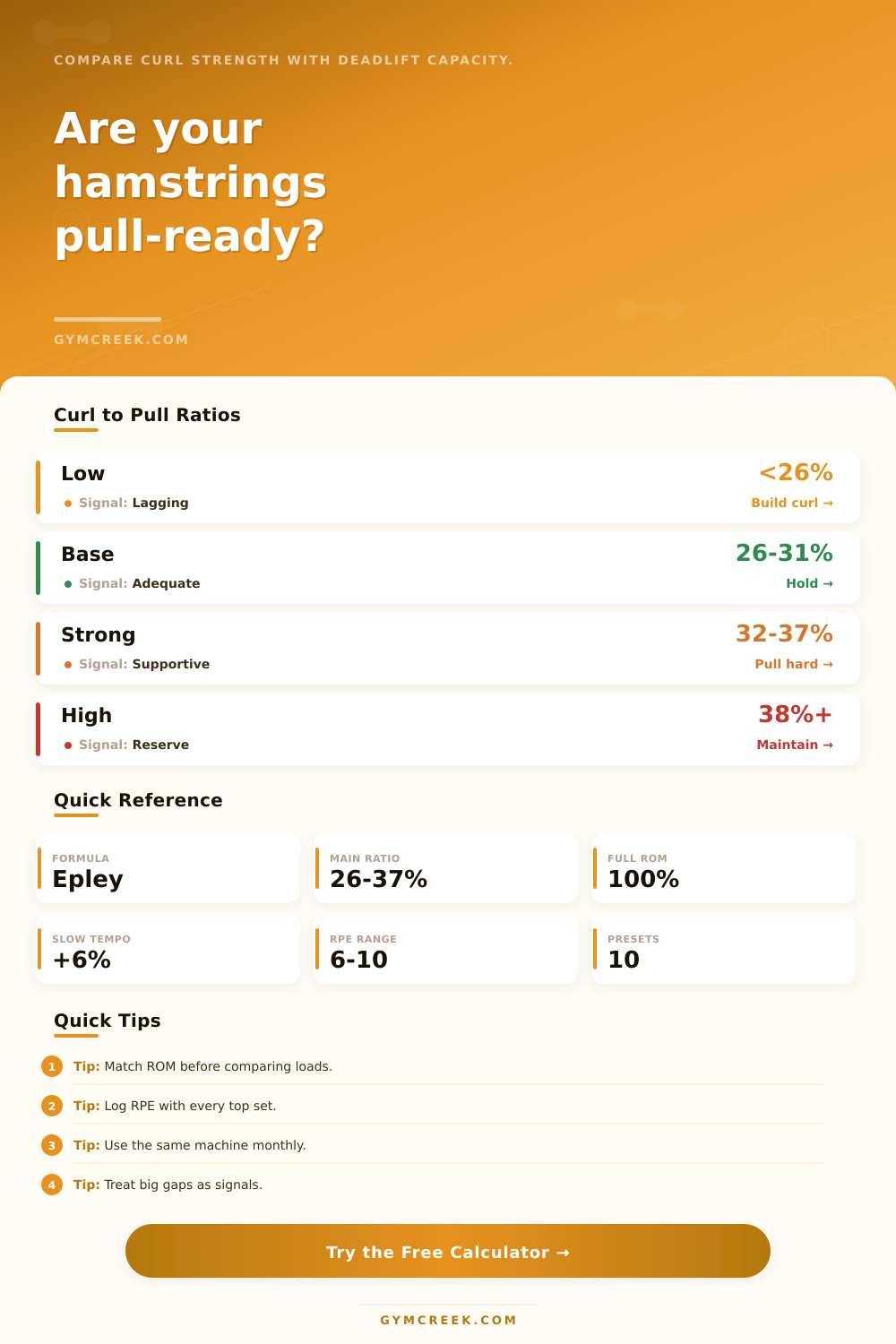
| Under 26% | Low | Hamstring isolation may lag your pull. | Retest strict curls. |
| 26-31% | Base | Enough for many balanced deadlifts. | Watch lockout speed. |
| 32-37% | Strong | Good curl support for heavy pulling. | Compare hip hinge work. |
| 38%+ | High | Large isolation reserve relative to pull. | Review technique limits. |
| Machine Type | Normalization | Why It Changes | Use With |
|---|---|---|---|
| Lying bilateral stack | 1.00x | Baseline machine comparison. | Most gym logs |
| Seated bilateral stack | 1.06x | Hip flexion lengthens hamstrings. | Strict full ROM |
| Plate-loaded curl | 0.95x | Resistance curve often varies more. | Same machine retests |
| Standing single-leg | 1.90x | Converts one-leg load to bilateral signal. | Side-to-side checks |
| Cable single-leg curl | 1.80x | Cable line and balance lower transfer. | Home gym setups |
| Nordic assisted equivalent | 1.20x | Body leverage differs from stack load. | Assisted Nordic sets |
| Input | Modifier | Higher Credit | Lower Credit |
|---|---|---|---|
| ROM | 0.65-1.08x | Lengthened full ROM. | Partial top-half reps. |
| Tempo | 0.85-1.08x | Paused or slow control. | Loose body-English. |
| RPE | RIR estimate | RPE 8 leaves reps in reserve. | RPE 10 is maxed out. |
| Emphasis | 26-38% | Stiff-leg pulls need more curl. | Sumo often needs less. |
💡Tips
The leg curl might seem like an afterthought in your workout routine, but it’s also a good way to check your posterior chain health. When the bar is loaded up, your hamstring serves as your main brake against falling forward. A weak one will cause other muscle to pick up the slack, namely the quad and lower back.
Use the calculator to see how well these two sides of your body stack up by matching your compound capacity to your isolation strength. A hundred pounds on the seated machine will be more difficult then one-hundred pounds on a lying leg curl. Your hips are flexed in the seated position, lengthening the hamstring and making it more difficult to perform with the same weight; accordingly, tool will compensate by placing different coefficients onto various machines. Normalizing the data allows for an apples-to-apples comparison.
Check Your Leg Strength Balance
Based off the reference table, the average well-balanced lifter’s ratio of curl to deadlift should fall somewhere between 26-37%. Anything under 26% probably means your hamstrings is falling behind your total potential. Partial reps are common due to difficulty at the bottom of the rep; range of motion is as important as how much weight is on the pin. Since short ROM doesn’t engage the muscle throughout its full length, the calculator penalize this bad behavior. Training only the strong portion of the curve won’t develop your hamstrings’ resilience to handle heavy deadlifts.
Log a full range of motion and the tool will reward you. Slow down the eccentric phase and you’ll get rewarded with even more credit, since time under tension develop the necessary structural integrity for heavy pulls. Another layer of honesty is added to the mix with rate of perceived exertion. If you have three reps left in the tank vs. Truly failing on that final rep, then your estimated one-rep max will be significantly lower. This is why the RPE slider allow you to adjust your estimate according to how close to failure you really came.
And it makes you honest regarding how hard you pushed yourself; most folks overestimate. Dialing it in properly reveals whether you’re gripping and torquing your low back too heavily during your deadlift, or if your hamstrings are adequately supporting it. If you have a high ratio, then you’re curling more than average relative to your pull. This shows you has a reserve. This tends to be the case for lifters who have longer limbs making the deadlift a mechanical challenge, or are big into muscle growth.
A low ratio on the other hand is a red flag that you’re under-developed in your posterior chain relative to the loads being moved. The good news is you can close this gap through some dedicated hamstring work. You can do this through dedicated hamstring work, such as Nordic curls and stiff-leg deadlifts. However, don’t feel like you must strive for symmetry; each body type are unique. For instance, sumo pullers tend to use less hamstring than those who does conventional lifting, and the tool recognizes this by allowing you to choose your preferred method of pulling.
The aim is balance, not perfection. Tweak accordingly with this info in hand; fill big holes but don’t worry if things is close; consider that good enough. Quit guessing at your weak spots and let the numbers reveal them; after all, who keeps you standing when the barbell’s loaded down? Strong hamstrings does.