Left Right Strength Asymmetry Calculator
Compare unilateral strength, estimated 1RM, velocity gap, limb symmetry index, and correction volume from left and right side test data.
📌Asymmetry Presets
Each preset loads a realistic unilateral strength test with side loads, reps, speed, range quality, soreness, and weekly training exposure.
⚙Calculator
Left-right strength snapshot
Enter comparable left and right tests to estimate asymmetry.
📊Fitness Metrics
📑Reference Tables
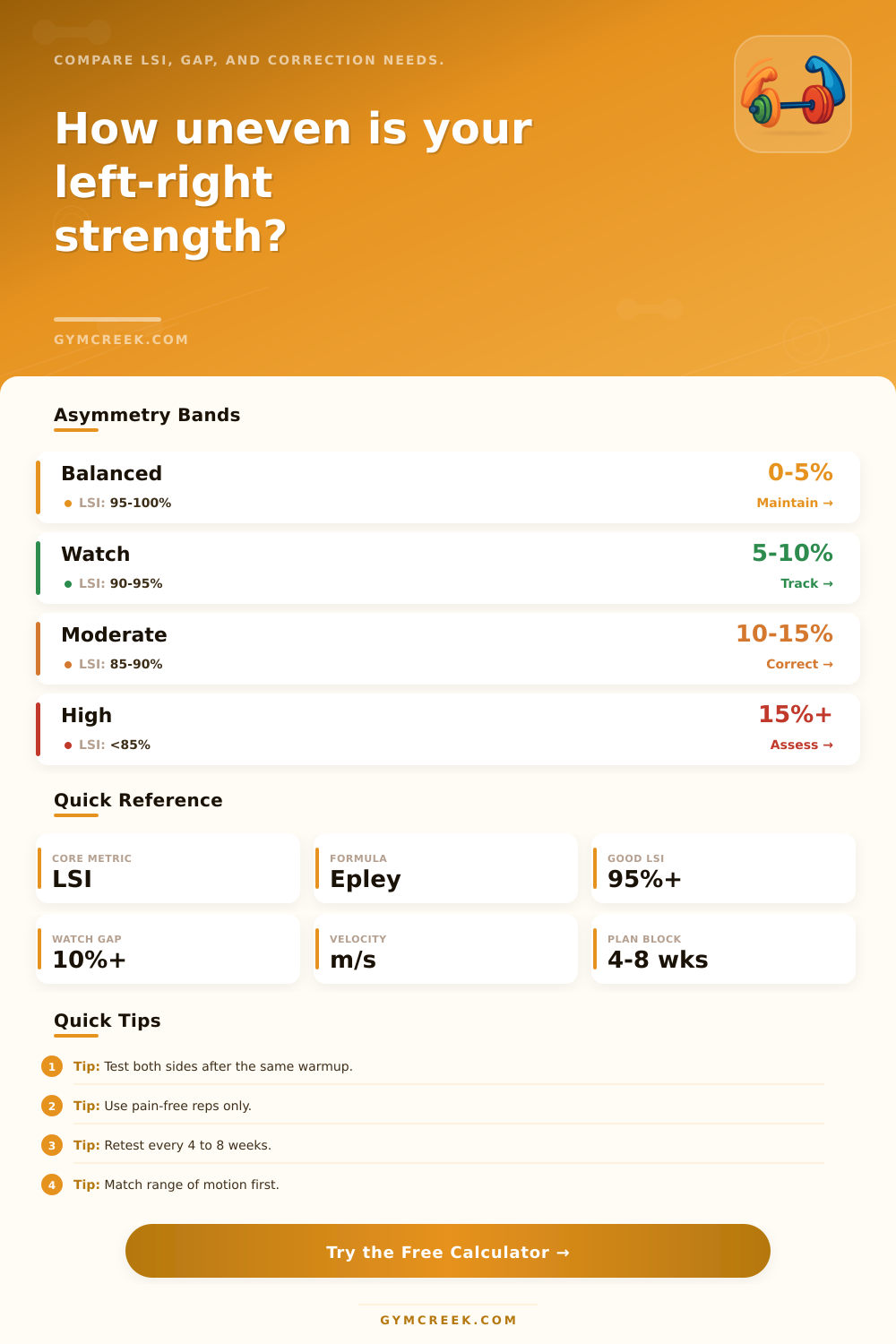
| Asymmetry band | Strength gap | LSI range | Training signal |
|---|---|---|---|
| Balanced | 0-5% | 95-100% | Maintain bilateral and unilateral work evenly. |
| Watch | 5-10% | 90-95% | Track weekly and add small weaker-side exposure. |
| Moderate | 10-15% | 85-90% | Prioritize weaker side volume and retest soon. |
| High | 15%+ | Under 85% | Use conservative loading and consider assessment. |
| Movement pattern | Common test | Main error | Best comparison |
|---|---|---|---|
| Lower push | Split squat, step-up, leg press | Depth mismatch | Same knee angle and tempo |
| Lower hinge | Single-leg RDL, ham curl | Hip rotation | Same trunk position and pause |
| Upper push | One-arm press, cable press | Torso lean | Same body angle and lockout |
| Upper pull | One-arm row, pulldown | Range shortening | Same scapular finish |
| Scenario | Typical gap | Volume cue | Retest window |
|---|---|---|---|
| General strength maintenance | 0-8% | Keep sides even | 6-8 weeks |
| Sport dominance check | 5-12% | Add weak-side accessories | 4-6 weeks |
| Return to training | 10-20% | Use submax controlled work | 2-4 weeks |
| Pain or guarding present | Any gap | Reduce intensity first | Before loading up |
| Formula | Inputs | Output | When useful |
|---|---|---|---|
| Epley 1RM | Load and reps | Estimated max | Rep-max unilateral tests |
| Quality adjustment | Score and form | Usable strength | Different range or control |
| Velocity modifier | Best m/s | Speed penalty | Intent or power mismatch |
| LSI | Weak and strong | Symmetry percent | Return-to-training checks |
💡Tips
When you train hard, raw power isn’t usually the first thing that stands out. You see the little things: the subtle differences between your right side and your left doing the exact same thing. One leg crisply controls its step-up to the platform, while the other hang back half an inch short of the mark. The one arm that fully locks out on a press; the one that rolls forward.
These aren’t uncommon. But these are the things that quietly determine how fast you’ll recover from workout to workout and how much extra weight you can safely added.
Checking Strength Differences in Your Body
There are so many reasons why strength asymmetry occur. This happens when we have old injuries that don’t completely let go of their protection pattern. We sit at our desks tilting our shoulders just slightly, which changes how we press. Our sport habits even make us lead with one side on every stride and every throw.
So rather than wonder if there’s an imbalance, a better question is: Is this imbalance stable? Does it limit what I’d like to do next? Testing both sides under matched conditions reveal the size of the gap. It’s not necessarily about the number but rather the range of motion, tempo and overall movement pattern. A one-knee-inward split squat doesn’t tell me as much as same split squat executed with clean tracking of both knees. Adding velocity into the mix further increases the practical difference. If the weak side is slower than, then the practical difference grows because power depends on speed as well as load. Movement quality scores keeps the test honest by punishing compensation (which may appear like strength).
Now that you have the numbers, what do they tell you about your plan? Typically small gaps are fixed by adding just a little extra to the weaker side with no significant changes to rest of the week. Larger gaps typically require a conscious shift in strategy. Perhaps you could begin all sets on the weaker side or reduce the stronger side temporarily until fatigue doesn’t hide the actualy difference. Guarding and pain completely alter equation. The goal becomes not closing the gap but maintaining its integrity as you figure out the cause.
After you input reps, load, speed, and a subjective measure of work quality, the calculator above does the math. Then it factors in your current state of soreness and training age to give you an answer that’s more indicative of risk while still maintaining performance. Finally, the reference table on the page converts the number to an easy-to-understand training signal, something you can do or not do without questioning each decimal point.
In real training, things are never so nice and even. Life gets in the way. One day you feel better then you did the last. Sometimes you’re just hesitant under bar. It’s not about being perfectly symmetrical. It’s about knowing what gap is part of the steady noise, and which represents something you want to address before it turns into an injury or limitation. And then retesting periodically (every 4-8 weeks) provide this clarity without making every workout a measurement exercise.
You should of checked your form too.