Lateral Raise Load Calculator
Estimate the right per-hand lateral raise load from your current reps, RPE, tempo, weekly set volume, and progression size.
📌Presets
Each preset loads a lateral-raise scenario with its own reps, tempo, RPE, frequency, and progression settings.
⚙Calculator
Lateral raise load snapshot
Enter a current clean set to estimate a smarter working load.
📊Side-Delt Metrics
📑Reference Tables
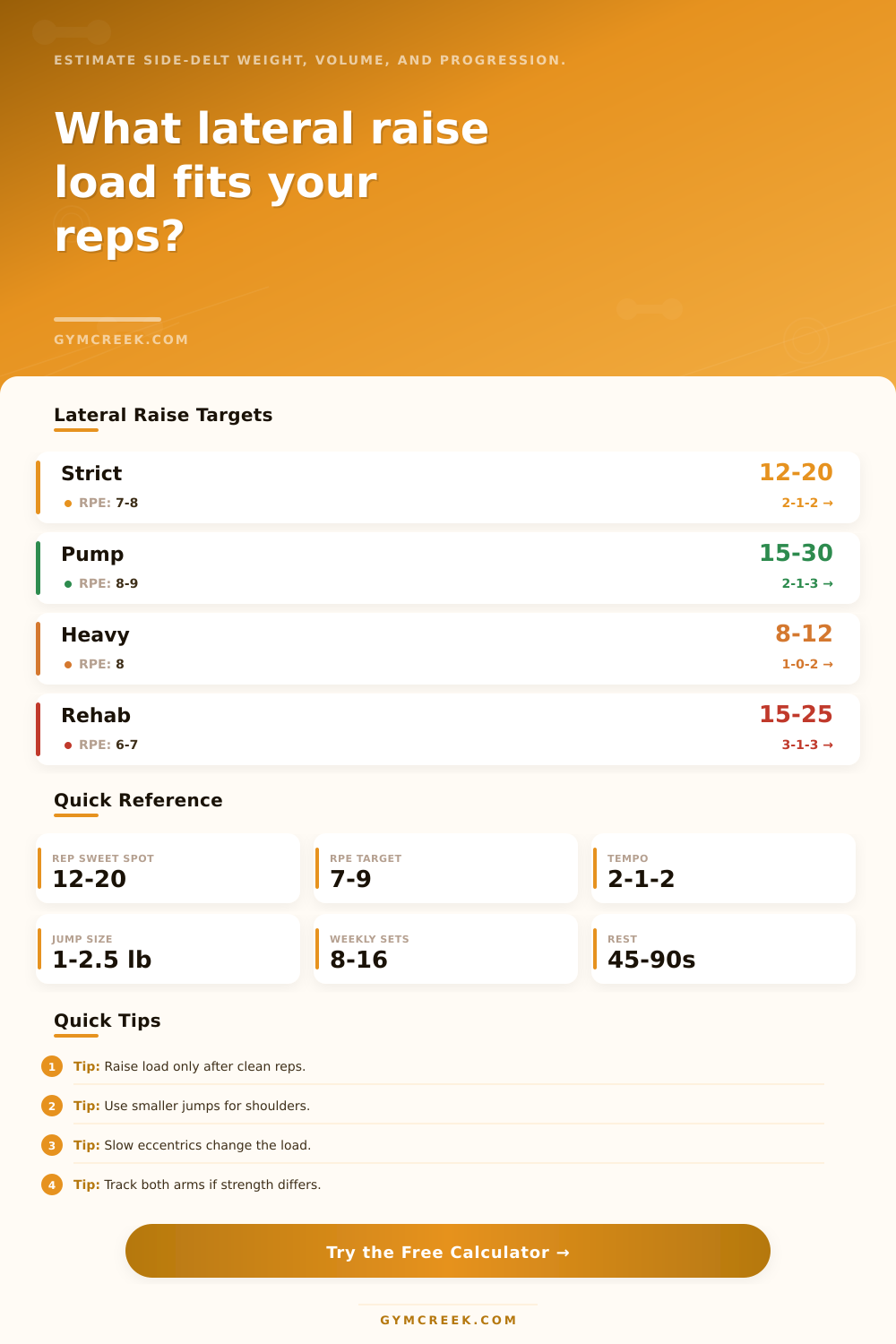
| Goal | Rep Range | RPE | Loading Note |
|---|---|---|---|
| Strict hypertrophy | 12-20 | 7-9 | Clean arc, no swing |
| Metabolic pump | 20-30 | 8-9 | Short rests, light load |
| Strength leaning | 8-12 | 7-8 | Controlled, not maxed |
| Joint-friendly | 15-25 | 6-8 | Slow tempo, lower load |
| Experience | Weekly Sets | Sessions | Progression |
|---|---|---|---|
| New | 4-8 | 1-2 | Add reps first |
| Novice | 6-10 | 2-3 | Small load jumps |
| Intermediate | 10-16 | 2-4 | Wave reps and load |
| Advanced | 14-22 | 3-5 | Manage fatigue closely |
| Tempo | Seconds/Rep | Load Effect | Best Use |
|---|---|---|---|
| 2-0-2 | 4 | Baseline | Smooth volume |
| 2-1-2 | 5 | Moderate | Strict hypertrophy |
| 2-1-3 | 6 | Load down | Eccentric control |
| 2-2-3 | 7 | Load down more | Peak awareness |
| Formula | Use | Inputs | Output |
|---|---|---|---|
| Epley + RIR | Rep strength | Load, reps, RPE | e1RM |
| Target reps | Work weight | e1RM, reps | Load |
| Tonnage | Weekly volume | Load, reps, sets | Total load |
| Stress index | Fatigue signal | Ratio, RPE, tempo | Low to high |
💡Tips
Instead, approach lateral raises as more of a precise practice different than just “going through the motions” of counting reps. Far too many lifter will reach for biggest dumbbell possible. Then they’ll shrug their traps and swing their entire body around. While this certainly feels like you’re working hard, it doesn’t hit side delts very well. Because there’s not much range of motion in the movement and you have poor leverage on the bottom of each rep, it’s deceiving.
By knowing how heavy you’re lifting, you gain an effective way to distinguish between moving under control and relying solely on momentum. After entering your effort level and clean reps, this tool (above) does all math for you; it takes out all the guessing as to how much weight your target muscle actualy receives. But where it’s truly valuable is knowing what each of these numbers mean when you’re in gym.
How to Use the Calculator for Better Shoulder Training
Your rep count are the major player here, but it needs to be an honest number. It is meaningless if you’re swinging your hip into the lift. Strict form is assumed with the calculator, since your side delt can’t holds up to the amount of weight your back/legs can produce. Entering your tested reps tell the system how much weight you can handle while keeping the weight controlled by your shoulder alone (no momentum required).
The other variable that trips people up are effort. How close did you come to failure? That’s called rate of perceived exertion (RPE). Let’s say you just completed a set of fifteen and could of gotten two more reps in there. Your RPE would be an eight. Sure, it’s a bit geeky sounding but it just means that you stopped short of losing proper form.
Shoulders are little muscles and they’re delicate. Most of the time, grinding through another rep with bad form will do more damage then good. Your effort score is factored into the calculator to determine your one-rep max. It may seem odd for such an isolation exercise but it gives us a starting point to progress.
But this change dramatically when you introduce tempo. With a fast, jerky rep, you may be able to swing a twenty pound dumbbell. But if it’s a slow and controlled eccentric phase then perhaps that same muscle work requires only a fifteen pound dumbbell. That’s where the dynamic described in the table below come into play.
The table shows how slowing down tempos and using less weight increases time under tension. It’s a trade off: less weight, but more quality. And most lifters don’t do it because they feel like lifting heavy is “easier” than lifting with control. But control is what forms the cap on your shoulders.
Long term gain comes with volume How do you decide when to increase? The calculator will show what each week’s sets look like as well as suggest when it’s time to move up. This avoids that all-too-frequent error of going heavier on each workout. For lateral raises, tiny increases of a pound or two are typicaly ideal. These muscles is small and their tendons are delicate. Going from 10 to 15 pounds is an enormous relative jump. Instead, maintain the same weight, add reps initially, then increase the weight after the desired number of reps becomes effortless.
So how do you know when to take that route? That depends on your level of experience. Novices should dial in their mind-muscle connection first; adding weight come later. Advanced lifters can handles more volume and varied tempos. It tailors its recommendations to user experience, which means you have to be truthful to yourself.
Are your shoulders tender? The sensitive mode lowers the suggested workload. It is not because you’re weak but because it won’t kill you. Shoulder injuries destroy careers. Smart loading prolongs them.
You aren’t trying to bang out sets with the heaviest dumbbell in the rack. You’re looking for weight where you can consistently pull off clean reps while maintaining tension. That’s what the calculator does; it takes emotion out of the equation so you can determine your starting spot. Plug in the facts, get a plan from the system and put it into motion. That’s how you develop width.
You enter the numbers and finish knowing you did it right.