Lat Pulldown to Pull-Up Calculator
Estimate strict pull-up readiness from lat pulldown load, reps, body weight, machine setup, grip, range of motion, and target reps.
📌Presets
Presets load realistic pulldown tests and calculate pull-up reps, assistance needs, and target pulldown loads right away.
⚙Calculator
Pull-up readiness estimate
Enter a recent lat pulldown set to estimate your strict pull-up capacity.
📊Readiness Metrics
📑Reference Tables
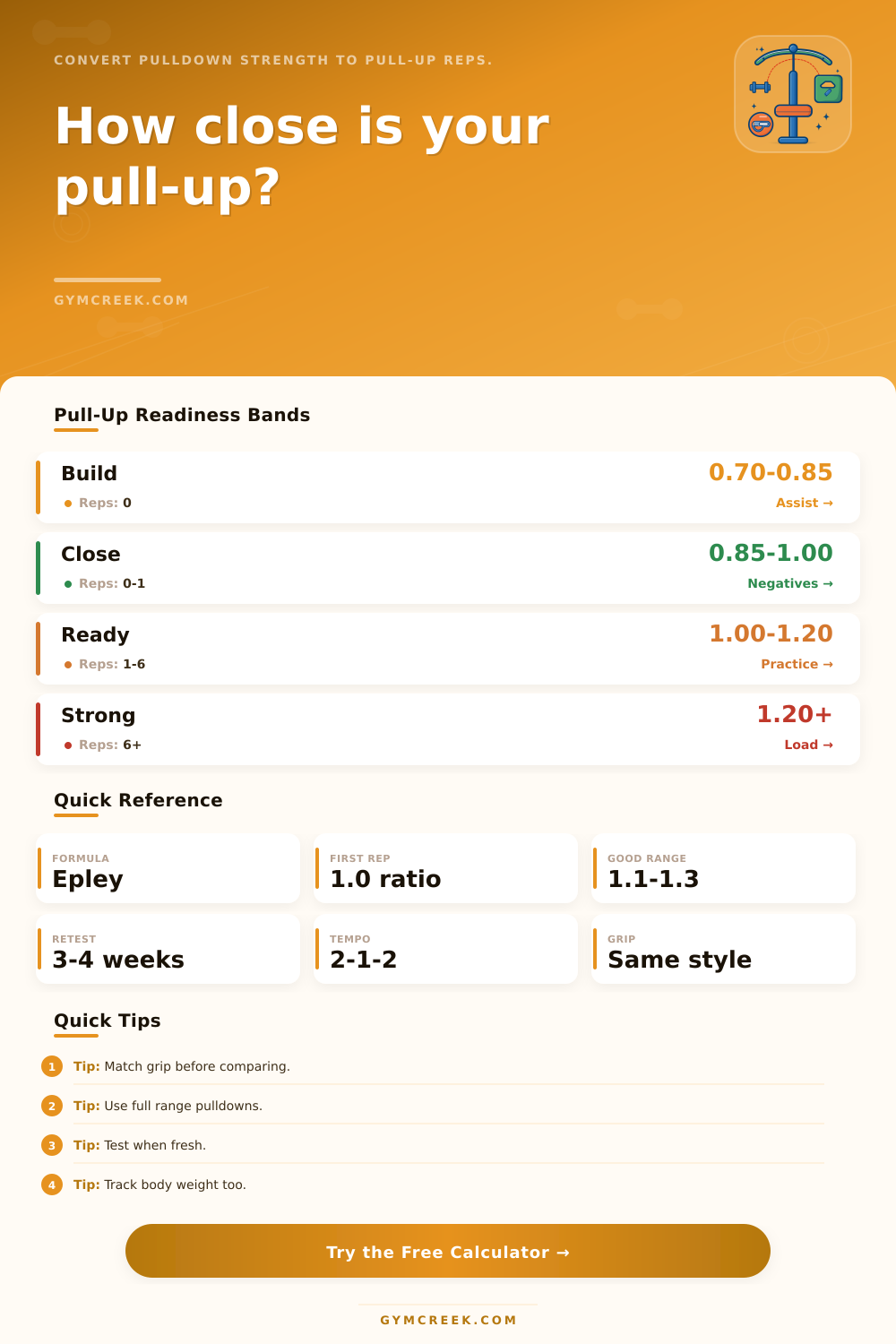
| Readiness band | Adjusted ratio | Typical pull-ups | Training cue |
|---|---|---|---|
| Build base | 0.70-0.85 | 0 strict reps | Use assistance and full range |
| Close | 0.85-1.00 | 0-1 reps | Practice negatives and singles |
| Ready | 1.00-1.20 | 1-6 reps | Accumulate clean reps |
| Strong | 1.20+ | 6+ reps | Add density or small load |
| Grip style | Transfer factor | Pull-up demand | Testing note |
|---|---|---|---|
| Chin-up grip | Highest | Often easiest | More biceps help |
| Neutral grip | High | Shoulder friendly | Great first-rep test |
| Pronated grip | Baseline | Classic standard | Match pulldown grip |
| Wide grip | Lower | Harder leverage | Avoid comparing to narrow |
| Formula | Use | Equation | Limit |
|---|---|---|---|
| Epley e1RM | Pulldown max | Load x (1 + reps / 30) | Best under 12 reps |
| Rep estimate | Bodyweight reps | 30 x (ratio - 1) | Needs skill practice |
| Assistance | Band target | BW - e1RM / rep factor | Band force varies |
| Mifflin BMR | Body context | Weight, height, age | Not a strength formula |
| Input | Why it matters | Higher value means | Best practice |
|---|---|---|---|
| Body weight | Load you must move | Harder reps | Track with strength |
| ROM quality | Strength specificity | Better transfer | Chest-height finish |
| Cable ratio | Actual resistance | Changes e1RM | Use known machine |
| RIR | Set difficulty | More reserve | Use honest estimate |
💡Tips
A lat pulldown machine and a pull-up bar is two different tools that help with the training of the back and arm muscles. Additionally, because of the way in which each tool is utilized, there are difference in the strength that is required to demonstrate proficiency on each tool. Specifically, an individual use a lat pulldown machine to perform movements with an external weighted object while controlling their body’s position.
However, for pull-up exercise, an individual must control their body’s entire weight. Because of this, the strength that an individual demonstrates on a lat pulldown machine does not necessarily translate to the strength that they can exhibit on a pull-up bar. For instance, an individual may be able to exhibit strength to move a heavy weight on a lat pulldown machine yet be unable to lift their body on a pull-up bar.
Why Lat Pulldown Strength Is Different From Pull-Up Strength
There are a few different reasons for the differences between the two types of strength. One reason is due to the fact that an individual must overcome their body weight during a pull-up exercise. Additionally, another reason for the difference is grip style; neutral and chin-up grip styles requires more biceps strength than a wide pronated grip style.
Range of motion and the tempo with which an individual performs the exercise are additional factor that may contribute to the difference between the two types of strength. Thus, an individual’s strength on a lat pulldown machine do not necessarily indicate their strength in performing pull-ups on a pull-up bar. In order to calculate the relationship between lat pulldown and pull-up strength, this calculator allow for an individual to input information regarding their sets, the pull-up bar setup, and their body weight to provide an estimate as to their one-rep max for pull-ups.
Furthermore, this estimate can account for the individual’s grip strength, body weight, and level of fresh. This strength is not a guarantee as to the individual’s actual ability to perform pull-ups, but it does serve as a starting point for estimating their ability to perform strict pull-up exercises. Additionally, the calculator also includes reference bands as to where the individual stand in relation to their strength, whether they are building a foundation of pull-up strength, working toward their first repetition, or ready to begin adding more load to their performance.
These results from the calculator can be used to inform and create an individual’s training plan. For instance, if the estimate for the individual’s one-rep max for pull-ups is lower then their body weight, they may want to use a resistance band or other assisted exercise to begin to build their strength and range of motion for performing pull-ups without assistance. However, if an individual’s estimate is approximately or higher than their body weight, they can use that calculation to determine how many pull-up repetitions they can perform before becoming fatigued.
Because the calculator accounts for the individual’s freshness, as well, the individual can use this to ensure that they are not attempting to perform lat pulldowns while tired; their performance will be reflected more accurate if they are fresh. Body weight is a variable in the calculator that must be accounted for in relation to pull-up strength because an individual’s strength may increase or decrease with their change in body weight. Furthermore, the calculator can plan the change in body weight to reflect the individual’s future requirements in strength.
Additionally, another factor to be accounted for is the difference between the two types of strength and the fact that an individual may have high lat pulldown strength but poor scapular control. Thus, to account for this, the individual should begin to practice hangs, scapular pulls, and performing assisted pull-up exercises to increase these skill. The readiness bands help to indicate the individual’s ratio of their strength on the lat pulldown machine to their body weight.
If an individual’s strength as compared to their body weight is below 0.85, they are in the build phase for their pull-up strength. Between 0.85 and 1.0 of an individual’s body weight, they are close to being able to perform a pull-up. If an individual is above 1.0 of their body weight, they should begin to focus on performing a higher volume of pull-ups.
Finally, if an individual is above 1.2 of their body weight, they should focus on increasing the load they perform pull-ups with or increasing the density of those set. These bands ensure that an individual maintains an understanding of their goals and keeps their focus on achieving them. Depending upon an individual’s goal in relation to their strength, the calculator can be adjusted to account for that specific goal.
For instance, the individual may have a goal of performing their first pull-up repetition or consistently performing pull-ups with additional load. By adjusting the calculator to account for such goals, an individual can avoid attempting to achieve a goal that may be too difficult to attain. Although this calculator is not a tool to replace the actual performing of pull-up exercises, it does remove the uncertainty that an individual may feel when performing those exercises.
For instance, if the calculator indicates the individual should be using assistance with performing their pull-ups, they may use that specific tool and purpose to train. Additionally, if the calculator indicates that an individual is ready to begin performing sets of pull-ups without assistance, they may stop use assistance to achieve that goal. Thus, over time with consistent use of the calculator, an individual’s lat pulldown strength and one-rep max for pull-ups will begin to align.