Larsen Press Load Calculator
Estimate legs-up bench strength, compare it with your flat bench 1RM, and choose a target load for your next Larsen press work sets.
📌Presets
Each preset loads a real bench context with current Larsen set data, stability rating, grip style, pause style, and target rep range.
⚙Calculator
Larsen press load snapshot
Enter your bench context and calculate a legs-up target load.
📊Metrics Grid
🧮Formula Cards
e1RM = set load × (1 + (reps + RIR) / 30)
RIR comes from RPE, so an RPE 8 set adds two reserve reps before estimating max strength.
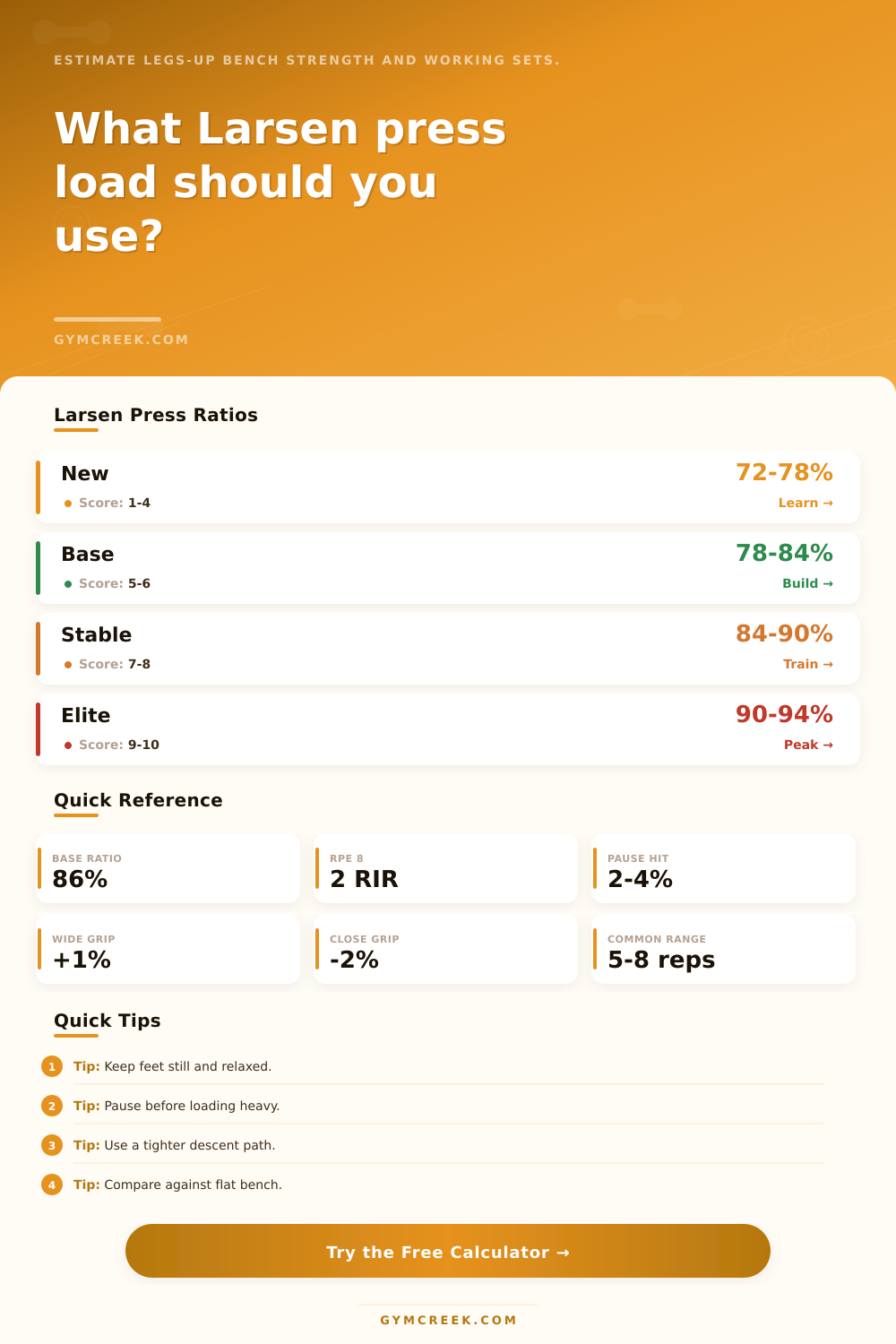
ratio = 86% + stability + grip + relative-strength adjustment
The model reduces the flat bench 1RM for lost leg drive, then adjusts for the lifter's control profile.
load = Larsen max / (1 + (target reps + target RIR) / 30)
Paused options add a small load discount so the recommended work sets match the selected rep style.
volume = rounded load × average target reps × target sets
This is not a full fatigue model, but it flags whether the chosen load is light, productive, or aggressive.
📑Reference Tables
| Stability Score | Typical Ratio | Load Meaning | Training Use |
|---|---|---|---|
| 1-3 | 72-78% | Large drop | Technique sets |
| 4-6 | 78-84% | Moderate drop | Base volume |
| 7-8 | 84-90% | Good transfer | Strength work |
| 9-10 | 90-94% | High transfer | Specific peaking |
| Target Range | Load Zone | RPE Fit | Best Use |
|---|---|---|---|
| 3-5 reps | Heavy | 7.5-9 | Strength skill |
| 5-8 reps | Moderate | 7-8.5 | Main volume |
| 8-10 reps | Moderate-light | 6.5-8 | Hypertrophy |
| 10-12 reps | Light | 6-8 | Control work |
| Grip or Pause | Modifier | What Changes | Load Note |
|---|---|---|---|
| Comp grip | 0% | Baseline path | Use normal ratio |
| Wider grip | +1% | Shorter ROM | Keep shoulders calm |
| Close grip | -2.5% | More triceps | Reduce top sets |
| Long pause | -4% | Less rebound | Round down |
| Bench Ratio | Larsen Signal | Likely Issue | Next Step |
|---|---|---|---|
| Under 75% | Low transfer | Stability leak | Lower load |
| 75-84% | Normal gap | Leg-drive reliance | Build volume |
| 85-91% | Strong transfer | Good upper drive | Progress slowly |
| Over 91% | Very close | High control | Use small jumps |
💡Technique Tips
When you take away leg drive from the bench press, you’re taking away your ability to push against the floor. What does this mean? You now have to completely support all of the structural load of movement with your shoulders and upper back alone, without that leg stabilizer pushing against the floor. Ouch!
For some lifters, it’s nothing less than a shock to the system. They’ll squat three times their bodyweight time and again; yet when they get feet off the floor, they might struggle to press half their bodyweight. It is not a strength issue. It is a stability issue.
Why Stability Is More Important Than Strength
Knowing how strong you are in this legs-up position will help you stop guessing and start programming with intent. Tonnage tend to dip pretty dramatically when going from flat bench to Larsen press. When tested, most lifters end up at around eighty percent to ninety percent of their normal one rep max on the flat bench with their legs up.
Input your recent set numbers and your current max into the calculator above to get your results. However, knowing why those are percentages is far more important than the numbers themself. Expect a larger decrease if you’re unfamiliar with the exercise. The more time you spend getting stronger at scapular control and core tension, the higher that number go. Keep track of that percentage over time. You’ll have a better idea of how strong you really are on the press then you’ll ever get through some random heavy flat bench effort.
The secret sauce is stability. I can get all up in there and think I’m bulletproof, but if my hips moves around or my legs are flailing, I’m wasting energy. If you rate yourself with a stability number between seven and eight, then you know you’ve got good control and can bring a large portion of your flat bench strength to the test. Lower numbers represent you learning how to control instability, so the suggested weight will be a little lower.
It is not because you’re weak. You don’t want to waste time and energy. To account for this, the tool uses your own control profile to adjust the base ratio. Again, it’s subtle, but it makes a difference when trying to hit productive weights while staying within your comfort zone.
More nuances include grip width and pause style. A wider grip will reduce your range of motion by a hair, possibly enabling an extra small percentage increase in load. Closing your grip typically means reducing the weight. This is especially true when there’s no leg drive helping to stabilize the bar path, which shifts focus toward the triceps.
Touch-and-go reps use the elastic rebound; pausing at the chest takes this away, thereby making the concentric phase more difficult. These stylistic choices are accounted for in the calculator, preventing a penalty on a particular variation. It modifies the target load based on your chosen mechanical demand, so you can stay productive through your reps instead of getting frustrated.
People mistakenly think of the Larsen press as just another step in training that follows the flat bench. That doesn’t work, however, because limiting factors are not the same. In the case of the flat bench, you’re helped by your legs, positioning the bar, producing force. With the Larsen press, you have to keep your torso rigid against gravity.
What does this do? It improves the mind-muscle connection in your front delts and chest while forcing greater core engagement. It’s also a great way to be tested for your structural integrity. Are your shoulders flaring when loaded? Is your back arching too much under load? These leaks will be shown immediately with the exercise. You see benefits down the road in terms of how well you perform during competition if you use it as a diagnostic tool.
Adding it to your routine requires volume management. Don’t go to failure. Try to build up quality reps in each set using a challenging but controlled effort. Use the tool to set a benchmark for your session load based on your sets and target rep range. This will allow for enough stimulus for strength adaptation without overtraining the anterior shoulder.
If the number seem too aggressive, dial back the RPE. If they seems easy, that means you’ve probably overestimated your fatigue or underestimated your stability. Trust the process more than the ego.
In the end, the Larsen press takes the crutch of traditional benching away. It makes you use nothing but your own core strength and mechanical upper body movements. The calculator will lead you to the sweet spot of both control and challenge, but what happens beneath the bar is the stuff. Focusing on stability and recognizing the lowered load, you create a press that will immediately work for competition day.
You will no longer use momentum-based lifts. You just move weight with precision. Now THAT’S something that stays with you when the lights come on and the chips are down. Taking the legs out doesn’t make the lift weaker. It makes it clearer.