Lander 1RM Calculator
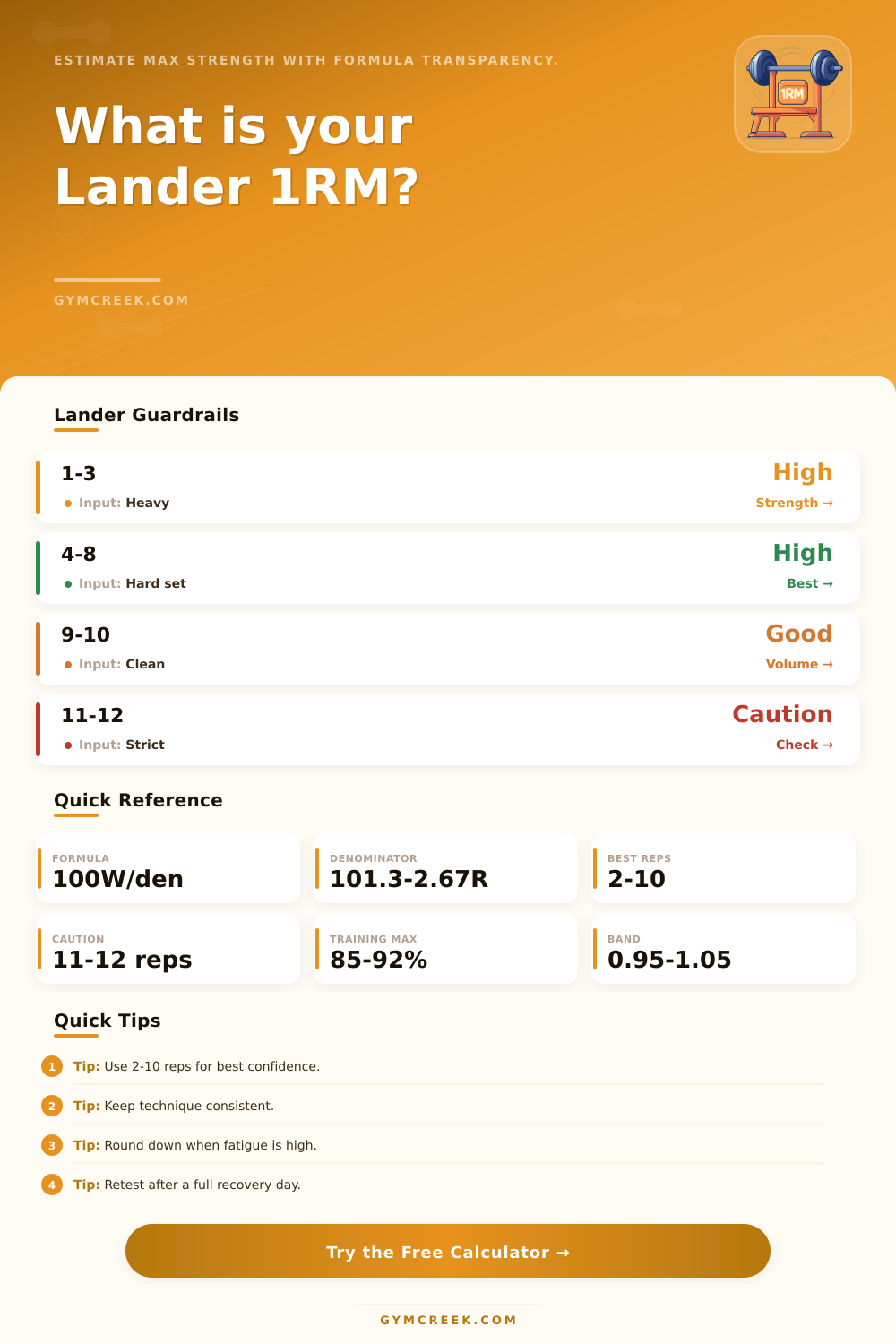
Estimate one-rep max with the Lander equation only, then see the exact denominator, multiplier, confidence band, and rounded training loads.
📌Lander Test Presets
Each preset changes the actual Lander inputs, confidence flags, training max percentage, and rounding style without switching to any other 1RM formula.
⚙Calculator Inputs
Lander strength snapshot
Enter a tested load and completed reps to expose the exact denominator and multiplier.
📊Lander Metrics Grid
📑Reference Tables
| Reps R | Denominator | Factor | Confidence |
|---|---|---|---|
| 1 | 98.62877 | 1.01390 | High, near-max |
| 3 | 93.28631 | 1.07197 | High, heavy set |
| 5 | 87.94385 | 1.13709 | High, stable |
| 8 | 79.93016 | 1.25109 | High if strict |
| 10 | 74.58770 | 1.34070 | Good, volume edge |
| 12 | 69.24524 | 1.44414 | Caution range |
| Completed reps | Confidence | Why it matters | Practical use |
|---|---|---|---|
| 1 to 3 | High | Close to the tested max | Peaking and heavy practice |
| 4 to 8 | High | Enough reps without too much fatigue | Best everyday estimate |
| 9 to 10 | Good | Volume fatigue starts to matter | Use for training loads |
| 11 to 12 | Caution | Endurance bias can inflate estimates | Round down and retest |
| 13 plus | Low | Formula is outside normal lifting use | Do not treat as a true max |
| Percent | Use case | Best for | Guardrail |
|---|---|---|---|
| 80% | Technique rebuild | Layoff, soreness, new lift | Very conservative |
| 85% | Volume block | Hypertrophy and clean reps | Good default |
| 90% | Strength block | Experienced lifters | Classic training max |
| 92% | Heavy practice | Low-rep confident tests | Watch bar speed |
| 95% | Near-test loading | Peaking only | Use sparingly |
| Lift | Input standard | Lander caution | Better decision |
|---|---|---|---|
| Bench press | Same pause or touch rule | Bounce changes reps | Use strict reps |
| Back squat | Same depth every rep | Fatigue shifts form | Trust 3 to 8 reps |
| Deadlift | Reset style noted | Grip may cap reps | Use a clean heavy set |
| Overhead press | No leg drive unless intended | Small jumps matter | Round carefully |
| Pull-up total | Bodyweight plus added load | Partial reps inflate | Count full range only |
💡Tips
Knowing your one-rep max is important because a one-rep max will help you find the proper training weight for your body. The Lander formula will provide you with an estimate of your one-rep max from a single working set of weight. This formula will allow you to calculate your one-rep max without performing a one-rep max exercise every single time.
The weight that you use for your training is important, as it will determine how fast your muscles will recover and how much strength you will be able to gain over several month. The Lander formula will allow you to calculate your one-rep max by dividing the weight that you lifted by a denominator that change according to the number of repetitions that you performed. The denominator for a higher number of repetitions will be smaller, which is one of the reasons why this component of the equation is so important to calculating your one-rep max correctly.
Find Your One-Rep Max with the Lander Formula
A set of three repetitions will provide you with a different calculation than a set of eight repetitions due to fatigue. While you could use a calculator to calculate the number for your one-rep max, understanding how this denominator contribute to the calculation will allow you to understand the reliability of your one-rep max calculation. One of the variables in the Lander formula is the number of repetitions that you perform.
This is one of the most important variables in the equation. For the best results, use sets of four to eight repetitions. Sets of four to eight repetitions will allow you to avoid performing any maximum effort set with your muscles.
Performing sets with fewer than four repetitions will provide you with a very reliable calculation of your one-rep max. However, performing sets with fewer than four repetitions will be very taxing on your body. For sets with more than ten repetitions, your estimation of one-rep max might include data regarding your muscular endurance. In these cases, you may use your one-rep max estimation as a rough target rather than an exact one.
Other factors that can be included in your one-rep max calculation include the strictness of your repetitions and how close you came to muscle failure with your sets. Performing repetitions with perfect form and performing sets during a normal training day will help you calculate your one-rep max very precise. However, if you performed your set after a poor night of sleep or with “touch-and-go” repetitions with the weights, your one-rep max calculation will be less precise.
These factor are accounted for in the calculator, which will provide you with a confidence range for your one-rep max. This confidence range alerts you to the caution that you should take if you use the calculated one-rep max as your training maximum. Additional factors that can be included in your calculation include training age and body weight. An individual who has trained for many years will have a different one-rep max calculation than an individual who has taken extended breaks from training.
An individual who has trained consistently over many years can train closer to the upper limit of the calculated one-rep max. A person who has not trained in a while will have to train to the lower limit of there calculated one-rep max. An individual’s relative strength is the ratio of their one-rep max to their body weight. This ratio can help to compare an individual’s one-rep max to that of others who may lift weights. These additional factors do not impact the calculation of an individual’s one-rep max using the Lander formula, but they do impact how an individual should use the calculated one-rep max.
The reference tables on the calculator will show the meaning of different repetition range that you may perform.
These tables will allow you to understand how a twelve-repetition test can produce a wider guardrail for your one-rep max than a five-repetition test. These tables can also alert you to the best percentage of your calculated one-rep max that you should use for different types of training. These tables are not strict; however, they will help to ensure that your calculated one-rep max remains within the proper range for your body.
Many mistakes can be made with using your calculated one-rep max as a target to be achieved for each exercise that you perform in the gym. Using your calculated one-rep max for each exercise may be a mistake. Rounding your calculated one-rep max up to a higher number may also be a mistake.
Using your calculated one-rep max for every exercise you perform is also a mistake. When calculating your one-rep max using the Lander formula, your calculated one-rep max will provide you with a range of weight that you can lift. Using any weight outside of this range may be a mistake.
Your calculated one-rep max will also allow you to train without guessing at the strength that you can build in any given exercise. If the calculated one-rep max allows you to lift weights, your strength will steadily increase. The Lander formula will give you an estimation of your one-rep max from your ordinary training sets.
This formula will remain a helpful tool for training individuals at the gym.