Lactate Clearance Calculator
Estimate blood lactate drop rate, net clearance, exponential half-time, and recovery quality from baseline, peak, and post-recovery samples.
📌Presets
Each preset loads a realistic athlete testing scenario with baseline, peak, recovery sample, and protocol quality.
⚙Calculator
Lactate clearance snapshot
Enter baseline, peak, recovery value, and timing to score the clearance block.
📊Fitness Metrics Comparison
📑Reference Tables
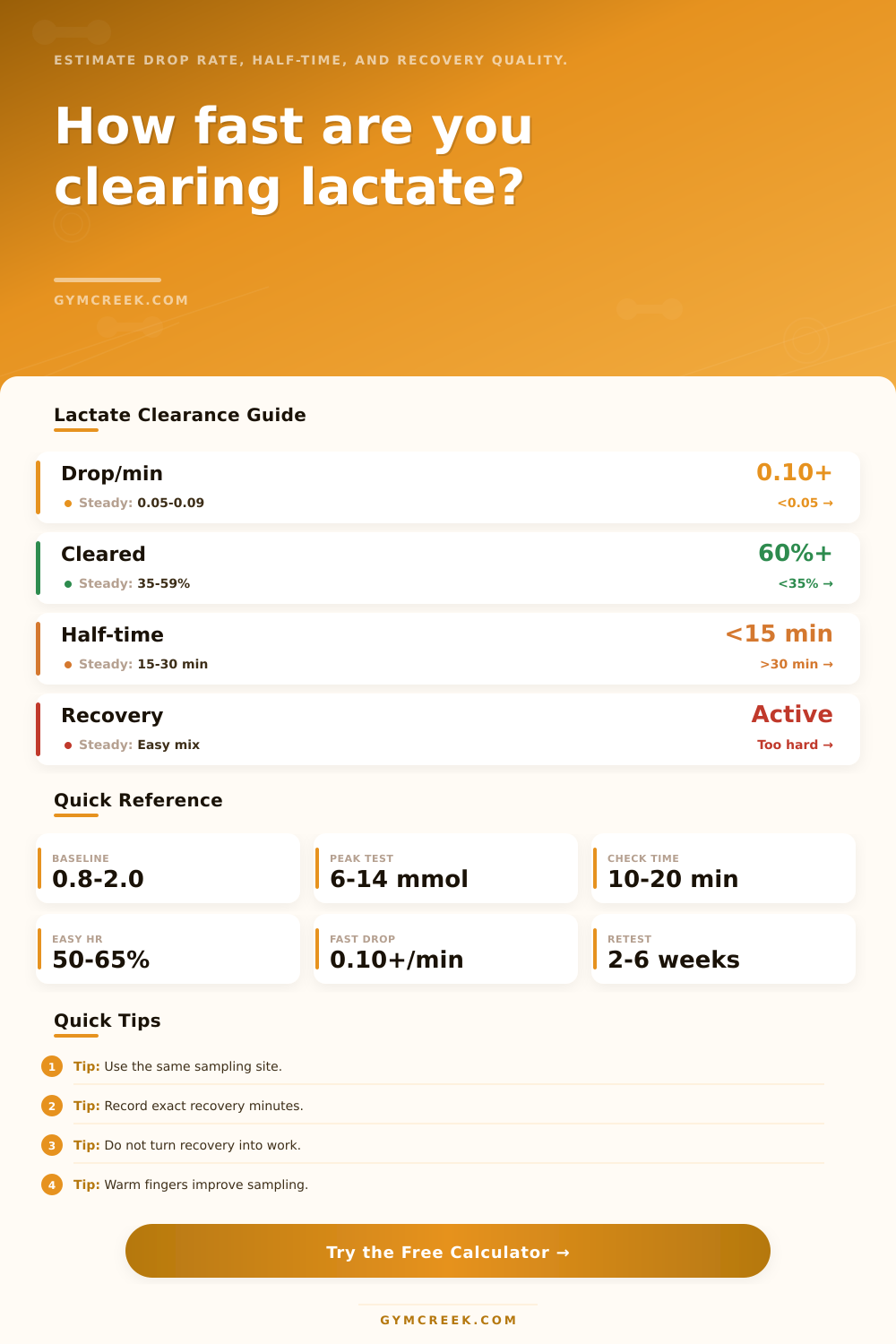
| Clearance marker | Strong | Steady | Flag |
|---|---|---|---|
| Net percent cleared | 60% or more | 35-59% | Under 35% |
| Linear drop rate | 0.10+ mmol/L/min | 0.05-0.09 mmol/L/min | Under 0.05 mmol/L/min |
| Exponential half-time | Under 15 min | 15-30 min | Over 30 min |
| Post-recovery value | Near baseline trend | Falling clearly | Flat or rising |
| Lactate value | Typical meaning | Training context | Calculator use |
|---|---|---|---|
| 0.8-2.0 mmol/L | Resting baseline | Easy or rested | Starting floor |
| 2.0-4.0 mmol/L | Moderate load | Tempo or steady | Recovery target |
| 4.0-8.0 mmol/L | Hard aerobic-anaerobic | Threshold work | Workload check |
| 8.0+ mmol/L | High glycolytic demand | Races, sprints, intervals | Clearance test |
| Recovery setup | Expected effect | Useful range | Watch point |
|---|---|---|---|
| Active easy movement | Often fastest clearance | 50-65% max HR | Keep it easy |
| Mixed active and passive | Moderate clearance | Short walk breaks | Match retests |
| Passive recovery | Usually slower drop | Seated or standing | Cold muscles |
| Too hard recovery | May slow clearance | Above 75% max HR | Adds lactate |
| Protocol factor | Best practice | Score impact | Retest note |
|---|---|---|---|
| Sample site | Same finger or ear | High trust | Repeat exactly |
| First drop | Wipe before sample | Cleaner reading | Log method |
| Timing | Fixed minute mark | Critical | Use a timer |
| Environment | Similar heat and altitude | Contextual | Note changes |
💡Tips
After completing a tough interval workout, you notice that your legs is tired and you look at your lactate meter and note it’s high. That peak number alone doesn’t tell the whole story about your fitness level. What really matters are your clearance rate… Your body’s ability to quickly rid itself of lactate.
Your clearance rate say far more about your aerobic system different than your maximum level of lactate does. Focusing on maximal levels of blood lactate is a mistake for most athlete. Clearance rate is what will separate you from other athletes.
Why Lactate Clearance Rate Matters More Than Peak Levels
How? Compare three points in time. Start when you are rested, measure your peak performance right after the effort and then rest again until you reach a final point to sample once more. Enter all that into the calculator and it’ll crunch the numbers. You won’t have to try to remember how to do logs or divide things out yourself. Raw data becomes a simple visualization of quality of your recovery.
Many folks don’t know that inputs are more important. Accuracy depends on timing. How long is it from when you took your peak sample until you take your recovery sample? If it’s 21 minutes and you’re looking at a clearance rate, then you might think it’s slow because you took your peak sample at one minute. Two minutes makes all the difference in the world; that’s why the tool request specific minutes between samples.
Also, what kind of recovery did you do? Flushing out lactate happen quicker with active recovery (e.g., easy jog) compared to just sitting there. This is shown by the tool since passive recovery typically results in a slower result given lower blood flow.
So what do the numbers mean? Look at the half-time. What’s your lactate clearance (i.e., how long it takes for half of the lactate you produced during a workout to dissapear)? Is it less than fifteen minutes? Good deal, you’re pretty dialed into your aerobic system. Your mitochondria is humming along nicely, and there’s probably good capillary density in the tissue.
It takes more than half an hour. Not so fast. You may need to work up to that level of aerobic fitness, or maybe you simply didn’t recovered enough from previous effort. Active recovery can feel like too much, I know people say. But you don’t need to recruit more muscle; you just need to get the blood moving. Low-intensity is name of the game here.
To show what these numbers mean, there are some reference tables that help. For instance, a good clearance rate is typically at least 60% (or more) cleared within your recovery window. Why does this matter? Because it determines how often you should of be doing heavy workouts throughout the week. The faster you clear lactate, the quicker your muscle fatigue subside, which allows for more volume and high-intensity workouts per week before reaching burnout. On the flip side, the slower you clear lactate, the longer your muscles will be spent, limiting workout frequency.
Expected results are also influenced by context. Clearance will naturaly be slower in hotter weather and higher altitudes. Your meter adjusts for these environmental factors, don’t panic if your numbers start trending lower in the heat or at altitude. This variation is normal; performance markers move with changing conditions.
Consistency in testing protocol is the key. Use the same meter, wipe the first drop of blood, use the same sampling site each time. Variations on these variables introduces noise which hides true trends.
Lactate clearance is an indicator of total aerobic fitness. It’s a marker of resiliency, a measure of how fast your body clears the metabolic byproduct of exercise and returns to normal post-stress. Follow it over time in weeks and you’ll know whether your training improve your body’s ability to recover. Or merely fatigues you further.
What those digits represent might appear dry on paper, but they represent the bodily engine beneath the hood. Let them dictate how you recover (not simply how hard you push). If you clear fast, that means you’re recovered faster and able to tackle next task sooner.