Lacrosse Calorie Calculator
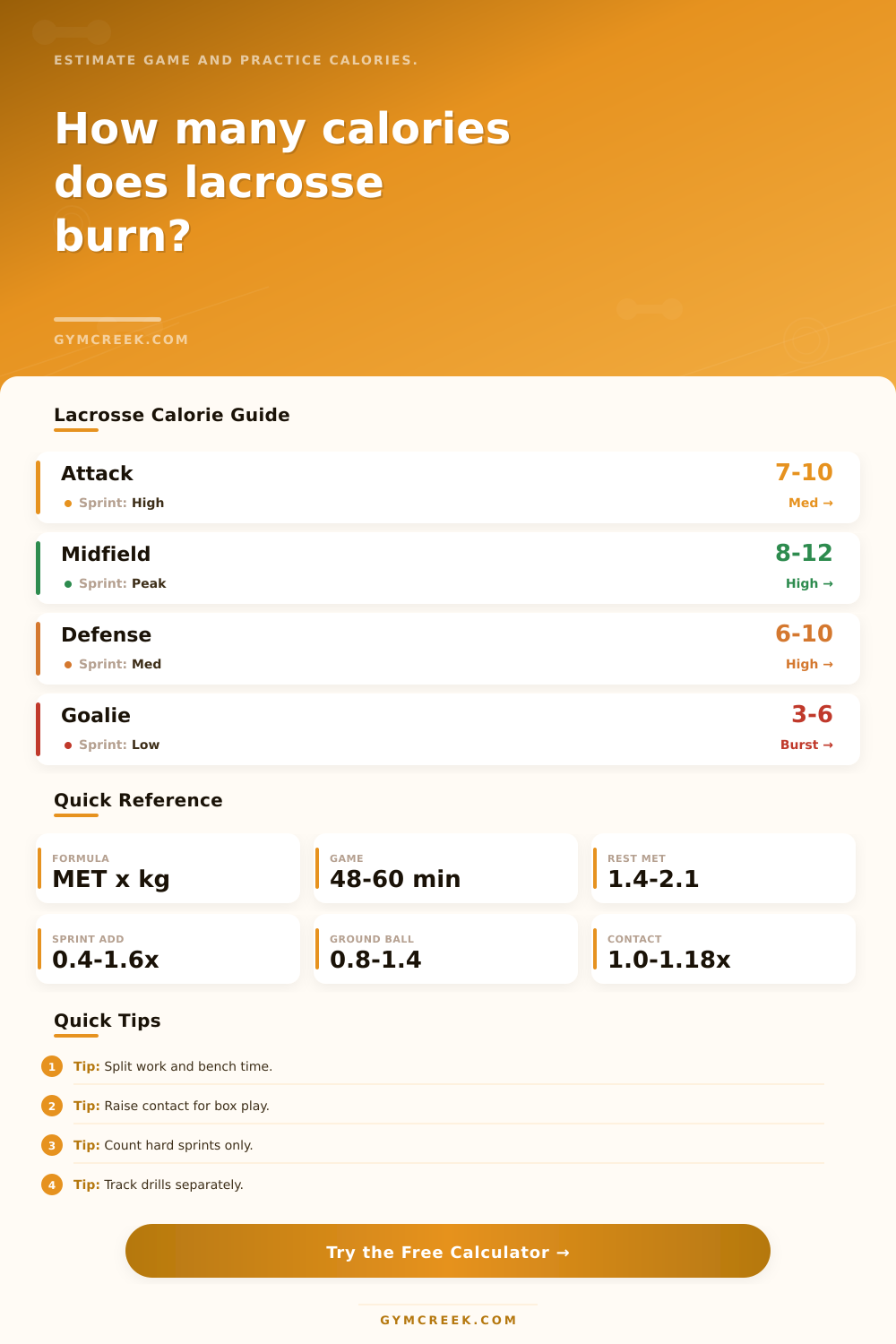
Estimate calories burned during field lacrosse, box lacrosse, practice, scrimmages, and goalie sessions using body weight, position, minutes, sprints, ground balls, contact, substitutions, rest time, and adjusted MET logic.
📌Presets
Each preset loads a realistic lacrosse profile and recalculates calorie burn from play minutes, bench ratio, sprint volume, ground balls, contact, and drill work.
⚙Calculator
Lacrosse calorie snapshot
Enter position, minutes, sprints, ground balls, contact, and substitution ratio to estimate lacrosse calories.
📊Fitness Metrics
🧮Formula Cards
Calories per minute = MET x 3.5 x body weight in kg / 200. The calculator applies this to field play, practice drills, sprint bursts, ground-ball work, and rest separately.
Attack, midfield, defense, LSM, faceoff, goalie, box, and practice roles start with different MET bands before intensity and session type adjust the base workload.
Sprint count converts to high-MET burst minutes. Ground balls add short contested efforts, with higher load for scrums, wing play, and faceoff battles.
Rest ratio shifts part of the session to low MET burn, while Mifflin-St Jeor BMR and activity multiplier estimate how much of daily energy the session represents.
📑Reference Tables
| Position | Easy | Game Pace | Elite Pace |
|---|---|---|---|
| Attack | 5.8 MET | 7.8 MET | 10.0 MET |
| Midfield | 6.8 MET | 9.0 MET | 11.8 MET |
| Close defense | 5.8 MET | 7.6 MET | 10.0 MET |
| Long-stick middie | 6.4 MET | 8.6 MET | 11.2 MET |
| Faceoff specialist | 5.6 MET | 8.2 MET | 10.8 MET |
| Goalie | 2.8 MET | 4.6 MET | 6.4 MET |
| Box runner | 6.2 MET | 8.4 MET | 11.0 MET |
| Session Type | Live Time | Rest Ratio | Best Input |
|---|---|---|---|
| Field game | 48 to 60 min | 18 to 38% | Position |
| Box shifts | 45 to 75 min | 35 to 60% | Shift rest |
| Team practice | 60 to 120 min | 12 to 30% | Drill split |
| Tournament day | 90 to 180 min | 35 to 65% | Game blocks |
| Goalie session | 45 to 90 min | 20 to 45% | Shot volume |
| Action | Typical Count | MET Effect | Meaning |
|---|---|---|---|
| Hard sprints | 15 to 70 | 11 to 15 MET | Transitions |
| Ground balls | 4 to 24 | 0.8 to 1.4 | Loose balls |
| Rides and clears | 8 to 35 | High burst | Pressure runs |
| Contact plays | Low to high | 0.96 to 1.18x | Body load |
| Bench rest | 10 to 60% | 1.4 to 2.1 MET | Recovery |
| Formula | Variables | Output | When Used |
|---|---|---|---|
| MET kcal | MET, kg, min | Calories | Main estimate |
| Sprint kcal | Count, sec | Burst burn | Fast breaks |
| Ground ball kcal | Count, load | Loose-ball burn | Scoops |
| Rest kcal | Rest MET, min | Bench burn | Subs |
| TDEE share | kcal, TDEE | Percent | Daily context |
💡Tips
On the field, we often use clock time as our measuring stick. But that doesn’t account for work output. Forty-eight minutes might be on game clock, but your energy system is going to feel as drained as if you’d been running steady for thirty minutes.
What’s happening here? Lacrosse isn’t “typical” aerobics endurance training. Instead, it’s a combination of sudden directional shifts, high intensity bursts, and static holds; which means plain-old calorie counting won’t cut it.
Why Lacrosse Burns Calories Differently
Inputting your unique workload into the calculator spare you from having to guess any coefficients. You get real deal: how hard the game really works you.
In most cases, athletes don’t think about what’s required on their specific shift when they see their position labeled. Typically, midfielders will be moving around the most, burning the most calories. But a wing who has more space to run around in have different requirements than a defensive midfielder stuck in a tighter box.
You can also account for how much sprinting you do and how intense contact is… Because contact adds extra energy costs that standard running metrics don’t consider. When you’re running, you’re not just running: you’re absorbing impact, using your core to stabilize against outside forces. Even with feet firmly planted, this takes energy.
The hidden calorie burn lies in the sprints, which in lacrosse last anywhere from 5-10 seconds. But they happen repeatedly each game. Because these brief bursts spike your heart rate far higher than your normal level, the calculator request the number of sprint per game. Your body has to work extra hard to get rid of that lactate and grab more oxygen between plays; it’s an afterburn effect. You’re burning calories when you stand still during this time so failing to account for these brief bursts underestimates your overall expenditure.
Ground balls are another secret variable in your energy equation. A loose ball needs a quick burst of speed; a drop in your center of gravity; a struggle to possess. These are all fierce anaerobic activities; and when it comes to ground balls, the tool let you account for the fury of the battle. Was it a contested scrum in the corner? Or was it a simple scoop? If you track these small efforts, you’ll get a truer sense of what’s draining you. You’re not only measuring time on the field, you’re measuring effort during that time.
Players misjudge resting time as “no work” if they’re just sitting on the bench. But even when you’re not actively moving or participating, your body is still working; it’s just using less energy. For those practices with lots of stopping and starting, or tournament days where subs happen frequently, that rest ratio is crucialy accounted for in the calculator. Your body burns fewer calories while resting compared to while playing, so if you only played an hour but sat out twenty minutes of it, your average will be less. The tool accounts for that and won’t let you overestimate calorie burn. This can help you better plan your nutrition. You’ll want fuel for the times you’re burning big-time output, and recovery for the times you’re paused and outputting less.
The problem with goalies is that they get moving slower from the start (lower base), then have to really explode in bursts (higher bursts). They spike up a lot with diving, fall down, then move around quickly again. So the calculator is set for a higher burst value but a lower base metabolic equivalent. It’s a very different type of fatigue, less about your lungs and more about reaction time and muscle endurance. Understanding this allows goalies to set up their workouts differently. It isn’t all about running all the time; it’s about stability and power.
In the end, it presents your exercise in a snapshot format with total active burn, total calories burned and your average metabolic equivalents. You can then compare this to other exercises, such as seeing if your drill session on Thursday is tougher than your scrimmage on Tuesday. It’s a cut-and-dry analysis based off of numbers that help overcome that sense of being exhausted by cutting through the mental fatigue and distinguishing it from your actual physical load. How you recover changes based off that knowledge.
The beauty (and beast) of lacrosse is its contrast. It’s fast and slow, go and stop, up and down. So it makes sense that you can’t simply reduce your calories burned into one figure. But you can estimate your caloric output based off input. Put it in the tank for the upcoming run and use the information to drive another day outside creating again.