Knee Sleeve Size Calculator
Match knee, thigh, and calf measurements to a practical sleeve size, compression feel, and fit risk for lifting, running, court sports, and return-to-training use.
📌Descriptive Presets
Presets load realistic measurement patterns and immediately calculate a sleeve size, tie-breaker direction, and compression estimate.
⚙Sleeve Inputs
Knee sleeve size snapshot
Enter knee, thigh, and calf measurements to find a practical starting size.
📊Fit Metrics Grid
📑Reference Tables
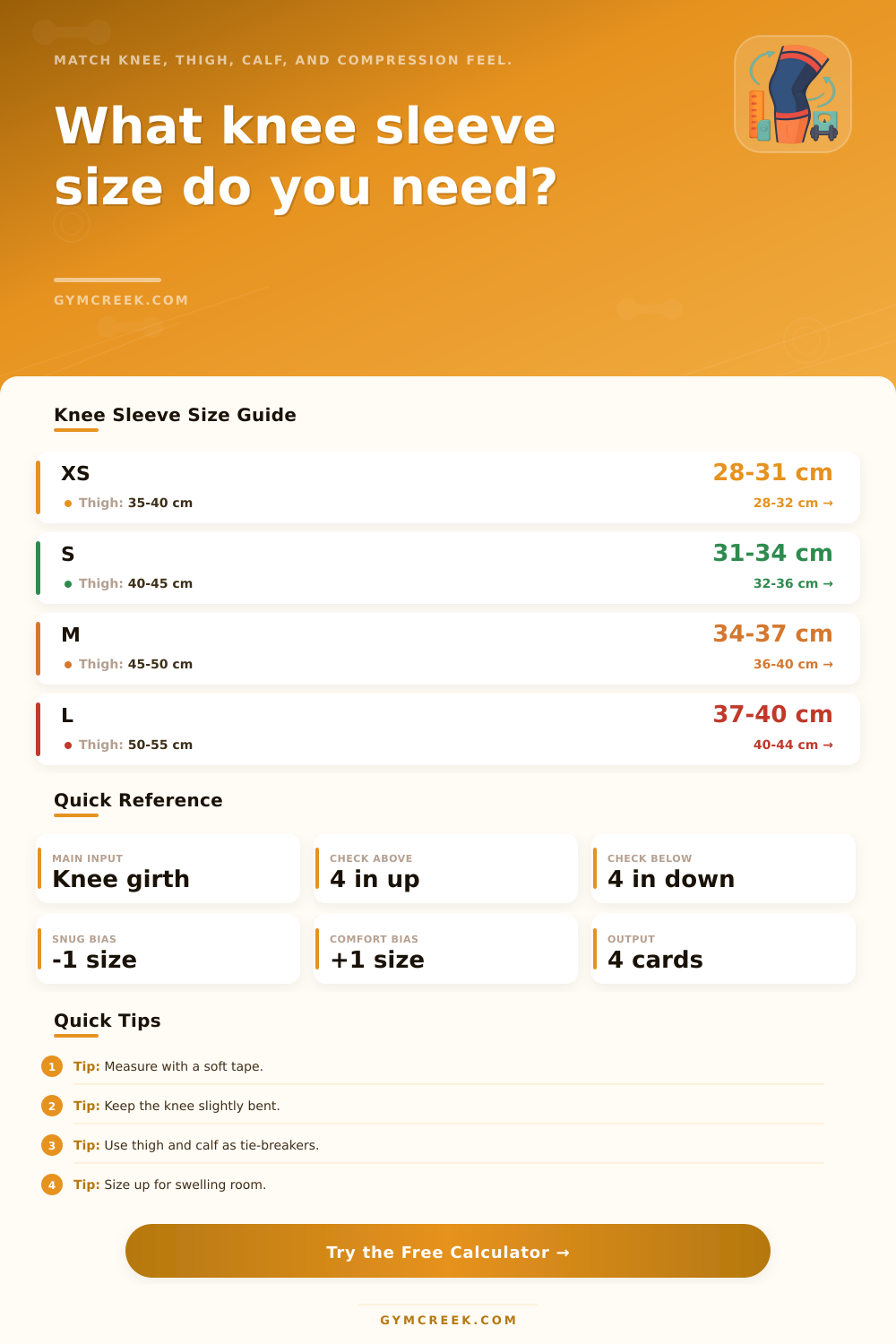
| Size | Knee inches | Knee cm | Typical feel |
|---|---|---|---|
| XS | 11.0-12.2 | 28-31 | Small frame |
| S | 12.2-13.4 | 31-34 | Light build |
| M | 13.4-14.6 | 34-37 | Average build |
| L | 14.6-15.7 | 37-40 | Larger knee |
| XL | 15.7-16.9 | 40-43 | Large frame |
| 2XL | 16.9-18.1 | 43-46 | Very large |
| 3XL | 18.1-19.3 | 46-49 | Max chart |
| Signal | Thigh read | Calf read | Action |
|---|---|---|---|
| Balanced | +4 to +6 in | 0 to +2 in | Use knee size |
| Large thigh | +6.5 in+ | Normal | Consider up |
| Large calf | Normal | +2.5 in+ | Consider up |
| Narrow leg | Under +3 in | Below knee | Consider down |
| Goal | Best thickness | Fit bias | Primary use |
|---|---|---|---|
| Mobility | 3 mm | Comfort | Running |
| Training | 5 mm | Balanced | Mixed gym |
| Heavy support | 7 mm | Snug | Squats |
| Meet day | 7 mm stiff | Tight | Powerlifting |
| Layer | Input | Adjustment | Reason |
|---|---|---|---|
| Base size | Knee girth | Chart match | Main fit |
| Openings | Thigh/calf | Up or down | Roll risk |
| Compression | Goal/thickness | Score | Feel estimate |
| Allowance | Swelling/use | Small add | Comfort |
💡Tips
When you purchase knee sleeve, you may encounter difficulty in the selection of the correct size. Many individuals that purchase these sleeve attempt to use the size chart to determine there size. However, size charts does not often account for the shape of an individual’s leg.
For these reason, an individual’s knee sleeve may either be too tight to allow for blood flow to their lower leg, or it may be too loose to remain on their leg during exercise. These issue can occur due to the assumption of the shape of the leg. Most size charts assume that an individual’s leg is cylindrically shaped.
How to Choose the Right Size Knee Sleeve
However, an individual’s leg is more cone shaped. An individual’s circumference at the knee is important to consider when purchasing a sleeve, but their circumference at the thigh and their circumference at the calf are also factors in that an individual will not be able to keep the sleeve on their leg if the thigh and calf are too large to allow the sleeve to remain in place on the leg. Individuals can purchase sleeves with a variety of intended use.
Knee sleeves can be soft knit material for individuals who wish to wear the sleeve to perform exercise like running, but other individuals may wish to purchase a stiffer knee sleeve made of material like 7mm neoprene for heavy lifting. The soft knit material will allow for more room for the individual’s leg to grow warm and blood to flow to the knee during exercise. However, the stiffer competition knee sleeve will not allow for as much blood flow or movement of the leg.
Thus, an individual may find it more difficultly to wear a stiff sleeve when they select a tight fit for the sleeve. Additionally, an individual’s leg will fill with blood during exercise. Thus, an individual may find that their leg becomes too tight to wear the sleeve throughout they’re exercise routine.
However, should the individual purchase the sleeve while they are cold and with no blood flow to the leg, the leg may become too tight once it fills with blood during exercise. An individual’s measurements of their leg are important to ensure that they are accurately measuring their leg. Many individuals will take the circumference of the knee while they are sitting and their leg is at a 90 degree angle to the floor.
However, while they are in this pose, their leg does not reflect the angle of their knee when they are lifting their leg. Thus, an individual should stand with their knee slightly bent to mimic the angle of their knee when lifting weights. Additionally, an individual must use a soft tape measure to measure the circumference of their leg.
If an individual takes a measurement with a tape measure that is not level to the leg, their measurement will be incorrect. An incorrect measurement will result in a knee sleeve that does not fit correctly to the individuals leg. The output of the risk of a knee sleeve failing to fit indicate the risk of the individual’s leg being too large in either the calf or thigh relative to their knee.
Thus, an individual should size up for their leg to avoid the risk of the sleeve sliding down the leg. Additionally, if an individual is calculated to need size up in their leg measurements, it is better for the individual to have a knee sleeve that is slightly loose around the joint where the knee is, as compared than being too loose along the rest of the leg. The goal of an individual wearing a knee sleeve is to achieve a balance of warmth, stability and blood flow to the knee.
An individual does not want too much pressure on the knee to the point of losing their mobility, but they also do not want too little pressure to the point of feeling uncomfortably when the sleeve supports their leg. Thus, an individual can achieve the best fit for their leg by finding a balance between their leg measurements, the thickness of the sleeve and the use case for which they would like to wear the sleeve. Additionally, because an individual’s leg is cone-shaped, it is important for an individual to account for this shape to ensure that their knee sleeve remains in place during their exercise routine.
An individual should of considered the shape of the leg more thorough.