
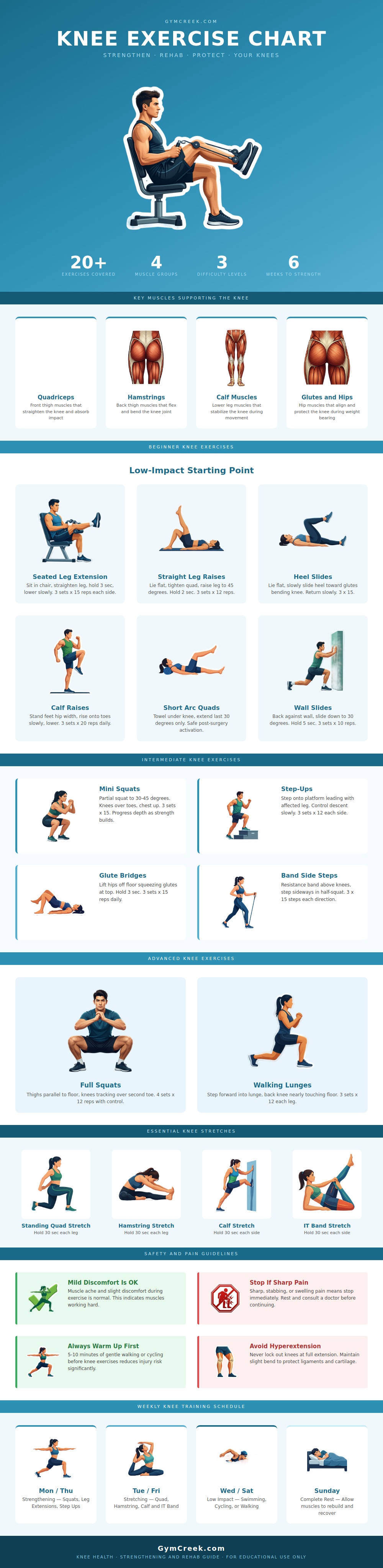
Knee pains occurs when the muscle around the knee joint dont provide enough support for the knee joint. When the muscles around the knee joint is weak, the joint must carry more weight than it was designed to handle. This excessive loading of the knee joint lead to the development of small aches that develop into larger problems over time.
In order to prevent this type of pain in the knee joint, the individual should strengthens the muscle that surround the knee joint. The exercises that an individual with a knee joint issue can perform are divided into different stages for the joint to gradually build up it’s tolerance to physical activity. The exercises in the first stage dont require any exercise equipment.
Simple Exercises to Make Your Knees Strong
The exercises in the second stage do require some degree of added resistance. It is important for the individual to follow this order because jumping straight into more difficult exercises that may place more pressure on the joint may worsen the irritation of the joint. There are four main muscle groups that is responsible for protecting the knee joint.
The quadriceps are the muscles responsible for performing the leg to straighten and absorbing the shock of each step that an individual takes. The hamstrings is responsible for the bending of the knee joint. The calves are the muscles responsible for pushing an individual body away from the ground.
The glutes and the hips are the muscles that are located above the knee joint, and they are responsible for the steering of the individual’s legs. If any of these muscle groups is weak, the knee will have to compensate for the weakness of that particular muscle group, leading to the development of pain within the knee joint. The exercises that an individual can perform as a beginner with a knee joint problem are those that will strengthen the quadriceps without placing a heavy load on the knee joint.
Exercises such as seated leg extensions and straight leg raises will strengthen the quadriceps while the individual is in a seated or lying position. These exercises will allow the individual to remove the majority of the body weight from the knee joint. Additionally, heel slides and short arc quads will help to teach the knee and the muscles around the joint to properly bend and straighten the leg.
These exercises will help the individual rebuild the connection between the brain and the muscles in the leg. Finally, calf raises and wall slides will help the individual place more demand on the muscles while placing less stress on the knee joint. Intermediate exercises will allow the individual to place more weight and to improve their balance with their knee joint.
Exercises like mini squats and step-ups will help the individual’s knee joint to accept more of their body weight while maintaining their alignment of the leg. Glute bridges will allow the individual to focus on their glutes and the muscles at the back of the hips. Glute bridges will help strengthen these muscles and the individual’s hips.
Band side steps will strengthen the outer hip muscle, and band side steps will also prevent the knee joint from collapsing inward when an individual is walking or running. Each of the intermediate exercises will provide more of a challenge for the knee joint to coordinate the various muscles that is required to perform those exercises. The advanced exercises will require an individual to perform deeper squats and lung strides, as well as maintain their balance while performing those exercises.
These exercises should only be performed after individuals have completed each of the earlier exercises in the program. Performing the advanced exercises too quickly may lead to the exercises backfiring on the individual. Stretching plays an important role in a knee joint exercise program, as muscles that are too tight can place the knee joint out of its correct position.
Muscles to stretch include the quadriceps, hamstrings, calves, and IT band. Each of these muscles should be stretched for thirty seconds. Stretching helps prevent the knee joint from fighting against the muscles.
Individuals must recognize the difference between ordinary effort and sharp pain. If an individual feels sharp pains or swelling in their knee, they should change their approach to the exercises; however, if they only feel an ache that lasts one or two days, they should continue to exercise. If an individual feels sharp pain, they should never exercise; however, if they only feel ordinary effort, they should begin to warm up their muscles with easy walking or cycling.
Performing each of the exercises in the program three times per week will help an individual to remain consistent with the program. Each individual should perform strength exercises on two non-consecutive days, stretching exercises on two other days, low-impact exercise on the remaining days, and take a full rest day each week. Taking a rest day allows for the muscles to truly strengthen, as strengthening occurs during rest.
The value of each of these exercises can be seen in the daily activities that they enable an individual to perform. For instance, an individual will find that it is more easier for them to climb stairs or stand for longer periods without becoming tired or shifting their bodys weight. While the chart illustrates the map of the exercises, the actual benefits of the exercises come from performing each exercise in the order in which they are illustrated in the chart.
You should of seen how much better you feel after following the proper sequence. It is naturaly helpful to stay motivated with a moddern approach to recovery.
