Kickboxing Calorie Calculator
Estimate kickboxing calories from body size, class format, round timing, bag work, pad work, sparring, effort, rest time, and heart-rate context.
📌Presets
Presets load realistic kickboxing sessions, then auto-calculate total burn, intensity, calorie pace, and conditioning context.
⚙Calculator
Kickboxing session snapshot
Enter session details to estimate calories burned and intensity context.
📊Kickboxing Metrics
📑Reference Tables
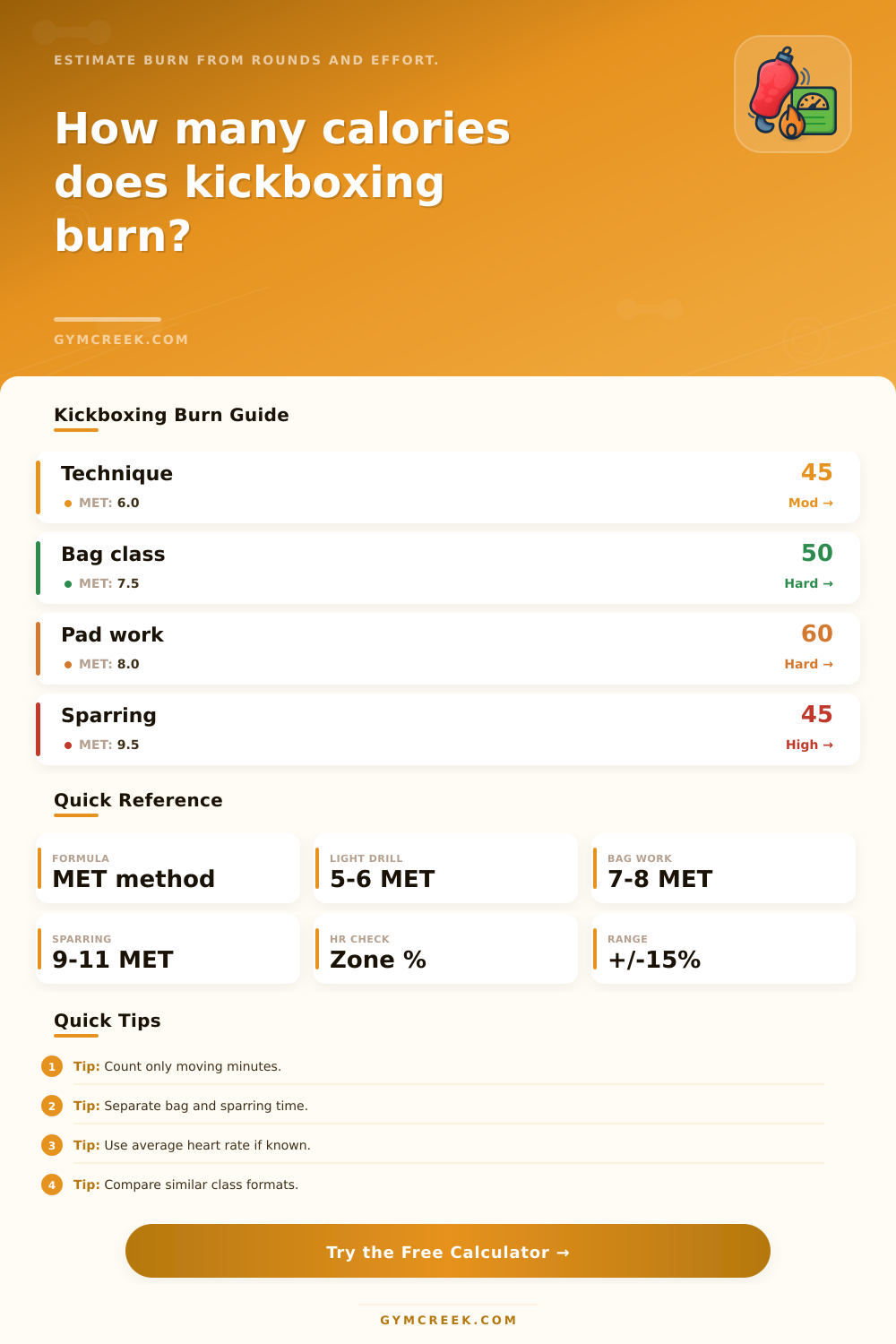
| Kickboxing format | Base MET | Typical use | Burn driver |
|---|---|---|---|
| Technique and footwork | 5.5 | Skill class | Movement quality |
| Beginner class | 6.5 | Mixed drills | Steady practice |
| Cardio kickboxing | 7.3 | Fitness class | Continuous pace |
| Heavy bag intervals | 7.8 | Bag rounds | Power output |
| Pad work | 8.3 | Coached combos | Bursts and defense |
| Controlled sparring | 9.5 | Partner rounds | Reactive work |
| Modifier | Lower | Middle | Higher |
|---|---|---|---|
| RPE | 3-5 | 6-7 | 8-10 |
| Active share | 50% | 70% | 85%+ |
| Contact type | Shadow | Bag/pads | Sparring |
| Round density | Low | Moderate | High |
| Heart zone | % max HR | Feel | Session use |
|---|---|---|---|
| Zone 2 | 60-70% | Steady | Skill base |
| Zone 3 | 70-80% | Moderate | Bag class |
| Zone 4 | 80-90% | Hard | Intervals |
| Zone 5 | 90%+ | Peak | Short bursts |
| Example profile | Weight | Session | Burn range |
|---|---|---|---|
| Smaller athlete | 125 lb | 45 min bag | 300-405 |
| Average class | 165 lb | 60 min mix | 520-705 |
| Larger athlete | 210 lb | 60 min pads | 720-975 |
| Sparring night | 175 lb | 45 min | 580-785 |
| Formula | Variables | Output | Best use |
|---|---|---|---|
| ACSM MET calories | MET, kg, min | kcal | Exercise burn |
| Mifflin-St Jeor | kg, cm, age | BMR | Daily context |
| Tanaka max HR | Age | Max HR | Zone check |
| Session density | Active, total | Percent | Class quality |
| Round setup | Work | Rest | Intensity note |
|---|---|---|---|
| Skill blocks | 2 min | 1 min | Controlled |
| Fitness rounds | 3 min | 1 min | Classic |
| Intervals | 2 min | 30 sec | Dense |
| Sparring | 3 min | 1 min | Reactive |
💡Tips
It is difficult to find the number of calories that will be burned during a kickboxing class because there are many forms of movement involve in kickboxing. Many use fitness trackers to calculate the number of calories that are burned during a kickboxing class; however, these fitness trackers use sensors that dont account for the various forms of energy use during a kickboxing class. The factor that will impact the number of calories that are burned during a kickboxing class include the total amount of time that was spent in the kickboxing class and the amount of minute in which the individual was actively striking a target.
Furthermore, the weight of the individual will also play a key role in determining the number of calories that burn during kickboxing. Other factors include the intensity of the kickboxing class, the type of kickboxing that is performed, the individual’s heart rate, and the type of kickboxing class being attend. The total amount of time spent during kickboxing does not necessarily indicate the amount of minute that an individual is actively striking a target.
What Affects How Many Calories You Burn in Kickboxing
During a kickboxing class, an individual may be spending time listening to the instructor, wrapping their fist, or breathing between rounds. Therefore, the trainer must separate the active striking minutes from the total amount of time spent in the gym. By excluding the inactive minutes of a kickboxing class, the calorie count will not be overestimative for that particular class.
The body weight of an individual will play a key role in determining the number of calories that are burned during kickboxing. An individual that weigh more will have to move their body mass more with each kick or punch. The more body mass that an individual has to move, the more energy that must be expend.
For instance, a heavyweight martial arts fighter will burn more calories during his kickboxing class then a flyweight fighter if the two athletes perform the same amount of kickboxing technique. This is due to the physics of the body mass of each fighter. The intensity with which an individual performs kickboxing will impact the number of calories that are burned.
Intensity can be measured in different ways. For instance, there are different forms of kickboxing with different level of intensity. Shadowboxing is a form of kickboxing with lower intensity than kickboxing with a heavy bag.
The reason for this is that when an individual is shadowboxing, they are not striking any mass. However, when an individual is working with a pad or sparring with another individual, the body must work to react to the other individual’s movements. This reaction require that individual to expend energy.
Sparring with another individual will burn the most calories during a kickboxing class. When sparring with another individual, an individual must guard their body, maintain their distance from their opponent, and watch for their opponent to strike at them. All of these effort require the individual to use their cognitive skills and their cardiovascular system.
Because sparring is taxing on these system, more calories are burned as a result of sparring as compared to kickboxing techniques without sparring. An individual’s heart rate while performing kickboxing will help to indicate the metabolic zone that they are performing in. However, heart rate will not always translate into the maximum amount of calories that will be burned during kickboxing.
For example, if the individual maintains a heart rate in Zone 4, their heart is working to maintain their anaerobic threshold. When maintaining this threshold, they will burn the most calorie after their kickboxing class. There is also a difference between cardio kickboxing and technical kickboxing classes.
Cardio kickboxing class are created to elevate the heart rate of the individual to the point of heavy sweating. However, technical kickboxing classes focus on the skill of kickboxing rather than the cardiovascular system. While the cardiovascular class may burn more calories while being performed, technical kickboxing build lean muscle, which increases the resting metabolic rate over time.
Therefore, while there is a difference in the number of calories burned during each type of class, there are long-term benefit to both types of classes. By keeping track of these factor, an individual can have an understanding of the density of the kickboxing class that they performed. If an individual increases the number of active striking minutes while keeping the total session time the same, they are increasing the density of that kickboxing class.
Density refers to the amount of work that is performed in a specific time period. If an individual is increasing the density of their kickboxing class, they are performing more work in the same period of time. However, the calories that will be burned during kickboxing can only be an educated guess based off the science of exercise.
Such estimate will never perfectly account for the metabolism of the individual or the environment of the gym in which the kickboxing class is performed. However, using these estimates, an individual can better manage their nutrition and there need for recovery after their kickboxing class.