Kick To Pull Ratio Calculator
Compare swim kick-only pace with pull-only pace, then estimate balance score, fatigue gap, efficiency, and the next technique priority.
📌Presets
Presets load realistic swim-test profiles and recalculate the kick-to-pull balance immediately.
⚙Calculator
Kick pull balance snapshot
Enter kick, pull, and whole-stroke test times to calculate the ratio.
📊Fitness Metrics Grid
📑Reference Tables
| Kick/Pull Ratio | Category | Meaning | Next Focus |
|---|---|---|---|
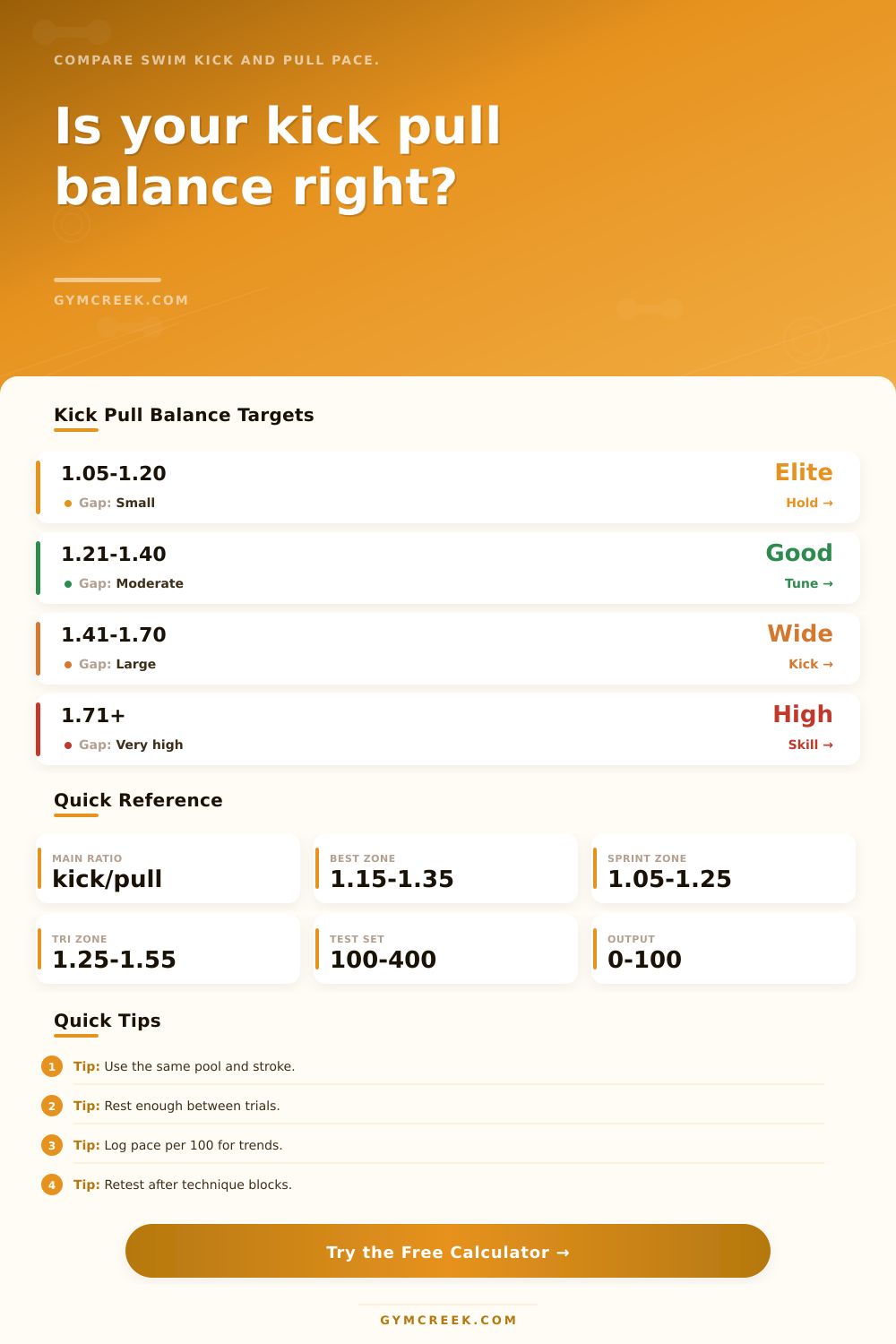
| 1.05-1.20 | Highly balanced | Kick nearly matches pull speed | Maintain timing |
| 1.21-1.35 | Good balance | Useful kick support | Refine transfer |
| 1.36-1.55 | Kick lag | Pull drives most pace | Kick mechanics |
| 1.56-1.80 | Wide gap | Leg output limits stroke | Body line |
| Over 1.80 | Major gap | Kick is much slower | Skill and mobility |
| Swimmer Type | Typical Ratio | Pace Pattern | Interpretation |
|---|---|---|---|
| Sprint pool swimmer | 1.05-1.25 | Fast kick and pull | High leg value |
| Distance pool swimmer | 1.20-1.45 | Controlled kick | Energy managed |
| Triathlon swimmer | 1.30-1.65 | Pull often leads | Common pull bias |
| Beginner swimmer | 1.55-2.20 | Kick slows sharply | Technique gap |
| Return to training | 1.35-1.80 | Fatigue sensitive | Build tolerance |
| Test Distance | Best Use | Rest Guide | Reliability |
|---|---|---|---|
| 25-50 | Power and sprint | 60-120 sec | High speed |
| 100 | Skill plus fitness | 90-180 sec | Best repeat |
| 200 | Aerobic balance | 120-240 sec | Good trend |
| 400 | Endurance bias | 180-300 sec | Fatigue test |
| 800+ | Long pool set | 300+ sec | Course specific |
| Formula | Variables | Output | Use |
|---|---|---|---|
| Pace per 100 | Time, distance | sec/100 | Compare trials |
| Kick/pull ratio | Kick pace, pull pace | Ratio | Main balance |
| Fatigue index | Effort, rest, gap | 0-100 | Consistency |
| Transfer index | Swim, best split | Percent | Whole stroke |
| Composite score | Ratio, RPE, transfer | 0-100 | Priority rank |
💡Tips
The tendency for swimmers is to get upset that no matter how much force they apply they are slow. Even though you drive your elbows back as far as possible, the watch doesn’t budge. Why? Arm strength isn’t the problem. Most likely it’s your legs not being in sync with your upper body.
That’s where the kick to pull ratio comes into play. Rather than working toward general fitness, it help them focus on what drives their swim. People think power equals velocity. Hydrodynamics says otherwise. When your arms pump, the water pushes back against them with extreme force. Your forearms and hands feels the resistance.
How to Swim Faster with Less Effort
Your hips sink if your kick is sluggish. As they descend, they create drag that pulls your body down and forces your upper body to work harder to get back up. With each stroke, you’re not only moving forward but rising from a hole.
The calculator above contrasts repeat pull buoy sets with isolated kick workouts. Then it converts that time disparity in a ratio. The ratio tell you precisely how much propulsion is escaping. Most swimmers underestimate just how much their inputs matter.
The only variable that you have control over is consistency. Run the test at the same distance each time on the same equipment while resting for the same amount of time. Meaningless if you run a pull test with paddles but then don’t use a board on the kick test. Paddles hide technical flaws in stroke while artificially increasing surface area. Using a board may help maintain hip height where without it your core stability might cause your hips to drop.
By logging what level of effort you’re producing, the tool accounts for those nuances so that you can better understand whether a deficit in propulsion is real or simply fatigue related.
If it’s close to 1.1, they are swimming very well. If you’ve ever seen an elite sprinter race, they’re using a lot of leg drive to propel them forward and stay up. The closer to 1.5 or even above (the higher), the bigger the difference between your kick and than your pull.
For triathletes and distance swimmers this isn’t necessarily a bad thing. It just means they’re trying to conserve energy. That can be a challenge if you’re looking to get faster without expending any additional calories. These numbers have been broken down in a table with actionable feedback loops so you know where to spend more time working on (technique maintenance vs. Refinement vs. You can also work on rebuilding your kick mechanics.
Swimming kicks are tiring. Why waste precious energy? Just pulling harder without proper balance won’t work because it ignores hydrodynamics. Wrong! If your body is properly aligned and ankles is loose enough to flex easily, kicking can be very efficient while using hardly any effort. The goal is not to sprint with your feet but to maintain momentum during the glide phase of the stroke.
Instead use your kick to help you stay moving forward as much as possible in the glide phase of each stroke. Your upper body is reserved for pushing. It’s effortless because that’s how it’s intended to feel. Balancing out takes some trial and error and patience.
Sometimes you’ll increase your kick count and slow yourself down because of timing mistakes or splash. Then you realize that your best splits come from kicking at a lower effort instead of grinding out the same level of effort on every kick set. That’s where the tool comes in. You can measure those little tweaks over time. Instead of chasing a single fast split, you’re seeing a trend. You’re turning your gut feeling into factual data point that you can work with.
At some point, however, the numbers aren’t about comparison anymore. They become about feeling, about knowing when your hips sink and when your kick fights with the water. That’s what the ratio becomes, a way of grounding your technique in reality instead of guesswork. When you know the maximum amount of propulsion your legs can create while not using extra energy, you don’t fight against the water. You move through it.