Kettlebell Weight Calculator
Estimate a practical kettlebell weight from body weight, goal, experience, movement, reps, RPE, one-arm or two-arm use, and injury caution, with kg/lb output, volume load, suitability cues, and progression steps.
📌Kettlebell Presets
Presets are examples, not standards. Adjust to your current skill, warm-up speed, available kettlebell jumps, and any coach or medical guidance.
⚙Calculator Inputs
Kettlebell load snapshot
Enter your training details to estimate a working kettlebell, progression jump, volume load, movement suitability, and safety range.
📊Metrics Grid
📑Reference Tables
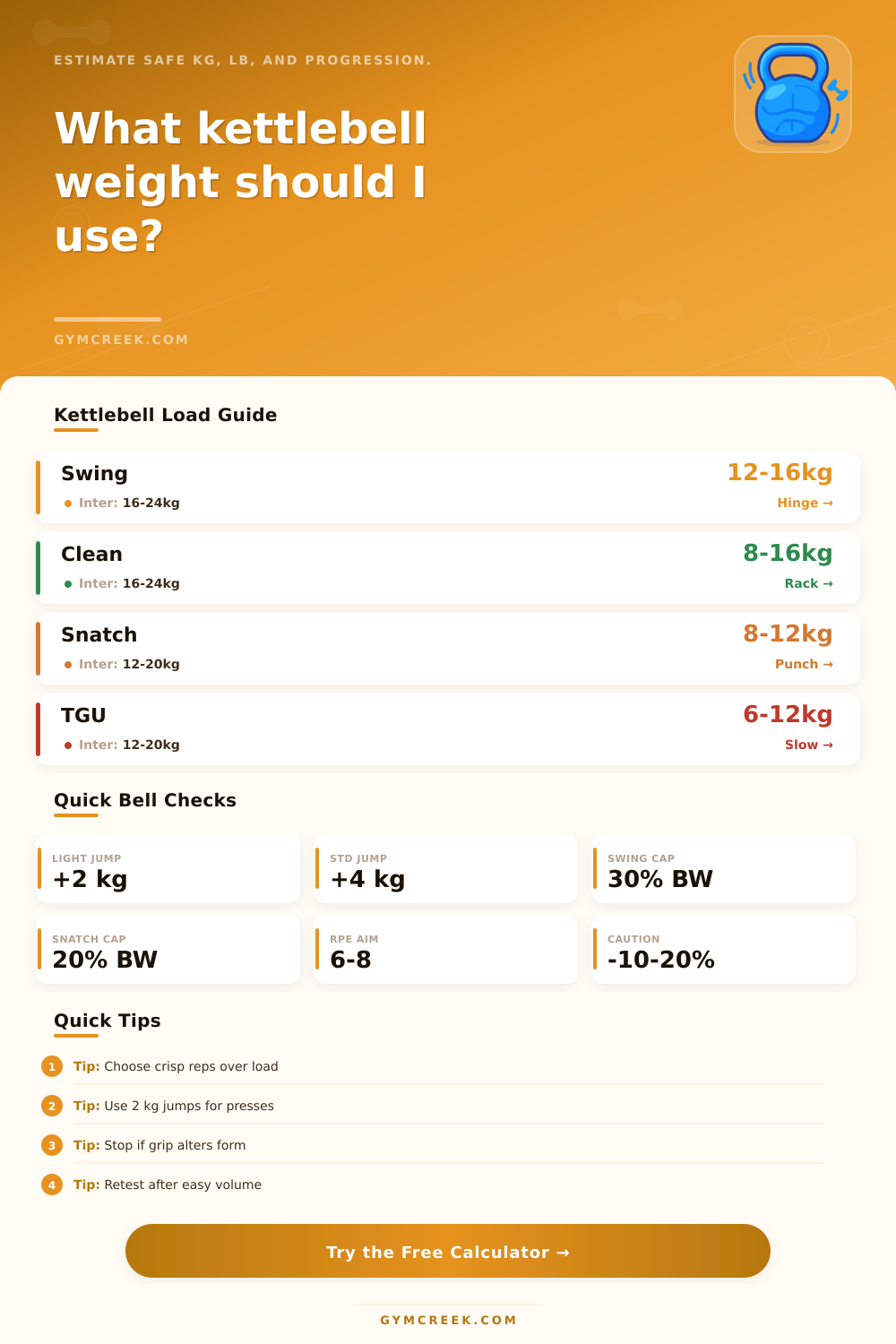
| Movement | New or beginner | Intermediate | Selection cue |
|---|---|---|---|
| Swing | 8-16 kg | 16-28 kg | Bell floats from hips, not arms |
| Clean | 6-14 kg | 12-24 kg | Rack lands quietly without wrist slap |
| Snatch | 6-12 kg | 10-20 kg | Lockout is stacked and controlled |
| Press | 4-12 kg | 8-20 kg | No lean-back or rib flare |
| Turkish get-up | 4-10 kg | 8-20 kg | Every transition can pause |
| Input | Conservative effect | Aggressive effect | How the calculator uses it |
|---|---|---|---|
| Technique or return | Reduces load 10-22% | Limits jumps to 2 kg | Prioritizes repeatable positions |
| Strength or power | Adds 5-12% | Allows 4 kg jumps | Useful when reps stay low to moderate |
| High reps | Reduces load 5-20% | Raises volume warning | Prevents grip and form drift |
| Advanced skill | Raises cap gradually | Still respects injury caution | Lets practice history influence load |
| Check | Good signal | Caution signal | Adjustment |
|---|---|---|---|
| Swing | Weight is 14-30% of body weight | Low-back caution or RPE 9+ | Use smaller bell or two-hand setup |
| Snatch | Weight is 8-20% of body weight | Shoulder/wrist caution or new skill | Practice clean or high pull first |
| Press | Weight is 6-16% of body weight | Rep speed stalls early | Use 2 kg jumps and lower RPE |
| Get-up | Weight is 5-14% of body weight | Cannot pause at transitions | Drop load before adding reps |
| Output | Formula | Inputs used | Interpretation |
|---|---|---|---|
| Raw load | Body weight x movement percent | Body weight and main movement | Baseline before training context |
| Adjusted load | Raw load x goal x skill x reps x RPE x caution | All form inputs | Working load estimate |
| Safety range | Recommended load x 0.85 to 1.12 | Recommended load and caution | Load window to test in warm-ups |
| Volume load | Bell weight x reps x sets x side factor | Bell, reps, sets, arm mode | External workload estimate |
| Progression | 2 kg or 4 kg based on movement risk | Movement, RPE, injury caution | Next jump after clean technique |
💡Tips
Selecting a kettlebell requires the consideration of a variety of different factors. The weight of a kettlebell is one of the factors that are generally considered when individuals selects a kettlebell for their training routine. However, it is possible that an individual may find that a kettlebell is appropriate for their performance of a few set repetitions of a movement, but that the weight of that kettlebell become too great for those individuals after they increase the number of the repetitions that they perform.
Factors that an individual should consider in the selection of an appropriate kettlebell for an individual’s training routine may include the experience level of that individual, the goals that that individual desires to accomplish through their training, the movement that they will perform with the kettlebell, and the number of repetition that they will perform with that kettlebell. Each of these factors are important in that they can influence the movement of that individuals body while they are performing their training routine with the kettlebell. The calculator that is included on this page uses each of these different factors to calculate the weight of the kettlebell that is recommended for that individual.
How to Pick the Right Kettlebell Weight
The weight of the individual’s body is used as a starting point for that calculation. The goal of the individual is used to determine if they are using the kettlebell to build skill with lighter weights, or if they are using the kettlebell weights to load their movements with heavy weights. The experience level that the individual has with using kettlebells is another calculating variable, since an individual’s coordination with their body will factor into the weight of the kettlebell that they can control.
The type of movement that the individual will perform with the kettlebell is another calculating variable, as movements like kettlebell snatches require different efforts from the body than movements like kettlebell goblet squats. Finally, the rate at which the individual can perform the repetitions of that movement, and the number of sets that the individual will perform with the kettlebell, will factor into the calculation of that weight. The Rate of Perceived Exertion (RPE) will determine at what level of physical limit that the individual intends to use the kettlebell.
Additionally, the configuration of the individual’s arm relative to their body, as well as any physical cautions that they are currently experiencing with their body, are two additional variables that will factor into the calculation of the weight of the kettlebell that is recommended for that individual. The recommendation of the kettlebell calculator for the weight that an individual should use is not to be utilized as a permanent rule for that individual. Instead, the individual should use the recommended weight to warm up with the kettlebell.
During this warm-up period, the individual can test different weights of kettlebells to determine at what weight their breathing begin to change, or at what weight their hinge position with their body changes. If any of these factors change with the use of a particular weight of kettlebell, that weight is too heavy for that individual. If the individual can successfully complete the sets of movements with that weight of kettlebell, however, that weight is within an appropriate range for that individual’s body during that session.
The suggested weights as calculated by the calculator are to be incorporated into the training routine of an individual over time. However, the individual should only incorporate those weights if their form with the kettlebell is stable and comfortable. If an individual attempts to increase the weight of the kettlebell without having first mastered the movements with their lighter weights, that individual’s form with the kettlebell may break down.
While the calculator provided suggets specific sizes of kettlebells that should be incorporated into an individual’s routine over time, the decision to increase the weight of the kettlebell is up to that individual, based off the way that their body responds to the kettlebell. In addition to the calculation of the weight of the kettlebell that is recommended for an individual, the kettlebell can also impact that individual’s grip strength and breathing. An individual may find that it was easy to perform the prescribed number of repetitions with the kettlebell, but that the individual found it to be more difficult to perform those same set of movements in later repetitions.
Certain movements, such as kettlebell swings or kettlebell snatch movements, require a great deal of stability from the individual, which is why the calculator calculates the suitability of the body for those types of movements. Such a suitability calculation is important for movements like kettlebell swings or kettlebell snatch movements, because these types of movements will punish an individual’s changes to their posture more than others. Finally, there are also reference tables that are included on the page.
These tables include the weights of kettlebells that are typically started by individuals of different experience levels with kettlebells, as well as the weights of kettlebells that are suggested for individuals of different types of movements. These tables provide a general indication of the weights of kettlebells that different individuals may start with and master over time. However, factors like sleep and recovery can change how much an individual can take in any given day, so these tables are not to be utilized as rules for an individual’s use of the kettlebell.
Instead, they are to be used as a target that an individual should aim for during their warm-up with the kettlebell, and which can be adjusted according to the bodys response during the individual’s training session. You should of used the weights as a guide, and dont forget to listen to your body. Its important to be careful with the weight.
Training can becomes hard if you choose weights that are too heavy. Youll need to be patient. If you’re using too much weight, it could be bad for you.
Also, make sure you check the weight of the kettlebell is correct. The weight of the kettlebell is important. Using too much weight can leads to injury.
The kettlebell weights should be chose carefuly. You should check the weight of the kettlebell before you start. The kettlebell weight is a very importent factor.
Use the weight that is right for you. The kettlebell weight should be adjusted based on how you feel. Making sure you have the right weight is actualy very important.
If you use a weight that is too heavy, it will be hard to complete the sets. The weight of the kettlebell should be something you can control. Make sure you are using the right weight for your level.
It is better to start with a lighter weight. This will help you to build strength. The kettlebell weight should be chosen based off your experience.
If you are a beginner, you should start with a light weight. As you get stronger, you can increase the weight. This will help you to progress.
The kettlebell weight should be increased gradually. This will help you to avoid injury. Using a weight that is too heavy can be dangerous.
Make sure you are using the right weight for your training. The kettlebell weight should be something that you can manage. If you find that a weight is too heavy, you should decrease it.
This will help you to maintain good form. Good form is very important when using a kettlebell. If your form is not good, you could get injured.
Make sure you are using the right weight for your form. The kettlebell weight should be something that allows you to maintain good form. If you cannot maintain good form, the weight is too heavy.
You should use a weight that is appropriate for your ability. This will help you to train safely and effectively. The kettlebell weight should be something that you can handle with ease.
If you find that you are struggling with the weight, you should reduce it. This will help you to improve your technique. Good technique is essential for kettlebell training.
It will help you to get the most out of your workouts and to prevent injury. The weight of the kettlebell should be something that you can control throughout the entire movement. If you cannot control the weight, it is too heavy.
You should use a weight that allows you to perform the movements with control and precision. This will help you to build strength and improve your overall fitness. The kettlebell weight should be something that you can manage comfortably.
If you find that the weight is too challenging, you should decrease it. This will help you to build a solid foundation before you move on to heavier weights. The kettlebell weight should be something that you can progress with over time.
As you become more proficient with the weight, you can gradually increase it. This will help you to continue to see progress in your training. The kettlebell weight should be something that is both challenging and manageable.
If it is too easy, you should increase the weight. If it is too hard, you should decrease the weight. This will help you to stay in the optimal training zone.
The kettlebell weight should be something that you can adjust as needed. This will help you to tailor your training to your specific needs and goals. The kettlebell weight should be something that you are comfortable with.
If you are not comfortable with the weight, you should adjust it. This will help you to train more effectively and to avoid injury. The kettlebell weight should be something that you can use to challenge yourself.
This will help you to improve your strength and conditioning. The kettlebell weight should be something that you can use to build skill. This will help you to improve your technique and to get more out of your workouts.
The kettlebell weight should be something that you can use to increase your intensity. This will help you to improve your cardiovascular fitness and to burn more calories. The kettlebell weight should be something that you can use to achieve your fitness goals.
This will help you to stay motivated and to see the results you want. The kettlebell weight should be something that you are excited to use. This will help you to stay consistent with your training and to enjoy your workouts.
The kettlebell weight should be something that you can be proud of. This will help you to stay motivated and to reach your full potential.