Kettlebell Pentathlon Calculator
Score clean, long cycle press, jerk, half snatch, and push press with event caps, kettlebell coefficients, RPM targets, bodyweight context, and pacing notes.
📌Presets
Presets load complete pentathlon scorecards and recalculate immediately, including capped reps, coefficient points, RPM, and the event most likely limiting the total.
⚙Calculator
📝Event Scorecard
Pentathlon scorecard
Enter reps and kettlebell weight to calculate event points.
📊Pentathlon Metrics
📋Event Breakdown
| Event | Raw reps | Capped reps | Bell | Coeff | Points | RPM | Cap gap |
|---|---|---|---|---|---|---|---|
| Clean | --- | --- | --- | --- | --- | --- | --- |
📑Reference Tables
| Event | Time | Rep cap | Cap RPM | Scoring note |
|---|---|---|---|---|
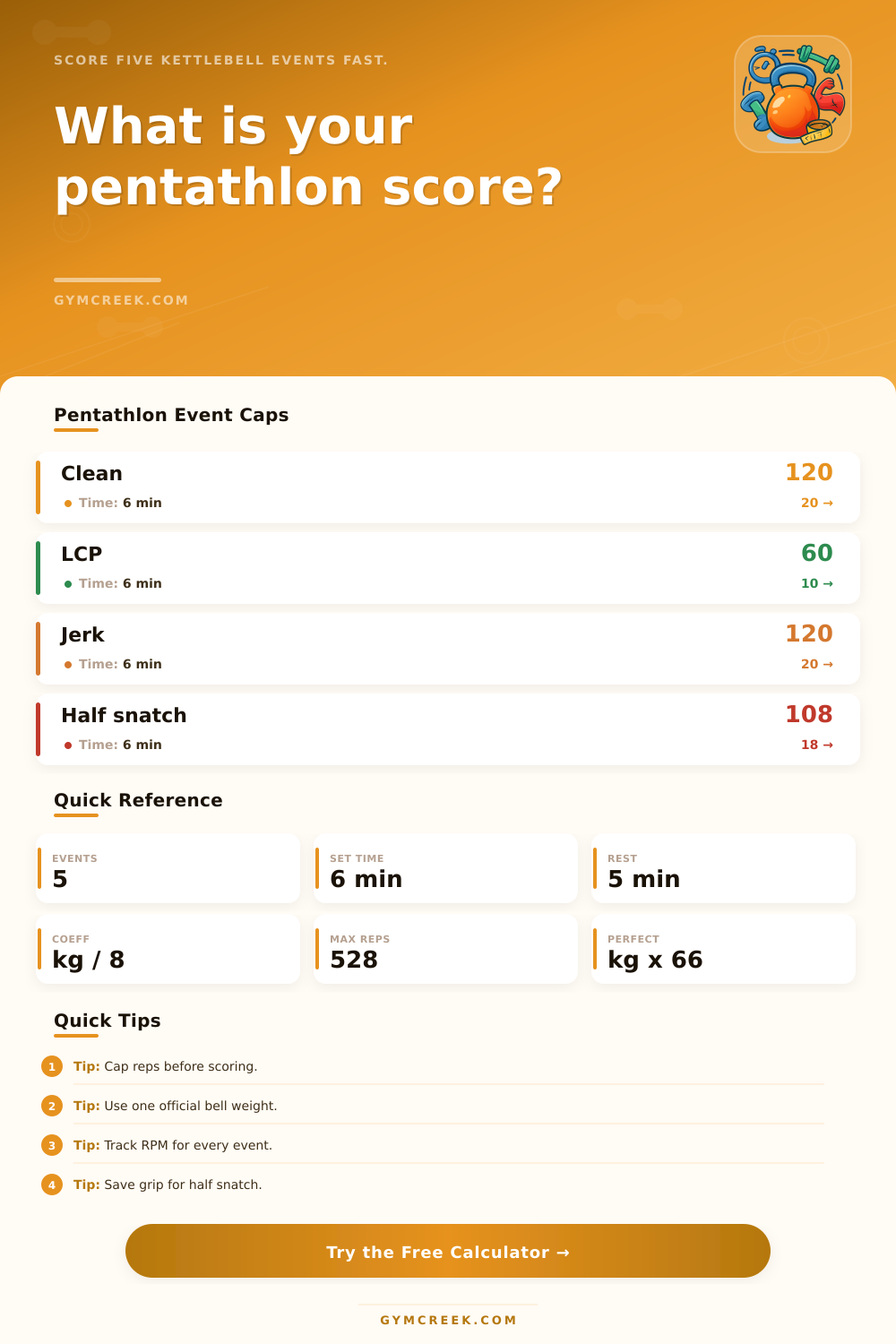
| Clean | 6 min | 120 | 20 | Fastest cap rate |
| Long cycle press | 6 min | 60 | 10 | Press usually limits total |
| Jerk | 6 min | 120 | 20 | Leg drive and rack recovery |
| Half snatch | 6 min | 108 | 18 | Grip and overhead rhythm |
| Push press | 6 min | 120 | 20 | Late-session shoulder endurance |
| Bell weight | Coefficient | Perfect event caps | Perfect total |
|---|---|---|---|
| 12 kg | 1.5 | 180 / 90 / 180 / 162 / 180 | 792 |
| 16 kg | 2.0 | 240 / 120 / 240 / 216 / 240 | 1056 |
| 20 kg | 2.5 | 300 / 150 / 300 / 270 / 300 | 1320 |
| 24 kg | 3.0 | 360 / 180 / 360 / 324 / 360 | 1584 |
| 32 kg | 4.0 | 480 / 240 / 480 / 432 / 480 | 2112 |
| Score band | 12 kg | 20 kg | 24 kg | Training meaning |
|---|---|---|---|---|
| Base | 350-500 | 600-850 | 700-950 | Learning event rhythm |
| Club | 500-650 | 850-1050 | 950-1200 | Solid full-test pacing |
| Advanced | 650-760 | 1050-1250 | 1200-1500 | Strong score balance |
| Peak | 760+ | 1250+ | 1500+ | Near cap in key events |
| Formula | Variables | Calculation | Use |
|---|---|---|---|
| Event points | Reps, kg | Capped reps x kg / 8 | Official-style scoring |
| Completion | Capped reps | Total reps / 528 | Volume profile |
| RPM | Reps, time | Capped reps / 6 | Pacing check |
| Mifflin-St Jeor | Body data | BMR context | Profile only |
💡Tips
The kettlebell pentathlons requires a person to complete five different lift with one kettlebell within a six-minute time limit. Because only one kettlebell and one clock are used for the pentathlon, there is a scoring problem for many lifters. One lift will score more fewer repetitions than the other four lifts with the same person using the same kettlebell within the time limit.
The total score for the pentathlon will reflect the weakness of a particular lift of the person rather than the total strength that the person possess. The calculator can process the math for you using your repetitions, your kettlebell weight, and your personal profile detail. The calculator wont tell you what the resulting numbers mean for your training.
How the kettlebell pentathlon score works
The score for the pentathlon is calculate by multiplying the capped repetitions by the weight of the kettlebell and dividing that number by eight. This number is divided by eight to make the score for individuals using different weights of kettlebells comparable to one another. For example, if an individual perform a clean with a 24 kg kettlebell, they earn three points for each completed repetition of the lift.
However, if an individual perform a long cycle press using a 16 kg kettlebell, they earn only two points for each completed repetition of the lift. There is a cap of 120 repetitions on the number of cleans, jerks, and push presses that an individual performs. Additionally, there is a cap of 60 repetitions on the number of long cycle presses that an individual perform.
Because the long cycle press has a lower repetition cap than the other lifts, the long cycle press will impact a persons ranking within the competition. The rest time between each lift is important to their performance in the competition. Five minutes of rest between each lift is provided for competitors.
However, many athlete will take less than five minutes of rest during their training to increase the similarity of their performance in the competition. You can enter your percentage of rest in the calculator. The weight of the kettlebell and the repetition caps will not change with a change in the rest time between lifts.
However, rest time will change the number of quality repetitions that an athlete can complete within each lift. Additionally, many athletes will miss the fact that rest time difference can alter the difficulty of a pentathlon competition. Body weight and age are two variables that are required to be entered into the calculator for the pentathlon.
These two variables change the way that an individual can be scored within the competition. For example, a 70 kg athlete may perform the same number of repetitions as a 95 kg athlete using the same 20 kg kettlebell. However, the performance of the 70 kg athlete may be scored differently than the 95 kg athlete due to the difference in there body weights.
The score per kilogram allow for individuals to see how strong they are relative to their body weight. Age can be used to calculate the metabolic estimates for individuals of different ages, such as comparing the performance of a 28-year-old athlete to that of a 48-year-old athlete. While the age and body weight of an athlete will not change the number of points that they earn for the competition, those variable will change the meaning of their score for the competition.
The event balance skill is displayed in the kettlebell pentathlon. The half snatch has a repetition cap of 108 and a target of 18 repetitions per minute, which place it between the long cycle press and the jerk. The grip strength for an individual may decrease between each lift due to the physical demand of the other lifts.
Additionally, many athletes will lose their half snatch rhythm due to their fatigue from the other lifts. The pentathlon calculator will calculate the lowest percentage of lifts completed to help an athlete see in which lift they need to improve their strength. There are two way to use the kettlebell for training.
An athlete can use one kettlebell to perform each of the lifts or they can switch to a different kettlebell for each lift depending on their strength with each lift. The calculator allow for both training methods as it allows for each event to have a different weight of kettlebell. If an athlete selects a different weight for each event, the points earned will be based on the actual weight of the kettlebell used instead of an average coefficient for each lift.
The official competition will require athletes to use one kettlebell, so the single kettlebell mode in the calculator will help athletes simulate the competition. The repetitions per minute will be displayed for each lift in the calculator. If an athlete completes 20 repetitions per minute for six minutes, they will reach the repetition cap for the lifts of 120 repetitions.
Most athletes will not be able to complete 20 repetitions per minute for each of the five lift. The repetitions per minute will show the athlete the average number of repetitions perform per minute. This will allow an athlete to see if they were too fast with the first three lifts as they will lose points when the rate of repetitions per minute drop during the last push press lift.
Many athletes make the mistake of treating each lift within the competition as separate events of strength. The repetition caps was established for the pentathlon to allow for athletes to perform the lifts with sustainability rather than strength. If athletes use too much energy in the first three lifts, they will not have the energy for the last two lift.
Additionally, many athletes treat the long cycle press as a test of their strength when it is actually a test of their ability to maintain a pace for their lifts. The calculator wont prevent these mistake but will show athletes the cost of these mistakes within the competition score. An athletes value of the score can only be understood by comparing the scores that they receive during different sessions of the kettlebell pentathlon.
For instance, if an athlete increases their score by 50 points after three months of training their jerk lifts, they have a measurable goal to pursue. The competition use the same formulas to calculate an athlete’s score for each session. The calculator will remove the manual arithmetic for athletes to focus on their training.
The same kettlebell and clock are used for each lift within the competition, which allows athletes to understand in which aspect of the lifts they have trained the most. The calculator will make this information readily available for athlete to read.