Keto Fat Intake Calculator
Convert calories, lean mass, net carbs, and protein into a practical keto fat target so daily grams, meal splits, and macro ratios stay aligned with your low-carb goal.
📌Keto Preset Deck
Each preset loads a realistic low-carb profile with a calorie lane, protein anchor, and net-carb ceiling so you can see how keto fat grams shift before changing your own numbers.
⚙Keto Macro Inputs
Build your keto fat target
Enter your stats or load a preset to turn calories, protein, and net carbs into daily fat grams and keto macro ratios.
📊Keto Metrics Grid
📑Keto Reference Tables
| Keto style | Net carbs | Typical fat share | Best fit |
|---|---|---|---|
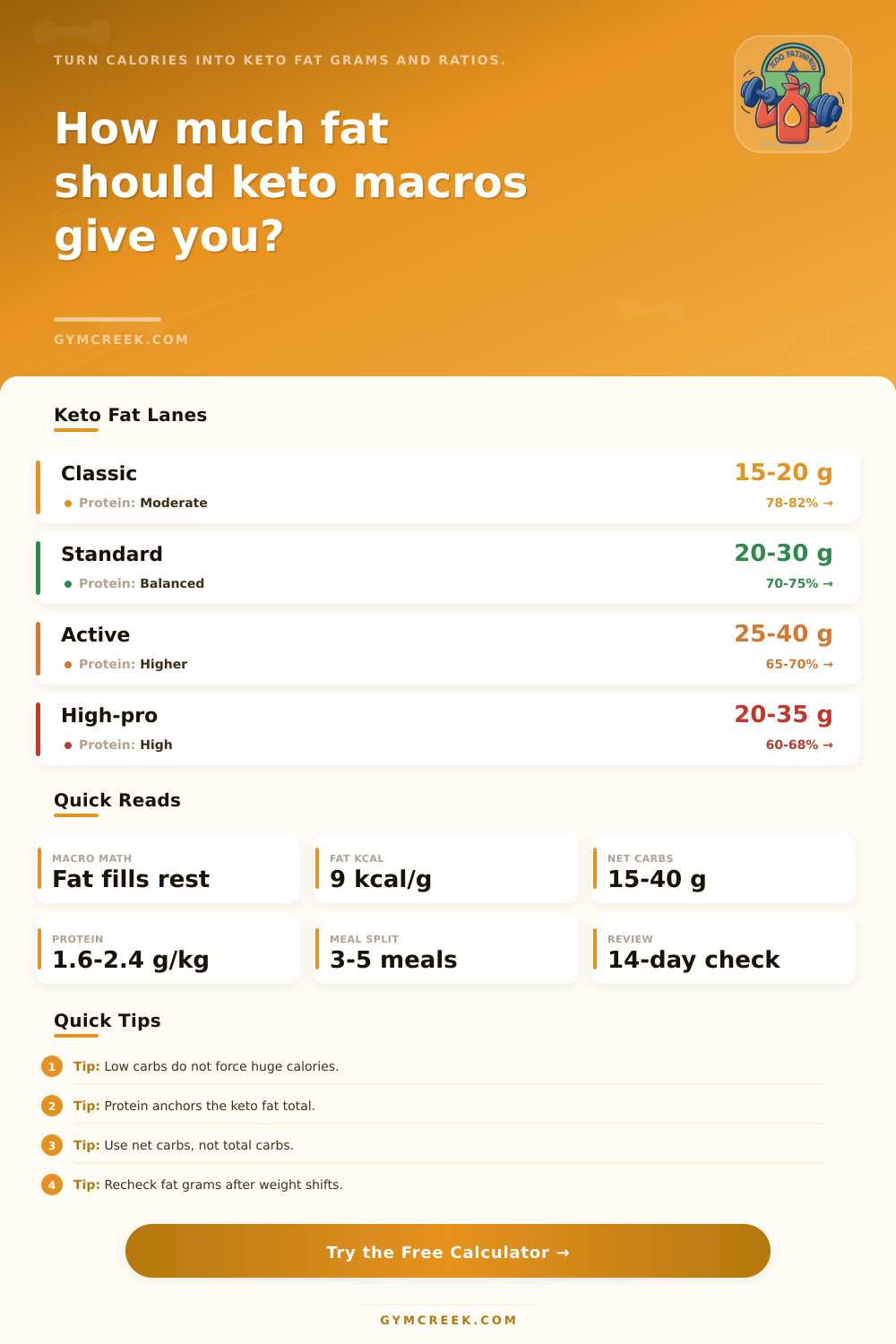
| Classic keto | 15 to 20 g | 78 to 82% | Very low-carb structure with moderate protein |
| Standard keto | 20 to 30 g | 70 to 75% | Most general low-carb maintenance or fat-loss phases |
| Active keto | 25 to 40 g | 65 to 70% | Higher movement weeks that still keep carbs tight |
| High-protein keto | 20 to 35 g | 60 to 68% | Lifters who want a firmer protein floor |
| Calories | 70% fat | 75% fat | 80% fat |
|---|---|---|---|
| 1600 | 124 g | 133 g | 142 g |
| 2000 | 156 g | 167 g | 178 g |
| 2400 | 187 g | 200 g | 213 g |
| 2800 | 218 g | 233 g | 249 g |
| Protein anchor | g/kg lean mass | When useful | Fat effect |
|---|---|---|---|
| Base keto | 1.6 | Lower training load or easier maintenance blocks | Leaves more calories for fat |
| Balanced keto | 1.8 | Most low-carb plans with steady lifting | Often keeps fat in the 70% lane |
| Athletic keto | 2.0 to 2.2 | Higher-volume training or harder cuts | Pulls fat grams down slightly |
| High-protein keto | 2.4 | Lean phases with strong protein priorities | Most likely to lower the keto ratio |
| Formula step | Math | Output | Why it matters |
|---|---|---|---|
| BMR route | Katch or Mifflin | Resting calories | Builds the calorie target when custom intake is blank |
| Activity bridge | BMR x multiplier | TDEE | Moves resting burn into a daily maintenance estimate |
| Goal shift | TDEE plus lane | Calories used | Sets the macro budget for cutting or gaining |
| Keto fat math | Calories minus protein and carb calories | Fat grams | Fat fills the remaining calorie budget |
💡Keto Notes
On keto, fat grams are not a fixed reward for dropping carbs. If calories are lower or protein is higher, the fat target should move with them instead of staying static.
If fasting compresses the day, the same total fat grams have to fit into fewer meals. That is usually easier with structured meal timing than with random snacking.
In order to follow a ketogenic diet, you need to manage your intake of fat, protein, and carbohydrate. You should keep carbs low to allow your body to enter a state of ketosis. In ketosis, your body burn stored fat for fuel instead of sugar.
Protein is an essential nutrient for protecting your lean muscle mass and maintain it as you lose weight on the diet. Fat is the primary source of energy required for your ketogenic diet once you have met your protein and carbohydrate needs. Though if you do not consume enough fat, you may feel hunger pangs.
How to Work Out Your Protein and Fat on a Keto Diet
However, if you consume to much fat without regard to the total number of calories you are supposed to consume on the diet, you will end up consuming too many calories. In order to calculate your protein needs, you need to know your lean body mass. Lean body mass is your body weight minus the weight of your body fat.
You can calculate your body fat percentage. To get an accurate measurement of your body fat percentage, you must use an accurate reading of your body fat percentage. Once you know your lean body mass, you can calculate your protein need by multiplying your lean body mass by a number of grams.
The number of grams of protein you consume daily should be between 1.6 and 2.4 gram of protein per kilogram of lean body mass. If you are an athlete who lift weights, you may need more protein. If you consume more protein, you will naturaly burn less fat grams for fuel.
There are several different style of ketogenic diets. The classic ketogenic diet has carbohydrates under 20 grams per day and fat take up 78 to 82 percent of your total calories. The standard ketogenic diet has 20 to 30 grams of carbohydrates per day with 70 to 75 percent of calories from fat.
The active ketogenic diet is for those who are very active and has 25 to 40 grams of carbohydrates per day with 65 to 70 percent of calories from fat. The high protein ketogenic diet takes in 2.4 grams of protein per kilogram of lean body mass with 60 to 68 percent of calories from fat. Each of these styles of ketogenic diets may be appropriate for certain individual with specific goals for there body and there health.
In addition to the different styles of ketogenic diets, you must also take into consideration the effects that fasting may have on your fat intake on the diet. If you are going to practice intermittent fasting, you will have fewer hour in which to consume your required gram of fat. If you fast for 14 hours each day, for example, you will only have 10 hours in which to consume your fat.
If you fast for 22 hours, you will have very few hours in which to consume your fat grams. Another important aspect of a ketogenic diet is the tracking of net carbohydrate instead of total carbohydrates. Net carbohydrates are total carbohydrates minus fiber content.
Carbohydrate content doesnt raise the blood sugar levels of the body as much as total carbohydrate do. To calculate your macro, you have to first determine the amount of total calories you need. This will be based off your level of activity and whether you want to lose weight or gain weight.
Once you have calculated the amount of total calories you need, you can calculate the amount of protein you need based on your lean body mass. Then, with your total calories, the calories from protein, and the grams of carbohydrates you consume each day, you can calculate the amount of grams of fat you need to consume daily. For example, if you would like to consume 2400 calories each day, and you consume 100 calories from carbohydrates and 520 calories from protein, you will have 1780 calories left over for fat intake.
Because there are 9 calories in a gram of fat, 1780 calories divided by 9 will provide you with the total grams of fat you should consume per day. Your macros should be re-evaluated every two weeks. As you lose weight, your lean body mass change.
Therefore, your protein and fat intake must also change. You should also monitor your energy and satiety level to ensure that the amount of fat you are consuming each day is appropriate. If you dont feel as energetic each day as you should, your fat intake may need to be adjusted.
However, make sure you maintain your protein intake to protect your lean bodys mass. Finally, ensure the fat sources you consume are of the highest quality. Some of the best fats to consume on a ketogenic diet include saturated fats from meat and monounsaturated fats from olive oil.