Keto Diet Calculator
Estimate a complete keto diet target from body stats, activity, goal, net carbs, and protein, then see daily fat grams, macro ratios, and meal splits.
📌Keto Presets
Presets load realistic low-carb profiles with different calorie goals, carb ceilings, protein anchors, and activity levels.
⚙Calculator Inputs
Keto diet snapshot
Enter your stats to estimate calories, net carbs, protein, fat grams, and keto ratio.
📊Keto Metrics
📑Reference Tables
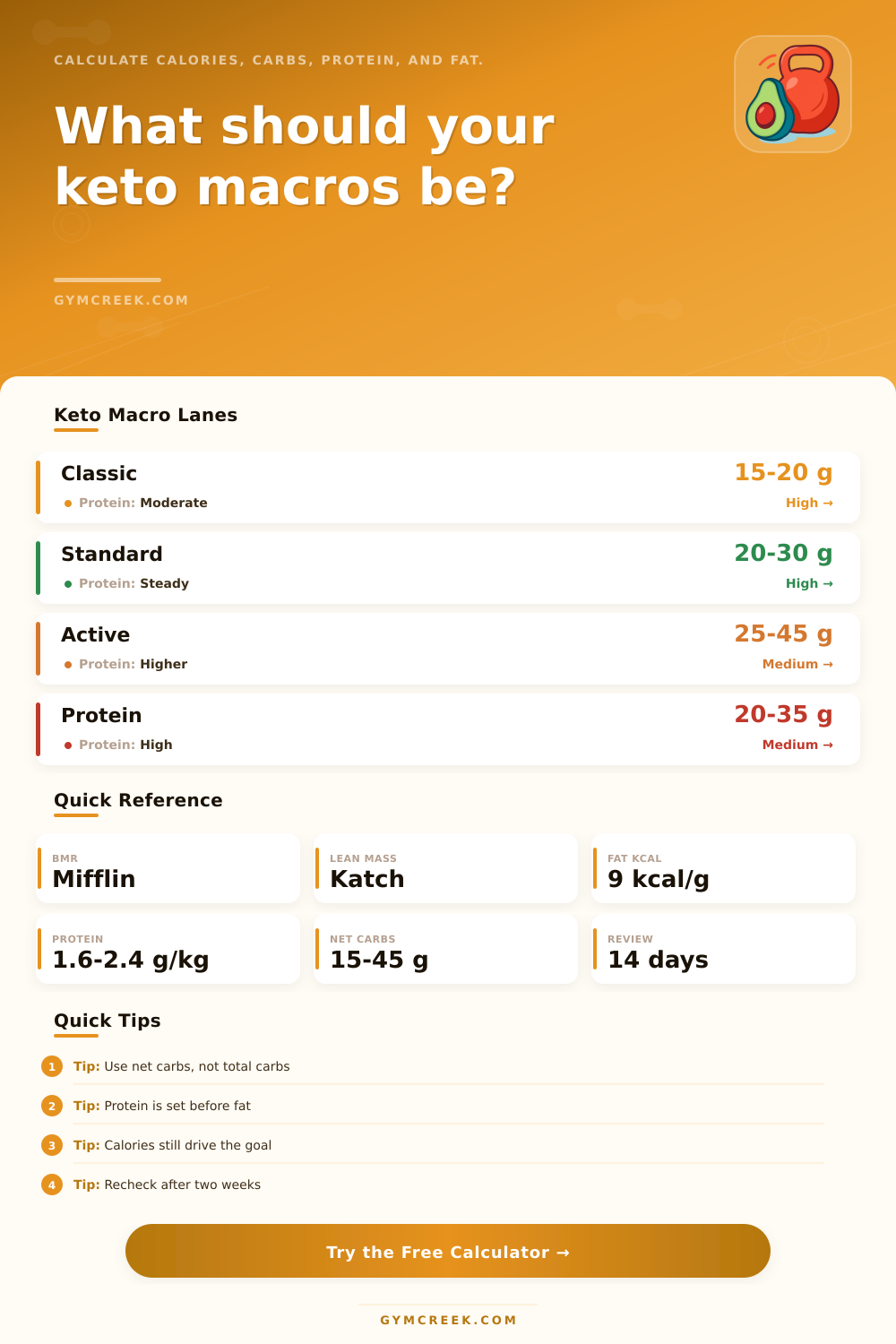
| Keto style | Net carb lane | Protein anchor | Typical fat share |
|---|---|---|---|
| Classic keto | 15 to 20 g | Moderate | 78 to 82% |
| Standard keto | 20 to 30 g | Steady | 70 to 75% |
| Active keto | 25 to 45 g | Higher | 65 to 72% |
| High-protein keto | 20 to 35 g | High | 60 to 68% |
| Protein factor | Use case | Calories per kg | Effect on fat |
|---|---|---|---|
| 1.6 g/kg | Lower training load | 6.4 kcal | Leaves more fat room |
| 1.8 g/kg | General keto dieting | 7.2 kcal | Balanced macro split |
| 2.0 g/kg | Regular lifting | 8.0 kcal | Fat grams move down |
| 2.4 g/kg | Hard cut or lean phase | 9.6 kcal | Lowest fat allocation |
| Formula | Inputs | Output | Why it is used |
|---|---|---|---|
| Mifflin-St Jeor | Sex, age, weight, height | BMR | Reliable resting calorie estimate |
| Katch-McArdle | Lean body mass | BMR | Useful when body fat is known |
| Activity multiplier | BMR and activity | TDEE | Moves resting burn to daily burn |
| Keto macro math | Calories minus protein and carbs | Fat grams | Fat fills the remaining calories |
| Daily calories | 20 g carbs | 30 g carbs | 40 g carbs |
|---|---|---|---|
| 1600 kcal | 80 kcal | 120 kcal | 160 kcal |
| 2000 kcal | 80 kcal | 120 kcal | 160 kcal |
| 2400 kcal | 80 kcal | 120 kcal | 160 kcal |
| 2800 kcal | 80 kcal | 120 kcal | 160 kcal |
💡Calculation Notes
The calculator assigns protein and net carbs first, then uses the remaining calories for fat grams. That keeps keto macro targets tied to the calorie goal.
Scale weight, training performance, and recovery can shift after the first two weeks. Recalculate when body weight or activity changes meaningfully.
To use a keto calculator, you must first input you’re age, your sex, your weight, and your body fat percentages. Your age and your sex will determine your resting metabolic rate (calories burned while at rest), your weight will determine your caloric and protein need, and your body fat percentage will allow the calculator to use a lean mass formula (which is more accurate then calculating based on total weight because total weight will overestimate the calories needed for individuals with high body fat percentages). Next, you must input your activity level, which will determine the number of calories you burns per day.
Your activity level is important because if you are inactive, you will burn more fewer calories than if you are more active. Following your activity level is your goal with keto, whether you want to lose fat, maintain your weight, or gain muscle. If you want to lose fat, you will consume fewer calories than you burn.
How to Use a Keto Calculator
If you want to gain muscle, you will consume more calorie than you burn. Following your goal, you will have to choose a protein factor. If you lift weights regular, you will need more protein than individual who perform only light physical activity so that muscle can replenish the protein used during weight lifting.
The calculator can calculate this protein target from your lean mass or total weight, lean mass will provide a more realistic target for protein intake for those who consumes high amount of body fat. The net carbohydrates setting cannot be adjusted since the body burn fiber differently than carbohydrates. Net carbohydrates are the amount of carbohydrate you must consume to remain in ketosis.
Your keto style will determine the amount of fat and carbohydrate you consume. A classic keto diet is low in carbohydrates and high in fat. Standard keto diet allow for slightly more carbohydrates.
Active keto diet allow for carbohydrates to be consumed only after workouts to replenish expended glycogen. Active keto diets is useful for this reason. High protein keto diets increase the protein and decrease the fat in your diet.
These outputs will provide you with the total number of calories you should consume per day, the gram of protein you should consume per day, the grams of carbohydrates you should consume per day, the gram of fat you should consume per day, your keto ratio (grams of fat divided by gram of protein and carbohydrates), a meal split average (to help you remember how much of each macronutrient to consume per meal), and how you feel throughout the day. However, the calculator cannot measure how you feel, you must monitor your sleep, hunger and energy level yourself. If you feel lethargically or weak, adjust your protein factor.
Additionally, monitor your body weight over a fourteen-day period so that you have a more accurate measurement of your weight than if you weighed yourself once per day. Additionally, the quality of the food you consume is important regardless of your macronutrients. It is possible for two individuals to consume the same amount of calories and carbohydrates but experience different result in their bodies if one consumes mostly vegetable and protein while the other consumes processed snacks.
High quality food will aid in your digestion and reduce inflammation in the body. Additionally, if you perform heavy training session per week, your carbohydrate needs will increase so you should shift your carbohydrate intake to your training day. The keto diet allows you to model such shift in your body.
Finally, you should recalibrate the calculator every few week as your body change over time. Your weight or activity level may have changed so your caloric and macronutrient need have changed accordingly. If you do not recalibrate your needs, your diet will drift off track from your goal and target will be set for a body that does not reflect your current state.
Recalibrating the calculator will ensure your diet remains effective.