Kayaking Calorie Calculator
Estimate calories burned while kayaking from body weight, boat type, paddle cadence, water class, wind, current, gear load, distance, and on-water time.
📌Presets
Each preset loads a named kayaking scenario and recalculates with route, boat, water, cadence, load, and weather conditions.
⚙Calculator
Kayaking calorie snapshot
Enter paddle duration, cadence, route distance, boat load, and water conditions to estimate kayak calories.
📊Kayaking Metrics
🧮Formula Result Cards
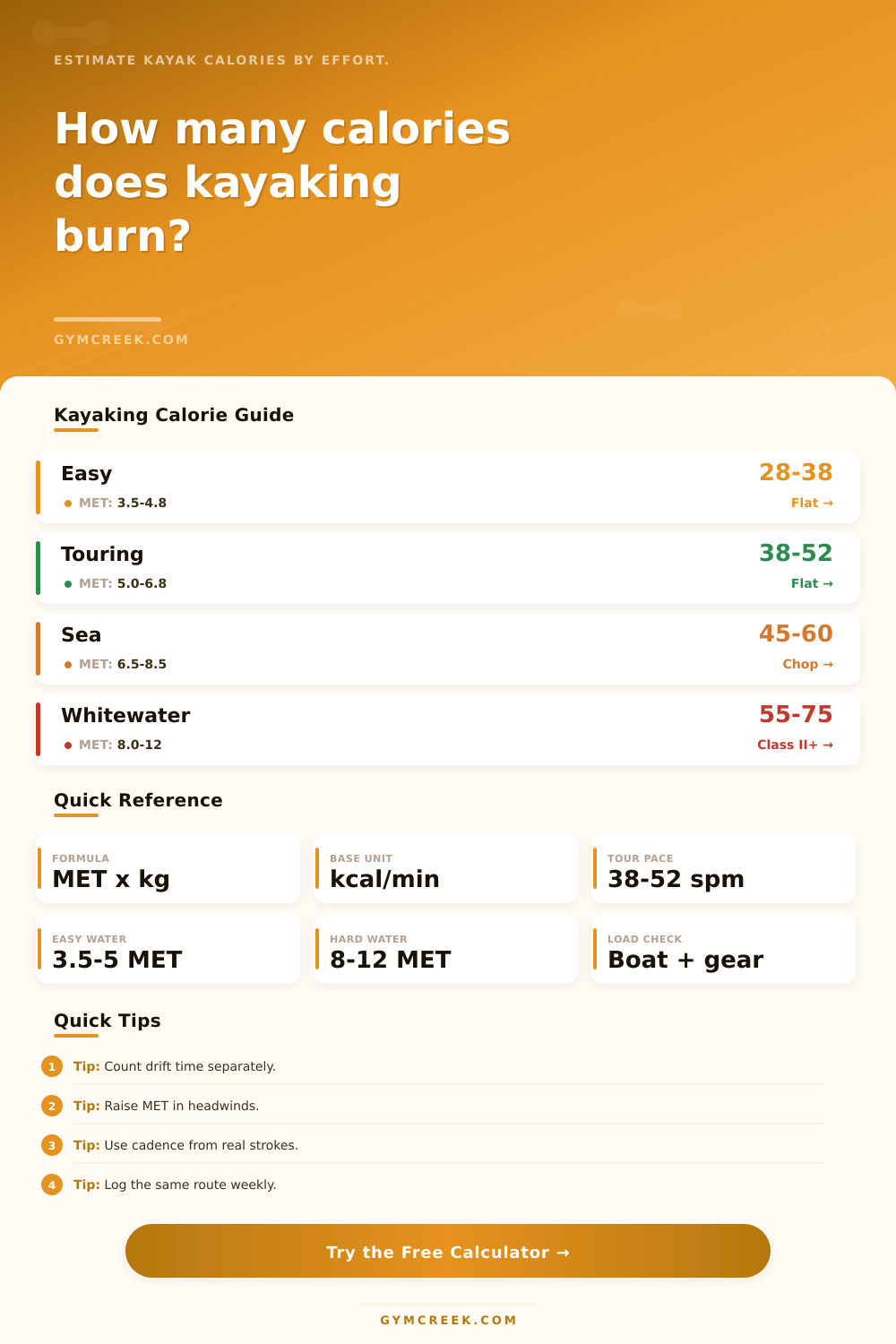
Calories per minute = MET x 3.5 x body weight in kg / 200. Kayaking work uses adjusted MET and active paddle minutes.
Base MET is selected by kayak style and water class, then cadence, stroke pressure, wind, current, load, and handling modifiers tune it.
Coasting time is counted separately at a low afloat MET so long trips with breaks do not get overstated.
Mifflin-St Jeor estimates BMR from height, weight, age, and gender, then activity level estimates TDEE for session share.
📑Reference Tables
| Kayak Style | Easy | Steady | Hard |
|---|---|---|---|
| Recreational sit-in | 3.5 MET | 4.8 MET | 6.2 MET |
| Touring kayak | 4.5 MET | 6.0 MET | 7.6 MET |
| Sea kayak | 5.2 MET | 7.0 MET | 8.8 MET |
| Whitewater kayak | 6.0 MET | 8.5 MET | 11.5 MET |
| Fishing kayak | 3.8 MET | 5.2 MET | 6.8 MET |
| Cadence Zone | Strokes/Min | Modifier | Typical Feel |
|---|---|---|---|
| Drift and easy | Under 30 | 0.90x | Conversation pace |
| Recreation | 30 to 44 | 0.98x | Light aerobic |
| Touring | 45 to 59 | 1.06x | Steady cardio |
| Fitness | 60 to 74 | 1.14x | Hard sustained |
| Rapid or race | 75 plus | 1.22x | Peak bursts |
| Condition | Example | Modifier | Why It Matters |
|---|---|---|---|
| Flat water | Calm lake | 1.00x | Efficient glide |
| Chop | Wind waves | 1.10x | Balance and braces |
| Headwind | Open bay | 1.16x | More drag |
| Current against | River return | 1.18x | Lower speed |
| Whitewater | Class II-III | 1.20x | Frequent moves |
| Formula | Variables | Output | When Used |
|---|---|---|---|
| MET kcal | MET, kg, min | Calories | Main estimate |
| Load factor | Gear, body kg | Modifier | Boat plus kit |
| Pace rate | Distance, time | Speed | Route context |
| Mifflin BMR | kg, cm, age | Baseline | Daily context |
💡Tips
Generic fitness trackers often provide suspiciously low calorie counts for water-based exercise. This is due to one reason, most devices don’t have a realistic picture of how hard one works in moving water. Rapids adds resistance. Cross winds add drag. Other elements make kayaking harder then generic apps can anticipate.
Using a simple formula that factors in your cadence, boat type, water state, wind and load gives you a decent idea of how many calories burned during kayaking. That’s why I developed the calculator above. It delivers a closer approximation by breaking down the variables.
Why This Kayaking Calculator Works Better
Kayaking isn’t a one size fits all sport. Calm waters requires less energy than rough ones, while a headwind will increase effort over a tailwind. Enter that information into the form below to get a better breakdown.
Because paddling is a variable workout, the calculator accounts for different types of boat, body types and wind. It considers wind exposure and weight carried in the craft as important parts of calorie burn. Paddling a heavy touring kayak with loads adds more effort compared to using a light, svelte sea kayak.
The most important input for the calculation is your stroke rate. This is the core of your estimation. Paddling at thirty strokes a minute? You are probably in the efficient aerobic zone. Bump it up to sixty or seventy strokes and you’re cranking out calories, increasing the intensity.
How fast you go also relates to metabolic cost (see the reference table on the page). It is not just how hard you pull but how frequently you pull. A higher cadence mean more muscle are used per minute, which leads directly to more energy being spent.
Simple estimates tend to overlook wind and current. If you’re paddling hard against a stiff headwind, you’ll be doubling your work rate just to make steady progress. You can make up for this wind resistance in the calculator and arrive at a figure representing the energy you expended in practice.
Similarly, if you had half your journey going with the current and another half battling against it, the average won’t reflect the reality of what you put your body through. Better to consider each leg of the trip independently. The calculator takes care of the details for you.
You don’t need to do any algebra by hand, which saves you time and reduces the margin for error. Also separate out total time spent on the water vs. This is your active paddle time.
There may be times when you’re staring at birds or floating around in an eddy for 20 minutes. That goes into the total time it took to complete your trip. But it’s burning calories different than the actual number of strokes you make while rowing. By separating the rowing time from the coasting time, you can see how much energy you burned.
And that will help you know if you were training or having fun. Fun is good. Training is good too. Just for different reasons.
Finally, here is the result in context. The calculator not only shows you how many calories you burned during your session, it breaks that out into active paddle calories as well as a moddern metabolic equivalent. In other words, it gives you a sign of how hard you worked (relative to your resting metabolism).
For those interested in fitness through kayaking, this is more valuable information than just the raw calorie count. This will let you know whether or not you were working hard enough to get any sort of change from your workout. It will give you a sense of output so that instead of guessing about input, you’ll know exactly what you got.
When combined with real life variables such as cadence, load and wind, these numbers aren’t gospel but they start to provide a good guideline. After getting out on the water, you won’t be wondering what kind of workout you had. You’ll know precisely what you got which makes that leisurely outing a workout worth having.
It should of been helpful.