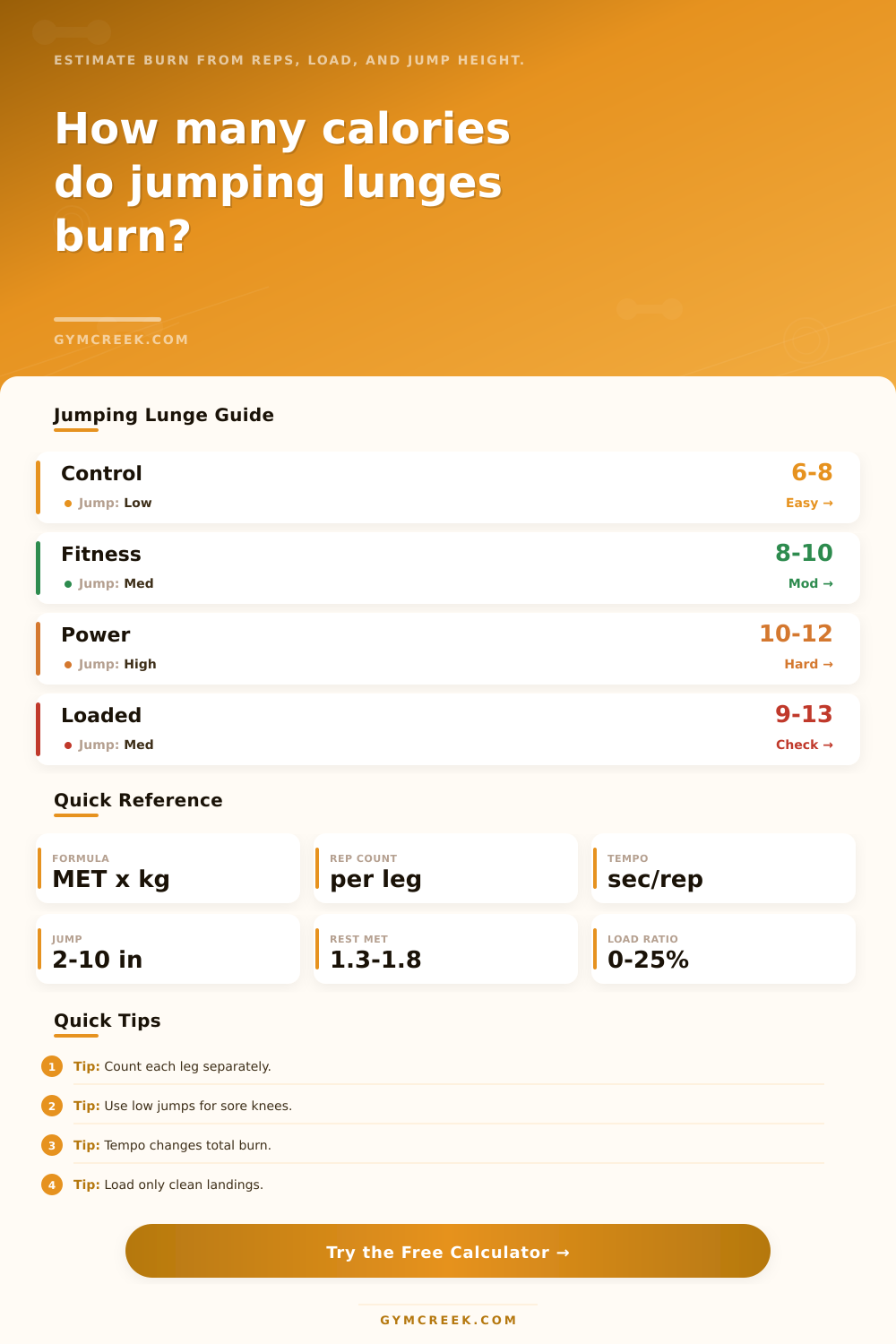
Jumping Lunge Calorie Calculator
Estimate calories burned from reps per leg, bodyweight, external load, jump height, sets, tempo, rest, weekly frequency, and knee comfort.
📌Jumping Lunge Presets
Each preset fills a realistic unilateral plyometric setup and recalculates reps, calories, density, and knee-comfort scoring.
⚙Calculator
Jumping lunge calorie snapshot
Enter reps per leg, jump height, load, tempo, sets, rest, and knee comfort to estimate the session.
📊Metrics Grid
🧮Unilateral Power Logic
Reps are entered per leg, then doubled because every switch requires one left-side and one right-side landing cycle.
Mechanical work estimates how much bodyweight plus held load is moved upward through the average jump height.
Calories use MET x 3.5 x body weight in kg / 200, with modifiers for tempo, load, jump height, and intent.
Comfort and landing quality do not diagnose pain; they flag when lower jumps, less load, or slower tempo may be smarter.
📑Reference Tables
| Style | Typical MET | Tempo | Best Use |
|---|---|---|---|
| Technique lunges | 5.5-7.0 | 2.0-3.0 sec | Landing control |
| Fitness circuit | 7.5-9.5 | 1.4-2.0 sec | Repeatable burn |
| HIIT finisher | 9.0-11.5 | 1.0-1.5 sec | High density |
| Loaded jumps | 8.5-12.5 | 1.5-2.4 sec | Power with control |
| Jump Height | Landing Demand | Power Bias | Note |
|---|---|---|---|
| 0-2 in | Low | Low | Use for swaps |
| 3-5 in | Moderate | Base | Most circuits |
| 6-9 in | High | Strong | Power focus |
| 10+ in | Very high | Peak | Only crisp reps |
| Knee Comfort | Interpretation | Calculator Bias | Adjustment |
|---|---|---|---|
| 5 | Pain-free | Full score | Progress slowly |
| 4 | Comfortable | Minor caution | Watch landings |
| 3 | Mild awareness | Caution | Lower jump |
| 1-2 | Uncomfortable | High caution | Modify or stop |
| Formula | Variables | Output | Why It Matters |
|---|---|---|---|
| MET kcal | MET, kg, min | Calories | Session burn |
| Vertical work | kg, g, height | Kilojoules | Jump demand |
| Average power | Work, time | Watts | Explosive output |
| Density | Work, rest | Percent | Fatigue load |
💡Tips
Lunge jump: If you are healthy in your joints, this is a sign of success or danger depending upon what you want to accomplish. Depending off how it feels, it’s somewhere between a high intensity cardio workout and strength training exercise. Your muscles need to provide some explosive power, particulary your glutes and quads. You also repeat moving your bodyweight (and whatever else you’ve loaded) around the space over and over. This taxes your cardiovascular system. For most, the burn comes first.
Focus on landing mechanics before you worry about burning calorie. But you plug in your variables and the calculator does the work for you (see above). So no need to guesstimate how many calories is burned doing a ten rep set. But knowing what goes into this tool is realy where it’s at.
How to Calculate Calories Burned from Lunge Jumps
First, let’s talk about reps. And yes, you want to put in reps PER LEG, not total alternating reps. So if you’re doing ten reps total, that’s five on one side then five on the other. The tool will double that up since there is actualy a physical demand to each individual landing and extension cycle. It is a small detail but it makes a big difference when calculating volume. You will reset your center of gravity twice as many times than you would imagine.
The difference between good conditioning and joint trauma are jump height. Three to five inches of rise creates enough ground reaction force that spikes your heart rate. Your knees don’t grind out like gravel. Higher jumps dramatically increase landing force exponentially. The reference tables on the page show this by style. Low jumps is used for practicing technique. High jump pushes you into power territory. More energy required means more recovery required. No one can maintain peak power for long without sacrificing form.
There’s also issue of external load. When you hold dumbbells while performing a plyometric exercise it does two things. First, it raises the number of calories estimated by raising the amount of work being performed against gravity. Second, it alters the momentum of your swing and leverage points. Too much weight lowers your jump height. You’ll land more heavily and lose control. To account for this change in load, the calculator raise the energy cost according to the load ratio.
There’s no formula for capturing the wobble as a dumbbell slams into your thigh. Make sure the load is light enough so you’re able to maintain a quiet, crisp jump. Thud? This happens from carrying too heavy a load or landing too stiffly.
How often you rest control your fatigue. Slowing down the landing phase builds eccentric strength and absorbs shock to protect the joint. You also slow down the landing phase to protect the joint from shock. But you can speed it up for intensity and the afterburn effect. You can toggle between the two to feel the difference in terms of how the total session burn shifts. Sometimes you discover that a slower pace with less rest result in a higher density score. In other words, you’re working hard but over a longer, continuous period. This tends to be more effective for fat loss different than sudden bursts of high effort.
The results panel also show the knee comfort score. That’s your sanity check. If it flags caution: trust it. Pain is data. Tell it to lower the box, reduce the load, or stop. Quality of movement matters more then quantity of calories burned. Doing more reps with heavier loads will make your total look good on paper. But chances are, it’ll come at the expense of your form, and that could cause an injury. Aim to strike a sweet spot between pushing your power output AND preserving your longevity.
View the guesses as rough guidelines for energy expenditure only; don’t take them as a detailed account. Pay attention to how your feet land. If they’re soft and quiet, congrats: you control the force. If they’re loud and hard, you fight yourself. Learn to control the landing before focusing on how many calories you burn; because the former will lead to the latter (as a by-product of efficient movement). The most effective workout is the one you could of perform again next week…with equal crispness.