Juggernaut Method Calculator
Map Juggernaut wave loading, phase sets, realization targets, projected maxes, tonnage, and next-cycle working max changes.
📌Presets
Each preset fills a complete Juggernaut setup and recalculates the selected wave, phase, and next working max.
⚙Calculator
Juggernaut wave snapshot
Enter a current max to calculate the wave.
📊Wave Metrics
📋Selected Wave Table
| Phase | Set Plan | Base Load | Top Load | Tonnage |
|---|---|---|---|---|
| Accumulation | --- | --- | --- | --- |
📑Reference Tables
| Wave | Accumulation | Realization | Primary Goal |
|---|---|---|---|
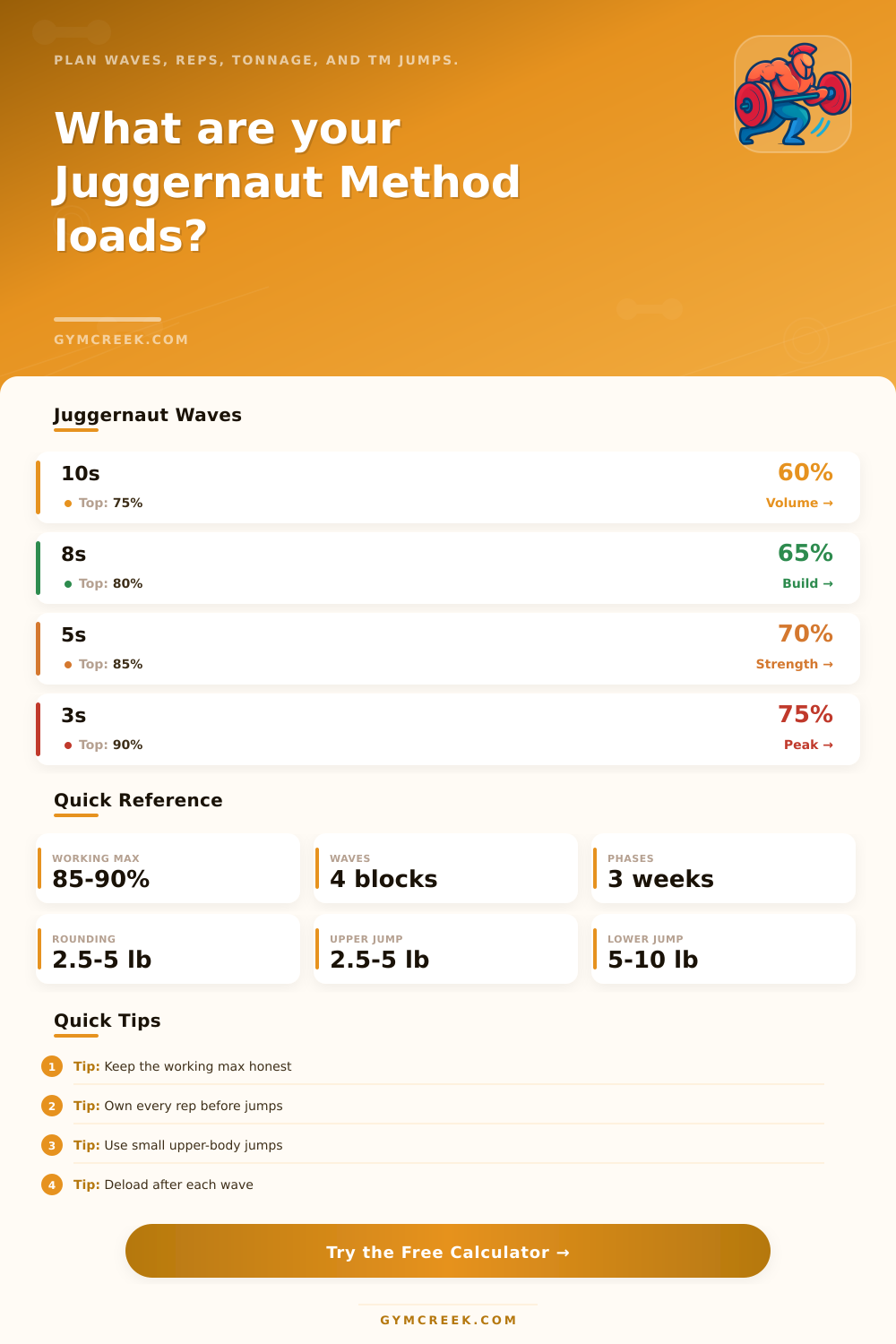
| 10s | 60-67.5% | 75% x 10+ | Volume base |
| 8s | 65-72.5% | 80% x 8+ | Hypertrophy |
| 5s | 70-77.5% | 85% x 5+ | Strength |
| 3s | 75-82.5% | 90% x 3+ | Peak strength |
| Phase | Intent | Rep Feel | Load Cue |
|---|---|---|---|
| Accumulation | Volume | Clean sets | Submax |
| Intensification | Practice | Hard sets | Moderate |
| Realization | AMRAP | Rep record | Top set |
| Deload | Recover | Easy speed | Light |
| Lift | Start WM | Rep Value | Jump Note |
|---|---|---|---|
| Squat | 85-90% | 5-10 lb | Clean depth |
| Bench | 85-90% | 2.5-5 lb | Paused reps |
| Deadlift | 82-90% | 5-10 lb | No hitching |
| Press | 80-88% | 2.5-5 lb | Small jumps |
| Formula | Input | Output | Purpose |
|---|---|---|---|
| Working max | 1RM x % | WM load | Set base |
| Epley | Load x reps | Est. 1RM | AMRAP read |
| Tonnage | Load x reps | Volume | Stress check |
| TM jump | Extra reps | New WM | Next wave |
💡Tips
The Juggernaut Method is a training program that use a system to manage an individual’s training progress with regard to weightlifting. Specifically, the Juggernaut Method use four-wave blocks to structure training for an individual, and each of these four-wave blocks build upon the previous block to create a cycle to follow. Instead of attempting to reach a new personal record with each training block, an individual begins with a submaximal training max. If an individual can complete extra repetition for the top set for an exercise within a block, those extra repetitions indicate that it is time to increase the training max for that individual.
The Juggernaut Method treats the working max for an individual differently than other training methods for lifting. For many training methods, the weight that an individual lift for training is very close to the individual’s one rep max. For these methods, the weights can feel very heavly for each training session. For the Juggernaut Method, an individual starts at a lower percentage of their one rep max, such as 85-90%.
How the Juggernaut Method Works
An individual must complete each repetition at this load before they earn the right to increase their working max for that training block. An individual can use a calculator to determine the base loads for each repetition for each set, the top set for a phase, and the projected working max for the next training block. Using this calculator will prevent an individual from having to mathematically calculate these values for each training block.
Each of the four waves within the training blocks for the Juggernaut Method have a specific purpose within that training block. The ten-rep wave aims to increase the work capacity for an individual. The eight-rep training load aims to encourage hypertrophy of the muscles being trained, but also use a higher repetition rate that allows for an individual to train with lower intensity.
The five-rep wave focuses upon increasing the strength of an individual’s muscles during training. Finally, the three-rep training load allows an individual to test how close to their one rep max an individual can train. Each of these four waves have four different phases to them.
The accumulation training weeks use higher volumes of sets with lower percentages of an individual’s working max, but the intensification weeks for each lift will use lower volumes of sets but higher loads for those sets. During the realization week for each lift, an individual will perform an all-out set for that exercise to count the number of clean repetitions that can be performed. This phase is the most important phase within each training block.
Finally, the deload week follows the realization week for each lift, and allows the body time to recover before the next training block begins. The inputs that are required for the calculator will ask for information regarding the individual’s experience level with weightlifting. For beginners, the jumps between each wave can be more pronounced within each training block than for an individual with more experience with lifting weights.
For individuals with more experience with lifting weights, the jumps between each wave need to be smaller to provide an honest assessment of the strength of that individual. Furthermore, another of the inputs for the calculator will be the quality of the effort for each set. If an individual can complete all of the repetitions for a set to exhaustion for a specific weight, they will earn a full jump in their working max for the lift.
However, if the individual can only complete grindy or reserved repetitions, there will be a smaller jump in their working max. An individual can program a five-pound adjustment factor into the calculator so that an individual doesnt have to memorize the jumps between each percentage within the training block. Another of the inputs for the calculator will be the body weight and age of the individual. The strength to body weight ratio can help to determine if the working max for an individual is realistic.
For example, an individual that weighs 200 lbs. Will have a different strength calculation than an individual that weighs 160 lbs. Furthermore, the calculator will also calculate the age of an individual into the tonnage for that individual because the body’s ability to recover from stress change as an individual ages.
An older individual will be able to tolerate less tonnage than a younger individual. Furthermore, the calculator will flag this information so that an individual knows that it may be necessary to lower the training volume or extend the deload phase for that individual. One of the specific outputs of the calculator will be tonnage for that individual.
Tonnage is the total amount of weight that an individual lift during a training phase. For phases with high tonnage for each lift, an individual will have increased work capacity, but will fatigue more quickly after completing those training sessions. For phases with less tonnage for each lift, an individual will be able to allow their muscles to rest and recover from the workload of that phase.
However, if an individual does not train with enough tonnage within a phase for too long, they may lose momentum in relation to the strength of their muscles. The calculator calculates tonnage by multiplying the number of sets and repetitions that an individual performs for each lift for that phase by the load that the individual will lift for that repetition. Furthermore, the calculator will also calculate the volume modifier for the individual, which can be set to standard, high volume, or low stress.
The Juggernaut Method is built with certain relationships between percentages and training goals for the lifts. For instance, the wave table for the Juggernaut Method indicates that as the number of repetitions for a lift declines for each wave, the percentage of the working max for that individual should increase. Furthermore, each phase within a training block has a specific purpose.
For instance, the accumulation phase for each lift increases the volume of the sets for that lift, but the realization phase allows for an individual to determine their actual strength. Each of these relationships are the same for all lifts, but the jumps between each wave can change according to the type of lift. For instance, the jumps for upper body lifts can be smaller than the jumps for the lower body lifts due to the differences in the recovery of the muscles for each of these body areas.
One of the most common mistakes for individuals that use the Juggernaut Method is to not account for the working max always increasing. Instead, each individual should use the jumps within the training block to determine when to increase the working max. For example, if the repetitions for an individual’s realization set for a lift are evened out, the calculator will indicate the amount of jumps for that lift will be minimal or 0. Yet, by repeating that training block for that lift, the individual may be able to find the extra repetition needed to justify the jump in their working max for that strength.
Furthermore, another error is to ignore the quality of the effort within the realization set. For many individuals, the quality of the effort within the realization set may be poor, and the individual may find that they are struggling with the jumps between each working max for their lifts. By allowing an individual to choose between selecting clean, grindy, or reserved efforts for the lifts will allow for the working max adjustments for each lift to be adjusted according to the quality of that individual’s effort within the training phase.
Furthermore, selecting the reserved efforts for the realization set will require a smaller jump for that individual’s working max. This will allow for the working max to be sustainable over multiple training blocks. Another of the critical components of the Juggernaut Method for strength and power development is the deload phase. After an individual completes the realization phase for a training block, their body is stressed out from the effort required to perform those sets for each lift.
During the deload week, the individual will perform the same lifts as during the other training phases, but at a lower load. This lower load allows their body to recover from the stress of the training block so that when they begin the next training block, their body will not be fatigued after performing each lift. If an individual skips the deload phase or if the deload phase is too intense for that individual, the Juggernaut Method may become a difficult grind for that individual.
The individual can program the loads for the deload phase into the calculator so that they are aware of the load at which each lift should be performed during that deload phase for that individual. In addition to the variables that are programmed into the calculator, there are other external variables that impact an individual’s performance according to their working max. For instance, if an individual is getting poor sleep or eats poorly, they will likely underperform according to their working max. Yet, the Juggernaut Method does not punish an individual for underperforming according to their working max for a training phase. Instead, the results of that underperformance will allow an individual to adjust the working max for the next training block.
Over time, these results can indicate to an individual if their working max is too aggressive for that individual and adjustments must be made to their training program. The Juggernaut Method works as a system due to the separation of training and testing for an individual. For most of each training block, an individual trains with submaximal loads for their lifts.
However, during one of the four training weeks within each training block, an individual will perform a set of repetitions with maximum effort for each lift for that block. The goal for that realization set is to earn enough repetitions with that max effort that the working max for that lift is justified for that individual. Furthermore, the creator has created the calculator to remove the need for an individual to perform the arithmetic for that calculation.
By allowing for small jumps in the working max for each lift, the gains in strength for those lifts will compound over time.