Judo Calorie Calculator
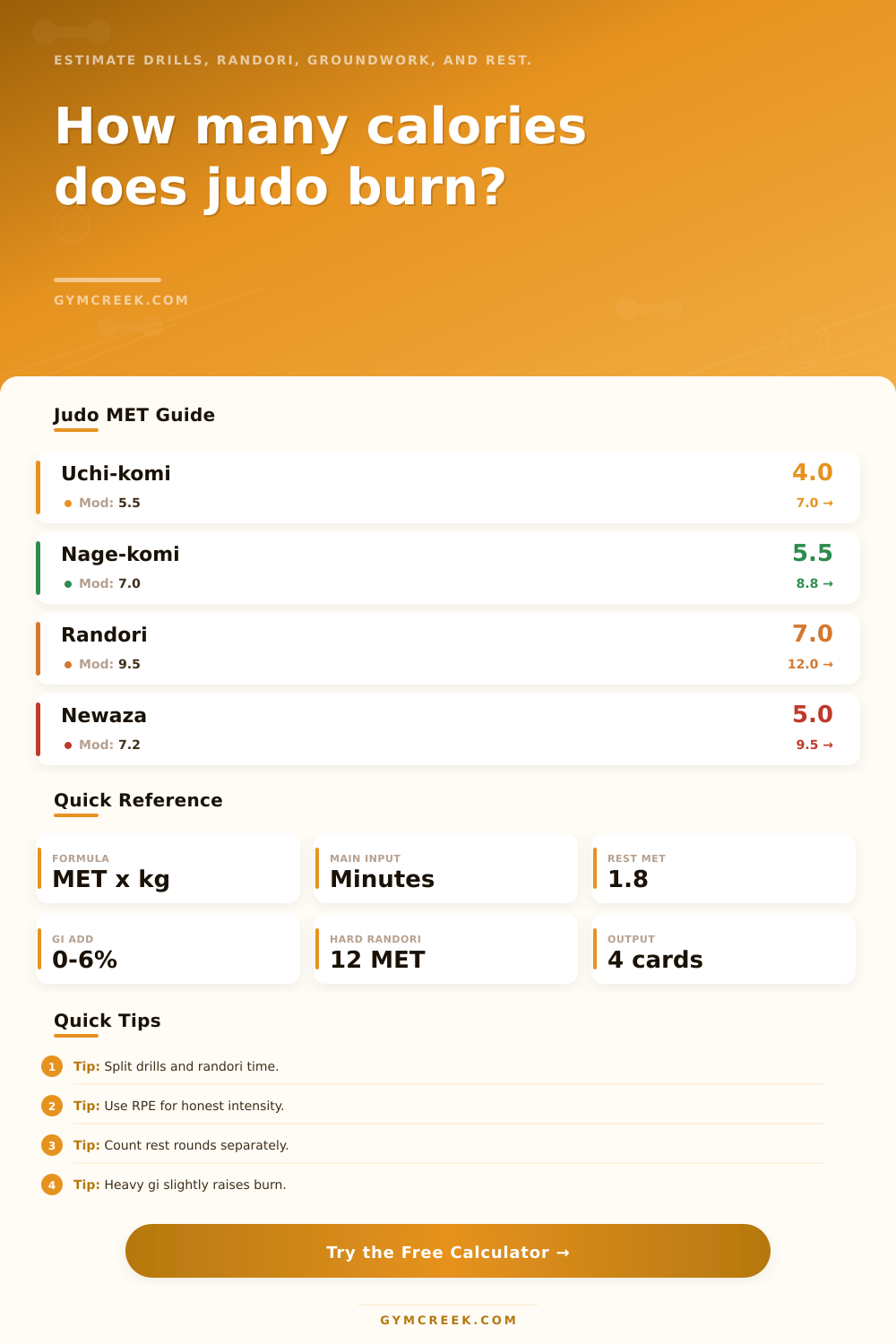
Estimate calories burned across uchi-komi, nage-komi, randori, newaza, warmups, and rest using weighted judo MET values.
⚡Judo Session Presets
Presets fill realistic practice structures; adjust the time blocks, intensity, and body weight for your own session.
📝Calculator Inputs
🧮Formula Cards
Your Judo Calorie Burn
Results combine time spent drilling, throwing, sparring, groundwork, and resting instead of treating the whole class as one intensity.
Calculation Breakdown
📊Judo Metrics Grid
📋Judo MET Reference
| Training Block | Light MET | Moderate MET | Hard MET |
|---|---|---|---|
| Warmup, ukemi, mobility | 3.5 | 4.5 | 5.5 |
| Uchi-komi and technical entries | 4.0 | 5.5 | 7.0 |
| Nage-komi and moving throws | 5.5 | 7.0 | 8.8 |
| Standing randori | 7.0 | 9.5 | 12.0 |
| Newaza sparring | 5.0 | 7.2 | 9.5 |
| Instruction, bowing, between-round rest | 1.5 | 1.8 | 2.2 |
🎯Common Session Patterns
| Session Type | Typical Time | Main Driver | Expected Burn |
|---|---|---|---|
| Beginner fundamentals | 45-60 min | Drills and rest | Low to moderate |
| Technical club class | 75-90 min | Uchi-komi volume | Moderate |
| Randori-heavy class | 60-90 min | Live rounds | High |
| Competition camp | 90-150 min | Throwing and rounds | Very high |
⚙Formula Reference
| Formula | Variables | Use In Calculator | Output |
|---|---|---|---|
| MET calorie equation | MET, kg, minutes | Each judo block | Session kcal |
| Weighted MET average | MET x minutes | Mixed class estimate | Average intensity |
| Mifflin-St Jeor | kg, cm, age, sex | Daily context | BMR estimate |
| Activity multiplier | BMR x activity | TDEE comparison | Daily share |
📈Intensity Adjustment Guide
| Input | Lower Setting | Higher Setting | Why It Matters |
|---|---|---|---|
| RPE | Technique pace | Near shiai pace | Scales the base MET estimate |
| Grip load | Loose drilling | Constant fighting | Raises forearm and trunk demand |
| Gi weight | No extra load | Heavy wet gi | Adds a small mass adjustment |
| Rest minutes | Short breaks | Long instruction | Lowers weighted session MET |
💡Calculator Tips
In reality, Judo looks like technical drilling, but intensity is actualy closer to high-intensity interval training. The spikes in intensity are missed by most fitness trackers; most rate session as moderate activity. It look easy on paper, but stepping onto mat to work on your throw mechanics results in you walking away sweaty and tired.
To get an idea of what’s going on with your body, you need to break down the hour. By entering your session structure into calculator (above), it does the math for you, there’s no need to guess on whether extra weight of your gi or the grueling grip fight will change your burn rate.
Why Judo Burns More Calories Than You Think
Ground grappling and static holds is significantly underestimated by most folks. Although newaza may appear slow, maintaining control over your opponent use up energy quickly. The tool accounts for how rest periods lower overall intensity. It categorizes sparring, throwing, and drilling using separate metabolic equivalents. Separating work from rest are what makes this estimate useful.
It might sound trivial, but all that added weight will eventually take it’s toll on calories. Adding four or five pounds to your body with a normal judogi will make every move, every lifting activity more expensive in terms of energy output. Because there’s no escape from that added weight you’ll want to plug it into the calculator (there’s a spot for “gear weight”). A wet gi will add even more weight; don’t forget this variable when making your estimate.
It’s subjective, so subjectivity matters: It’s called the Rate of Perceived Exertion, where you rate how hard you think you worked out. If you’re thinking “Man, I’m huffing and puffing,” or “My forearms are killing me”, then you was burning some anaerobic calories. Grip fighting forces you to constantly engage core muscles and raise the demand on your upper body. It makes a technical exchange turn into strength test. The calculator include that load; a class devoted to grip dominance show a higher burn than one drilling footwork with no resistance.
Of course, since amount of calories burned during an activity depends on how much body weight has to be moved, this is the biggest factor in any calorie estimate. If two judokas are throwing at the same speed, heavier one will burn more calories. It’s basic physics, but that doesn’t imply the lighter judoka isn’t working just as hard. Your weight and height are used to set a base metabolic rate with this tool, on which activity is layered. That way you can get some context for where session falls within your overall energy needs for the day.
“But don’t get hung up on the specifics, it’s an estimation, not a doctor’s note. It’s more about trends. So let’s say you do as much training but you’re burning fewer calories; maybe you’re underfueling or overtraining. The thing is that now you’ve got some numbers to talk about with your coach. Now you see what happens when you compete vs. When you’re technically maintaining.”
The post is titled How Many Calories Should I Eat? appeared first on Breaking Muscle USA.
How many calories you burn is not the only measure of how hard you’re working. Judo is a sport that are both mentally and physically challenging. It’s equally important to understand structure of your training. If you know why something’s so intense, you can train smarter, rest better, and get most value out of all that work. Numbers teach you to read the story written in sweat across the mat, and what to expect from drills versus sparring.