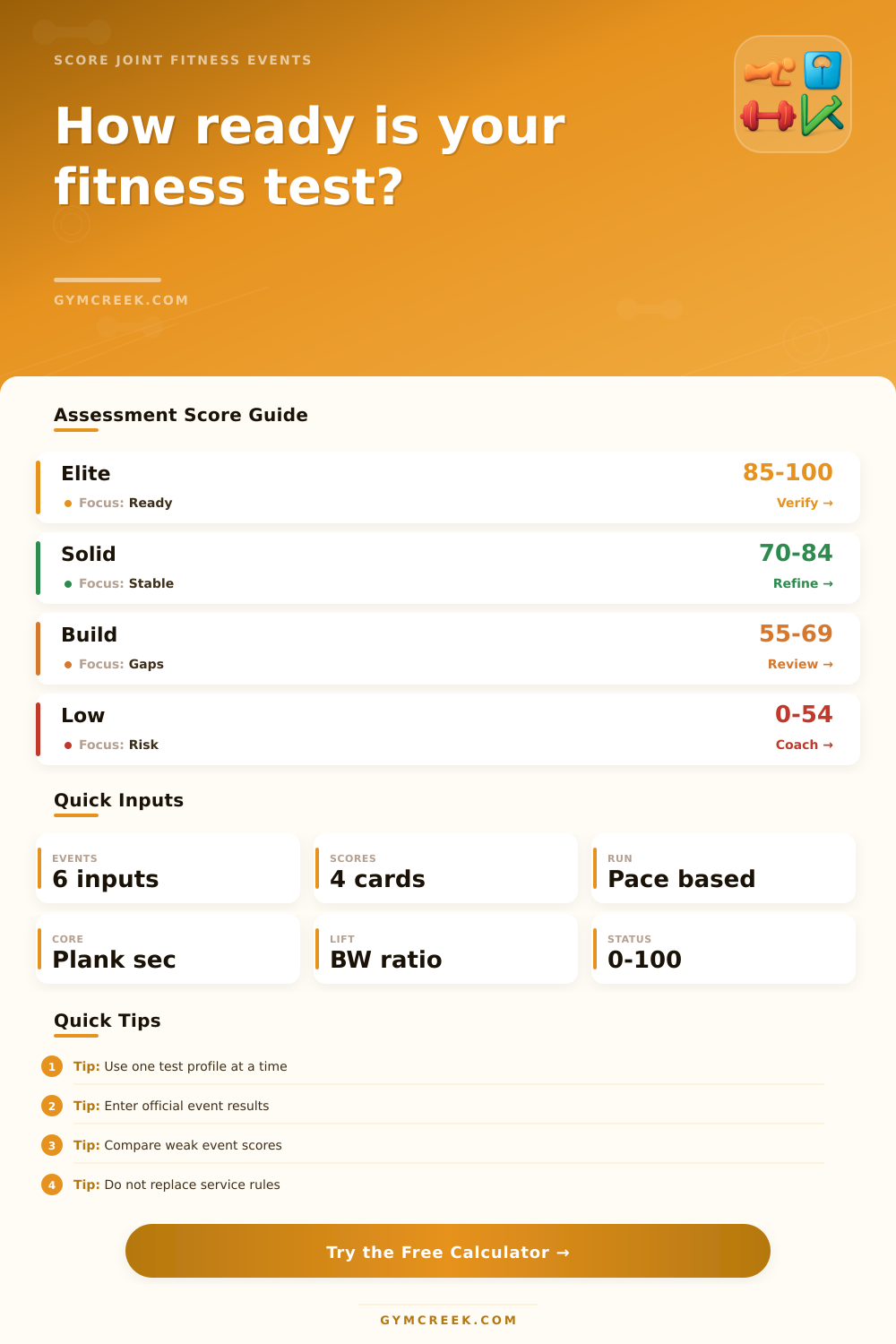
Joint Military Fitness Assessment Calculator
Score common military-style fitness events across strength, core, cardio, and tactical capacity using one consistent, branch-inspired planning model.
📌Assessment Presets
Presets are planning profiles, not official scoring tables. Change any field to match the event results you recorded.
⚙Calculator Inputs
Joint fitness assessment snapshot
Enter event results to estimate composite readiness, weak links, and supporting fitness metrics.
📊Fitness Metrics Grid
📑Reference Tables
| Profile | Strength | Core | Cardio / Tactical |
|---|---|---|---|
| Joint balanced | 25% | 20% | 35% / 20% |
| Army-style | 35% | 15% | 25% / 25% |
| Navy-style | 20% | 25% | 45% / 10% |
| Tactical field | 30% | 15% | 20% / 35% |
| Band | Composite | Meaning | Review point |
|---|---|---|---|
| Mission-ready | 85-100 | Strong across events | Verify with official table |
| Operational | 70-84 | Usable balanced result | Find the lowest event |
| Developing | 55-69 | Several gaps remain | Retest event accuracy |
| Needs review | 0-54 | High failure risk | Use qualified guidance |
| Event | What it checks | Calculator input | Scoring direction |
|---|---|---|---|
| Push-up or upper reps | Repeat strength | Reps completed | Higher is better |
| Plank or core hold | Trunk endurance | Seconds held | Higher is better |
| Timed run | Aerobic capacity | Distance and time | Lower pace is better |
| Shuttle or carry | Field movement | Seconds and load | Lower time, more load |
| Formula | Variables | Output | Why it helps |
|---|---|---|---|
| Mifflin-St Jeor | Age, sex, height, weight | BMR | Energy context |
| Cooper-style VO2 | Run pace | VO2 estimate | Cardio comparison |
| Relative strength | Load/body weight | Lift ratio | Size-adjusted strength |
| Weighted composite | Event scores | 0-100 score | Joint readiness view |
💡Tips
The thing is most folks think of fitness tests as just pass and fail exams. They fail to realize that there is a lot more to being ready for duty than simply running fast enough. In world of actual work, you have to be able to lift heavy things with your upper body as well. That’s why it’s important not to get hung up on getting the best possible score on an event while neglecting the other areas of your physical performance. If there is weaknesses, you’ll want to know about them so that they don’t come back to haunt you out on the job or in the heat of battle.
Instead of simply presenting you with a single raw score, the above calculator will help break your performance down into individual categories so you can visualize it more easier. It accepts scores from deadlifts and tactical movement. The calculator uses scores from carries or shuttle runs, a timed run, planks, and push-ups to measure different parts of your physical fitness. Push-ups test the muscular endurance of your upper body. The plank tests how well your core stabilizes itself under a load over time. The run gives you an estimate of your cardiovascular capacity, typically measured using VO2 max calculations which are highly correlated to both stamina and long term health. Put them together and you’ll have a better sense of how much actual operational capability you possess without having to rely on just pure speed or raw power.
Why You Need More Than Just Speed
People fall into another trap by only testing the areas they excel at. For example, maybe you suck at cardio but are strong as heck. So you skip over the run time because it’s not comfortabley. The beauty of this tool is that it weighs things different based off which profile you choose. The Marine Corps or Navy profiles lean heavier into endurance and core stability, whereas an Army-style profile prioritizes strength and power throws. Navy tends to be similar.
That’s important, because there are certain physical attributes required for different roles. Special operations wants you maxed out in all categories. An admin job may have lower thresholds for raw strength but need baseline levels of health. Your selection of the right profile will ensure you’re measuring where it really matter for your specific circumstances.
Beyond personal considerations, there is environmental factors that matter more than we realize. Something that tests well in perfect indoor conditions might not work the same way when you are at a high altitude, carrying all your gear, and dealing with heat. That’s why they account for those things in their assessment model. Fatigue and heat compound quickly. So an elite-looking run time in a nice, air conditioned gym could very well mean failure out in real world while you’re humping gear around in the heat. Environment adjustment provides a bit of realism to the scoring and helps keep you honest about your limits when things get stressful outside of comfort zone.
The composite score is a good place to start, but getting into the breakdowns will show you what to train and where to spend the energy. For example, if you have a decent strength number, but slow tactical movement time, you’re probably lacking aerobic power as opposed to muscle force. Likewise, even though you might be able to run your face off, if your deadlift is weak compared to your bodyweight then it’s time to pick up some heavier weights. These are the places that you can target your weaknesses and improve accordingly without wasting your time doing generic exercises because you know you’re strong enough there anyway.
Reference tables comes with the tool to help put things into groups so you know if something falls into an at risk or elite level. It all boils down to consistency and staying durable over time, versus performing at your best one day. You should of have a body that’s strong enough to withstand whatever life throws at it, while still maintaining a well-rounded look in every area. This multi-domain approach with this calculator will help you stop running after silly numbers and start gaining real-world resilience. It’ll also transform testing from an anxious effort to a tangible guide toward becoming stronger and more capable. Because the point isn’t passing the test; it’s being prepared for what happens next.