Jogging Calorie Calculator
Estimate jogging calories from body size, pace, duration or distance, incline, terrain, and weekly frequency using ACSM running energy equations with practical net-calorie context.
📌Jogging Presets
Presets load common jogging sessions. Change any field afterward to model your route, treadmill, or training week.
⚙Calculator Inputs
Jogging calorie snapshot
Enter your route, pace, body weight, and weekly frequency to estimate jogging calories.
📊Fitness Metrics Grid
📑Reference Tables
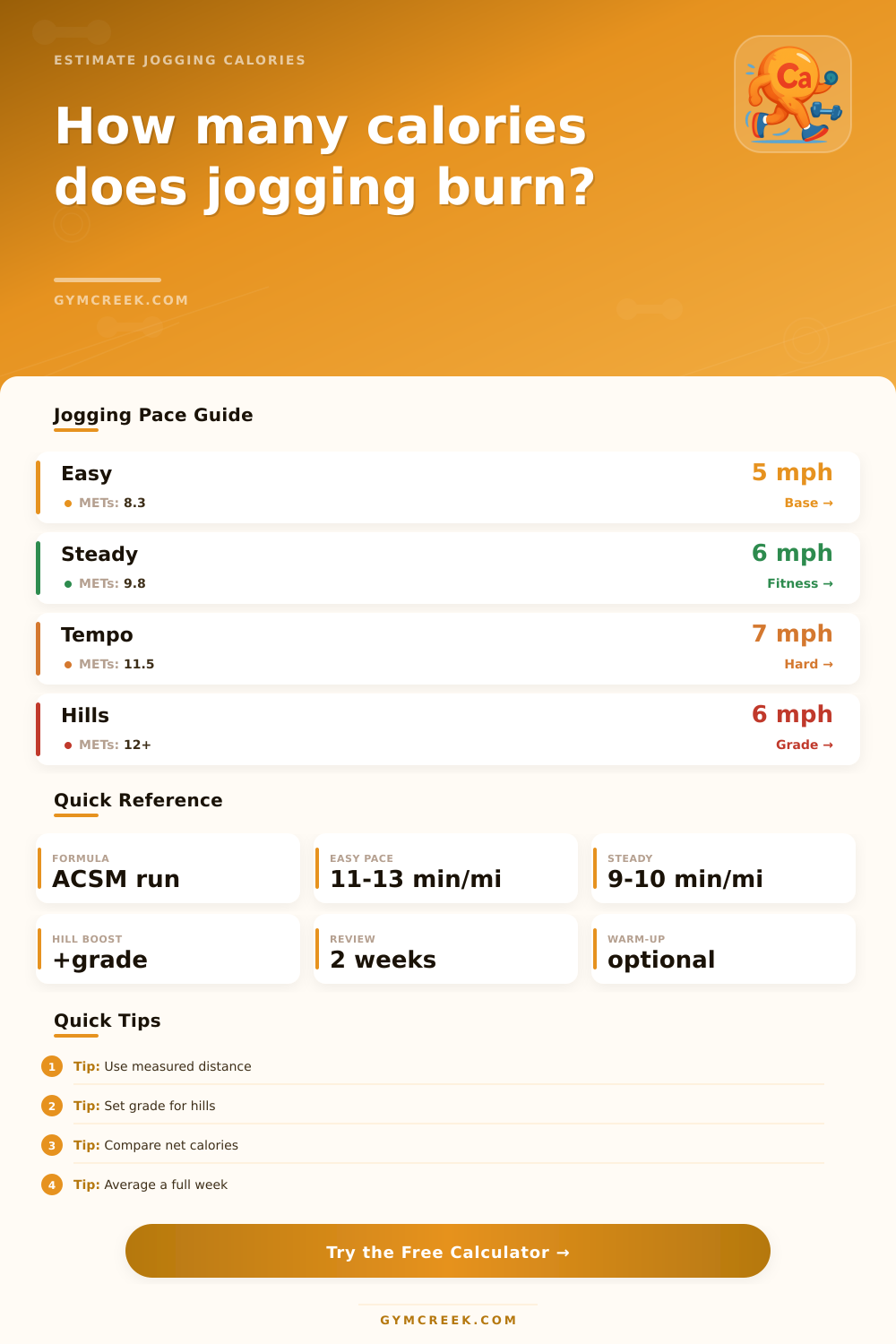
| Pace | Speed | Typical METs | Best use |
|---|---|---|---|
| 13:00-12:00 min/mile | 4.6-5.0 mph | 7.8-8.5 | Beginner jogging or easy return |
| 11:59-10:00 min/mile | 5.0-6.0 mph | 8.5-10.0 | Conversational aerobic jogging |
| 9:59-8:30 min/mile | 6.0-7.1 mph | 10.0-12.0 | Steady fitness running |
| 8:29-7:00 min/mile | 7.1-8.6 mph | 12.0-14.5 | Faster aerobic or tempo work |
| Hill jogging | Any speed | Grade driven | Treadmill incline or hilly route |
| Surface | Multiplier | Why it changes burn | Use when |
|---|---|---|---|
| Road or track | 1.00 | Stable footing and predictable pace | Flat pavement, track, firm path |
| Treadmill belt | 1.03 | Small setting and stride differences | Indoor run with known grade |
| Packed gravel | 1.06 | Minor surface loss | Firm park paths or compact trails |
| Rolling trail | 1.10 | Turns, uneven ground, small climbs | Trail jogging without technical footing |
| Soft sand or grass | 1.14 | Higher ground reaction loss | Soft fields, beach jogs, loose surfaces |
| Step | Formula or rule | Inputs | Output |
|---|---|---|---|
| Running oxygen cost | VO2 = 0.2 x speed + 0.9 x speed x grade + 3.5 | m/min and decimal grade | ml/kg/min |
| MET estimate | VO2 / 3.5 | Calculated VO2 | Average METs |
| Gross calories | VO2 x kg x minutes / 1000 x 5 | Body mass and duration | Exercise kcal |
| Resting subtraction | 1 MET x kg x hours | Total session time | Net kcal context |
| Weekly burn | Session calories x runs per week | Frequency | Weekly jogging kcal |
| Scenario | Typical setup | What to watch | Calculator setting |
|---|---|---|---|
| Fat loss support | 30-45 min, 3-5 times weekly | Appetite compensation | Use net and weekly average |
| Endurance base | Easy pace, repeatable volume | Weekly distance jumps | Keep effort easy |
| Treadmill incline | 1-6% grade with stable pace | Incline drives oxygen cost | Set grade carefully |
| Trail jogging | Slower pace, uneven surface | Terrain cost and GPS errors | Use trail multiplier |
| Recovery jog | Short, relaxed, low grade | Do not chase calorie burn | Very easy modifier |
💡Tips
The way most of us understand it, burning calories is a matter of basic arithmetic: Distance + Speed = Effort. So we’re frustrated when our odometer show mileage but the scale remains stagnant.
But here’s the truth: Your body isn’t a machine whose output can be easily calculated by its inputs; it’s a changing biological system responding to incline, terrain and (relative to your own resting base) how hard you’re pushing yourself. Getting familiar with these variables is far more important then tracking every single step or obsessing over exact numbers.
Why Calories Are More Than Just Numbers
And so it begins: body weight. It is the base of every good guess. Because your body is heavy; moving it around take energy. And then there’s sex (because men and women has different metabolisms) and age (metabolism shifts over time). The latter two aren’t merely demographic data, but rather bodily factors that alter the number of calories you expend just by being alive.
Add that figure with another, say, a jog, and it becomes easier to understand why you don’t only burn calories from exercise. You’re placing “exercise cost” atop an already-active metabolism. That pace is the driving force behind the cost. When I’m taking an easy stroll, my heart rate is low, my breathing is even, and it feels relaxed, like a slow jog. Speed it up and there’s a point at which you’ll begin to run up oxygen debt rapidly.
Those physiological changes are baked into the equations used to calculate energy expenditure, the same ones the calculator above uses to do the work for you. It’s not making guesses based on averages. It’s calculating exactly how much oxygen you consume depending on your weight and speed. And that precision help separate a casual stroll from a serious training block.
Then there’s terrain, which most people overlook as an additional factor. Running on pavement is effective because the ground gives back energy with every stride. Try it on dirt paths and uneven terrain; suddenly, you’re losing that return on investment. When your feet land on loose gravel, you have to absorb the impact, or when they hit something soft like mud, your legs must fight to maintain balance on changing ground. To avoid short-changing yourself, the tool has multipliers for those scenarios. You might log the same distance, say, five miles; but a five-mile run on a treadmill will feel different than five miles on a hilly trail.
Then it all changes with incline. When you go uphill, gravity is fighting you head-on with your calves and glutes. Without needing to run faster, that added resistance fires up your calorie-burn big-time. A mere 2-3 percent incline (which might seem like nothing) will double your metabolism vs. Running on flat ground. Ever notice how running sessions on the treadmill always seem to fly by? The answer: You’re not getting as far, but you’re torching more calories in every minute. If you’re short on time, this is a sweet deal.
But be patient, you’ll need time to get rewards. Weekly frequency matter just as much as how intense each individual session is. It feels great to burn 1,000 calories during an epic run, but what if it takes three days to recover? Breaking up those minutes into several smaller runs maintains a high metabolism throughout the week while preventing your willpower and your poor joints from giving out. Long term habits are built on consistency, not intensity. By projecting your weekly totals, the tool visualizes this concept and shows how small changes daily add up over time.
Gross calories are less informative than their net counterparts… Net calories take into account calories that you’d have used if only resting on the couch. This eliminates any potential for double counting and makes your expectation more realistic. When you’re trying to lose weight, it’s all about burning off net calories so you can create an actual caloric deficit instead of simply moving more. The difference might seem small, but it’ll change how you plan your meals and recovery days around your workouts.
The last obstacle is appetite compensation. Most runners are aware of their appetite for food rising after exercise, where they end up “eating back” half or more of calories expended. The calculator lets you account for this psychological fact so you’re not setting yourself up for failure. Jog five miles, then reward yourself by eating a large post-run meal? You lose your net gain. Half the battle is knowing about this trap.
Running is perhaps the simplest workout to do: all you need is a pair of shoes and you can fit it in anywhere, that’s why jogging is still one of the most approachable exercises out there. It’s about more than just calculating calorie burn or achieving a certain speed; it’s about understanding how those variables work under different conditions. When you learn how your body responds to varying conditions, like terrain, weight, consistency, the mystery goes away. Instead of guessing what each mile represents, you begin to run with purpose. And that sense of knowing makes even an ordinary jog more than just something to check off your list.