Isometric Strength Calculator
Score a static strength test from peak force, hold duration, bodyweight, joint angle, limb position, RPE, test style, and training goal.
📌Presets
Each preset loads a complete isometric test profile with a specific force source, position, angle, and goal.
⚙Calculator
Isometric test snapshot
Enter your test details to score strength, hold quality, and angle-specific readiness.
📊Metrics Grid
📑Reference Tables
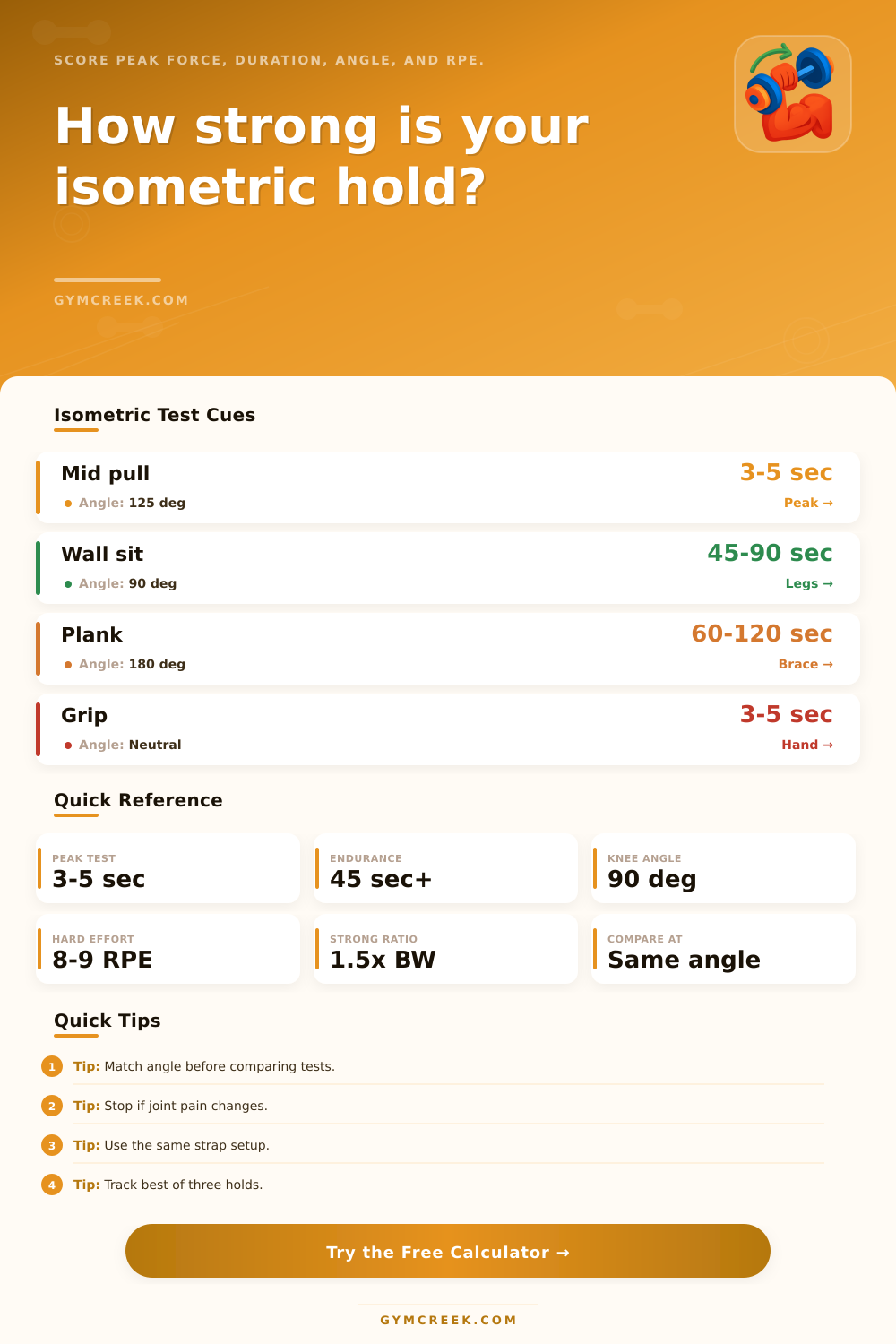
| Test | Primary Input | Typical Hold | Useful Angle |
|---|---|---|---|
| Mid-thigh pull | Peak force | 3-5 sec | 120-130 deg |
| Wall sit | Duration | 45-90 sec | 80-100 deg |
| Plank brace | Duration | 60-120 sec | Straight line |
| Grip squeeze | Peak force | 3-5 sec | Neutral wrist |
| Peak Index | Bodyweight Ratio | Interpretation | Next Check |
|---|---|---|---|
| Developing | Under 1.0x | Build base force | Technique match |
| Solid | 1.0-1.49x | Useful strength | Add consistency |
| Strong | 1.5-1.99x | High output | Track fatigue |
| Elite | 2.0x plus | Very high output | Verify setup |
| Goal | Best Signal | RPE Range | Result Focus |
|---|---|---|---|
| Max strength | Peak force | 9-10 | Force index |
| Return screen | Symmetry setup | 5-7 | Control score |
| Endurance | Hold time | 7-9 | Quality score |
| Sport check | Angle match | 8-10 | Readiness |
| Position | Modifier | Why It Matters | Compare With |
|---|---|---|---|
| Short lever | 0.95x | Less torque | Same lever |
| Long lever | 1.08x | More torque | Same angle |
| Single limb | 1.12x | Higher demand | Other side |
| Supported | 0.9x | Less control | Same support |
💡Tips
Force isn’t motion; it’s strength. When you’re tested in isometrics, you apply pressure against something not moving. Outcome is based off both the quality of the force (effort) and the quantity (amount). Knowing the difference lets you have a good idea about what test will show and thus get definitive information with one test.
The variables that alter value of our tests are shown by entries into the calculator. Our peak force tell us how hard we can go. But our duration tells us if we can keep going. Joint angle matter because strength is not uniform through a range of motion. While raw force may be the same between a mid-thigh pull at 125 degrees compared to a wall sit at 90 degrees, our joint angle are different.
How the Calculator Works
Setup stability adjust for leverage needs. A single leg hold have a different meaning than a supported two hand hold. Limb position adjusts for leverage demand too. An unsupported single-leg hold has a different meaning than a supported one with hands on a table. Effort rating assures that the test represent real-world capacity. If I scored a nine or ten I’m giving it everything I’ve got instead of just holding back.
These are the inputs, which become useful outputs. Relative strength is bodyweight ratio, based on no need to compare results with anyone else’s absolute numbers. Hold quality combine setup stability, angle match, and duration. This shows how well you maintained control of position or whether it was a struggle just to hold still. Goal readiness combine the test against your goals, like endurance versus maximum force, so you can see if score lines up with what you need.
None of these scores replaces judgement; however, they eliminate the guessing that always happens when you’re looking at only one variable. Chasing high numbers is default way most of us test our isometrics. That works up to the point where max number fails to improve anymore yet other metrics gets worse. Often, the first metric to get better will be duration at the same force level. Next is angle consistency. Then comes peak force later in the process.
The calculator show those layers rather than hoping you’ll notice them after the fact. It also comes with reference tables that put your result in context. What’s a good target? What is a test normaly measuring? Without these, you might look at every long duration and treat it as an endurance win and every hold as a strength test. Without that frame, even comparing different holds can be meaningless.
Re-testing is where this method shines. With the same warm up routine, strap height, and joint angle, you go from a snapshot to a trend. A change in force number may be preceded by small changes in angle or quality of hold. That’s important when deciding if you are getting stronger in a position or simply becoming more familiar with it.
Isometric strength is a balance of control and output. The calculator doesn’t substitute for that dynamic but offers clear language for both parties involved. You should of used this sooner. It would of helped to know how much weight we can absorbs. Its naturaly easy to mistake duration for force.