Isometric Hold Percentage Calculator
Estimate how demanding an isometric hold is from max strength, hold duration, bodyweight share, joint angle, and RPE.
📌Presets
Presets load realistic hold positions, max hold times, load assumptions, and bodyweight contribution estimates.
⚙Calculator
Isometric hold snapshot
Enter your hold load, max hold, and target duration to calculate the percentage.
📊Fitness Metrics Comparison
📑Reference Tables
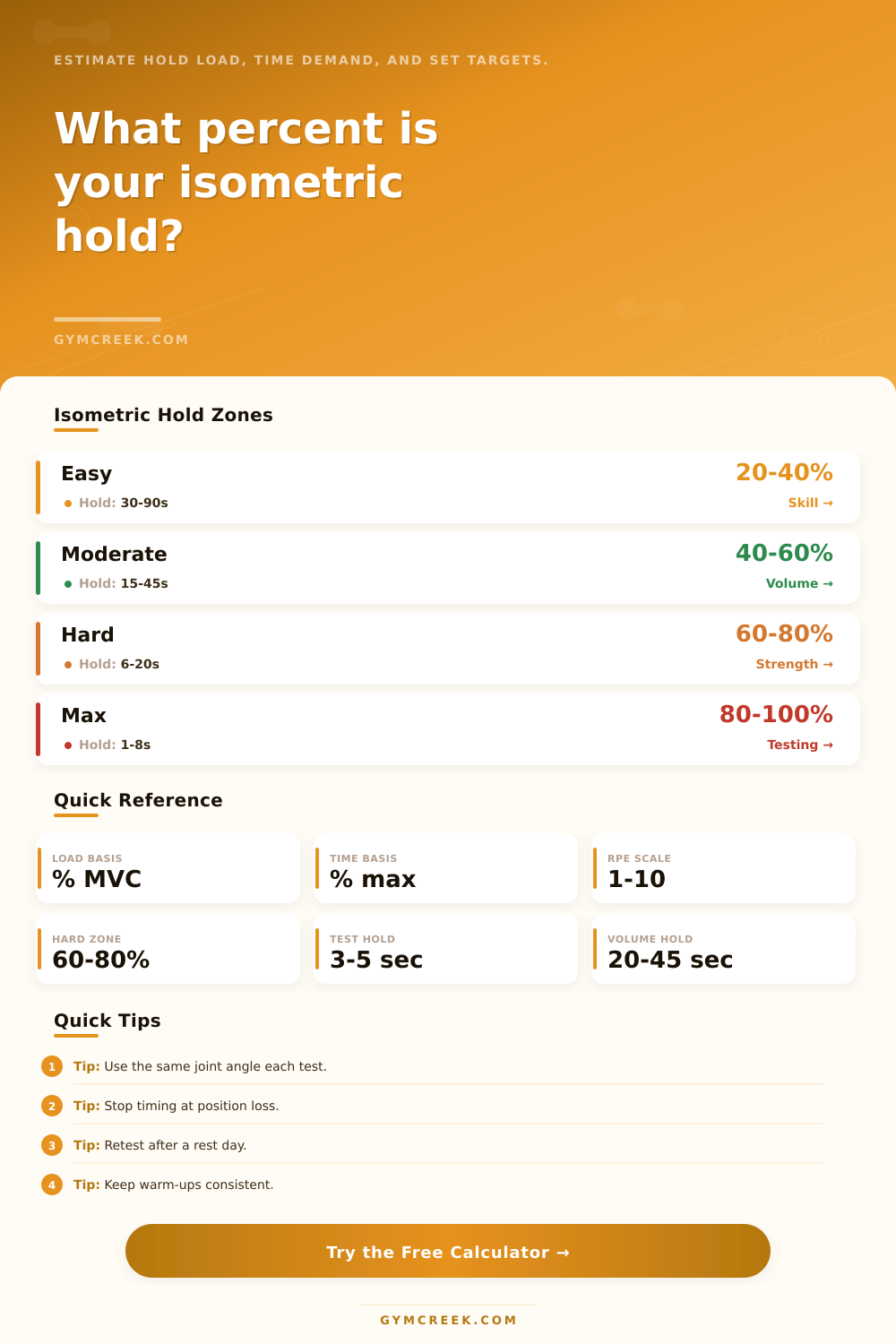
| Intensity Zone | % MVC | Typical Hold | Best Use |
|---|---|---|---|
| Skill and activation | 20-40% | 30-90 sec | Position practice, breathing control, low fatigue technique work. |
| Repeatable volume | 40-60% | 15-45 sec | Multiple sets where the same hold quality can be repeated. |
| Strength emphasis | 60-80% | 6-20 sec | High tension holds without drifting into all-out testing. |
| Max testing | 80-100% | 1-8 sec | Brief efforts using full rest and a consistent joint angle. |
| Hold Pattern | Bodyweight Share | Duration Clue | Measurement Note |
|---|---|---|---|
| Front plank | 55-70% | 45-180 sec | Count only time with ribs, hips, and neck controlled. |
| Wall sit | 45-65% | 30-120 sec | Use the same knee angle and foot distance each test. |
| Dead hang | 90-110% | 10-90 sec | Include added load, vest load, or assistance changes. |
| Loaded carry hold | 20-50% | 15-60 sec | Use total hand load plus relevant bodyweight contribution. |
| Split squat hold | 55-85% | 10-45 sec | Keep front shin and torso angle consistent. |
| Position Factor | Multiplier | Why It Matters | Example |
|---|---|---|---|
| Mid-range | 1.00 | Neutral reference point for most holds. | Half squat hold |
| Deep or stretched | 1.08 | Often feels harder at the same measured load. | Deep split squat |
| Lockout or support | 0.92 | Usually more mechanically favorable. | Ring support |
| Long lever | 1.12 | More torque from the same body mass. | Long plank |
| Short lever | 0.88 | Less torque and easier repeatability. | Knee plank |
| Formula | Calculation | Inputs Used | Interpretation |
|---|---|---|---|
| Effective hold load | External load + body weight share | Body weight, external load, contribution % | Approximates total load held in the position. |
| MVC load share | Effective load / max isometric load | Effective load, max load | Percent of your position-specific max strength. |
| Hold time share | Planned hold / best max hold | Target seconds, max seconds | Percent of your known endurance in that position. |
| Stress score | %MVC x square root(time share) x factors | Load, time, RPE, angle | Combines load and duration into one training demand. |
| Repeatable target | Max hold x readiness factor | Max hold, stress, rest, training age | Suggests a hold length that may repeat across sets. |
💡Tips
With isometric training, there’s this specific kind of tension generated when you create force against something without moving, which isn’t copied in dynamic lifting. When you watch someone doing a wall sit and think it’s just their body under the pull of gravity, the truth is that your muscle fiber are actively creating tension. The problem has always been how to quantify such tension, as there really isn’t a defined failure point in a hold. Only when your form fails, or your grip fails. Most people gets hung up on that lack of clarity. Instead of measuring the tension they simply guess at it, and thus do workouts that either don’t bring enough stimulus to cause adaptation or is so brutal they verge on being self-harmful.
To save you the guesswork when it comes to conversions and coefficients, all you have to do is input your estimated max hold time, external load and bodyweight into the calculator above, and let it handle the math. It does this by turning your physical effort into a percentage of your maximum voluntary contraction; a metric that removes ego from the equation and leaves nothing but raw data. Why does this matter? Holding eighty percent of your max for ten seconds is physiologically different then holding fifty percent of your max for forty seconds, despite how painful either one might feel at the time. The former stress peak force production and the nervous system, while the latter develops metabolic endurance and work capacity. Knowing this distinction lets you periodize your training instead of simply surviving it.
Stop Guessing: Use Data to Train Smarter
And then there’s joint angle, which most lifters forget to account for but has a huge impact on how difficult a movement is perceived to be. Even if I haven’t increased the load, a pause squat at parallel feels like it’s infinity times more difficult compared to a lockout hold at the top of the same rep. Why? The lever arms change, which shifts the mechanical demand onto certain connective tissues and muscle group. This reference table on the page breaks down holds into zones based off both duration and effort (i.e., how hard is it and how long will you hold it?) so you know what you’re training: skill or grinding for strength.
If you find yourself in the sixty to eighty percent zone, you’re probably training pure strength. You need short sets and long rest periods to let your nervous system fully reset. This means trying to do high volume in this range is junk volume and you’ll train nothing but fatigue. Then there’s your own bodyweight to account for. Many holds (front plank and dead hang among them) aren’t so much about moving any sort of external object as they are wrestling with yourself. So when your bodyweight changes, the effective intensity of each hold change along with it. This is another reason steady measurement conditions is necessary if you’re trying to track your results.
Test out your max hold on a rested morning, and then try to match it following a heavy leg day, the numbers will lie to you. To account for this, the tool lets you specify your rest period and training age, which adjusts the target based off what’s repeatable for you. For example, perhaps thirty seconds is already at your limit as a novice, whereas an advanced athlete can manage forty-five seconds without dropping off. Again, it sounds small but it makes all the difference for making gains.
Using these variables, the calculator generates a stress score, which is a number that represents the cumulative demands of a given session. This gives you an objective way to see how much work you are putting your body through, helping you avoid overtraining. Sometimes we think we’ve just killed it during a workout when in fact it didn’t really “stress” us out at all (i.e., low stress score). Other times, you’ll have crappy form and a high score, signaling you’re well into the red zone and building on shaky ground. Ideally, you don’t want to be chasing sky-high numbers every single day. But you do want to make sure the overall load is manageable across weeks and months.
Isometrics are all about control under pressure. Your body learns to find stability and produce force even as it tries to cave in. Moving towards precise percentages and away from vague ideas of effort turns a static hold into a dynamic growth tool. You stop guessing and start building. When you pull yourself up onto those rings or drop into that wall sit again, you’ll know actualy how much of your reserve you’re pulling from. It’s not just holding on longer but holding with purpose. That mental shift is where the real work happens. A simple pause becomes a powerful way to create change.