Interval Work Rest Calculator
Plan interval work, rest, rounds, sets, density, heart-rate recovery, estimated energy cost, and session load from body size, goal, effort, and timing variables.
◎Interval Presets
Presets load realistic interval structures for strength, conditioning, running, rowing, boxing, and court-sport work. Edit any field and recalculate.
⚙Calculator Inputs
Interval work-rest plan
Enter interval details to calculate ratio, density, total time, and load.
▣Metrics Grid
▤Reference Tables
| Training target | Typical work | Rest ratio | Quality cue |
|---|---|---|---|
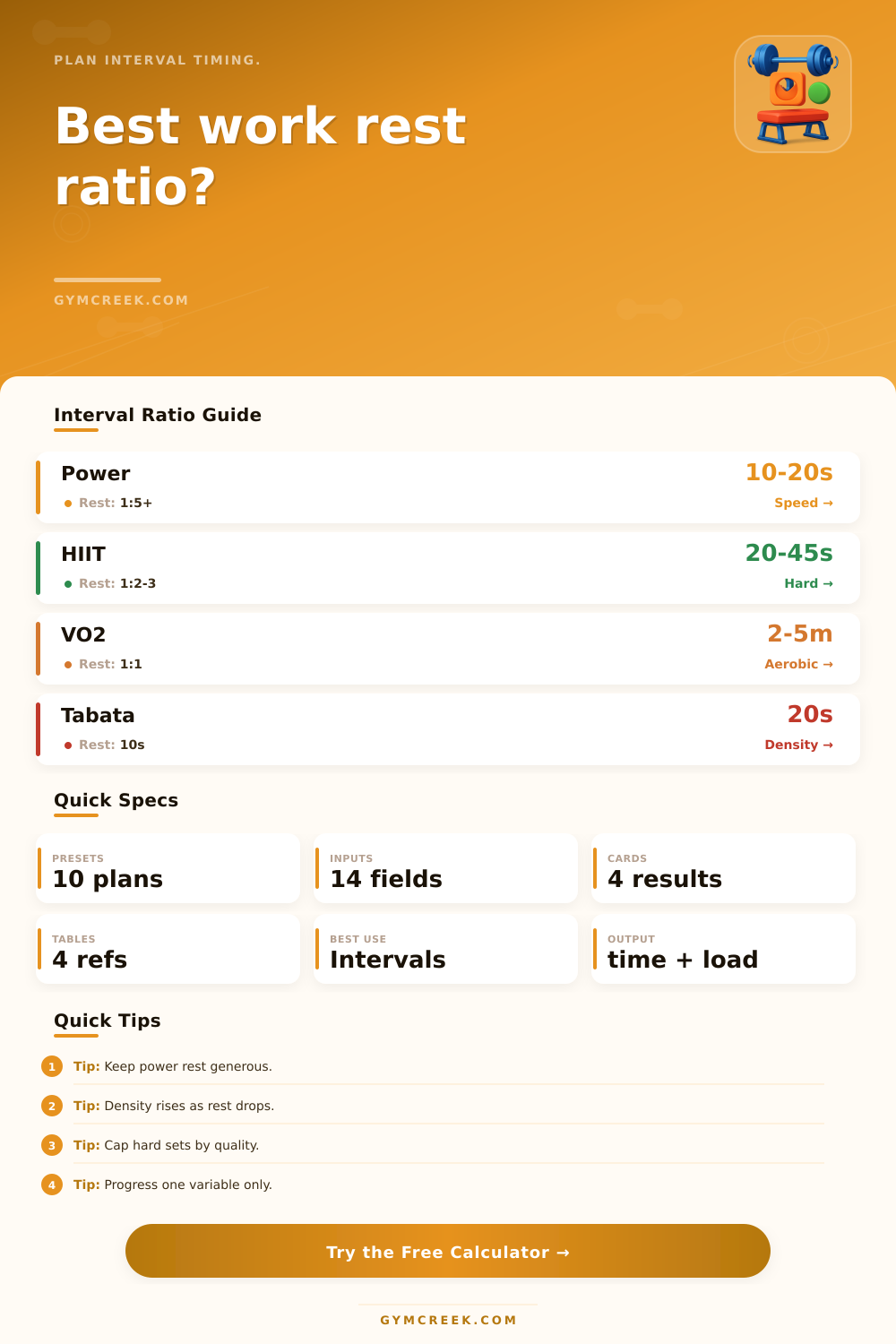
| Alactic power | 5 to 15 seconds | 1:5 to 1:12 | Speed stays crisp |
| Speed endurance | 15 to 45 seconds | 1:3 to 1:6 | Power fades slowly |
| HIIT conditioning | 20 to 90 seconds | 1:1 to 1:3 | Breathing is hard but repeatable |
| Threshold intervals | 2 to 8 minutes | 1:0.5 to 1:1 | Controlled burn, not sprinting |
| Density | Meaning | Best use | Watch |
|---|---|---|---|
| Under 20% | Very low density | Power and max speed | Too easy for conditioning |
| 20% to 35% | Moderate density | Repeat sprint quality | Rest may drift long |
| 35% to 55% | High density | HIIT and circuits | Technique breakdown |
| Over 55% | Very high density | Short finishers | Recovery cost rises quickly |
| Scenario | Setup example | Main output | Progression |
|---|---|---|---|
| Tabata style | 20 on, 10 off, 8 rounds | 67% density | Add quality before volume |
| Sprint repeats | 10 on, 90 off, 8 rounds | 10% density | Shorten rest only if speed holds |
| Boxing rounds | 180 on, 60 off | 75% density | Add rounds before intensity |
| VO2 repeats | 3 min on, 3 min off | 50% density | Add reps or slight pace |
| Output | Formula | Inputs | Purpose |
|---|---|---|---|
| Ratio | Rest / work | seconds | Recovery profile |
| Density | Work / interval time | work, rest | Session pressure |
| Calories | MET x kg x hours | mode, effort | Energy context |
| BMR | Mifflin-St Jeor | kg, cm, age | Body context |
💡Interval Planning Tips
The Air Bike sits before you; a stopwatch hangs around your neck. You have a vague idea of getting fitter. You have a vague idea of getting fitter. You’ll pedal as fast as you can for half a minute, then you’ll rest. And here’s the thing: this rest period is everything. It makes or breaks the effectiveness of exercise. More than nearly anything else, the duration of the break, what you do after the work interval. Will affect your body’s ability to grow stronger from the experience.
Active variables includes how much you rest, which determines what energy system your body uses. For example, if you are trying to train for pure power or speed, your body want full recovery time between reps, where each rep should feel just like the first. In other words, you take relatively longer pauses compared to how much time you spend working. Looking at alactic power target tables will reveal ratios as high as one to twelve. It sounds like a lot, but you won’t know until you have tried it. Shorter rests make a speed drill into an endurance grind.
Why Resting is Important for Exercise
To increase your aerobic endurance (cardiovascular capability) and/or melt off fat most effectivly, you will want to maintain a higher heart rate while also reducing fatigue. That’s going to tip the scale towards higher density; the proportion of total workout time where you’re actually working. Higher density means tight recovery periods. Your workouts feel relentless. It’s tough but great for conditioning. It train your body to endure discomfort and not stop.
With this tool, you just plug in your specific goals. Then the calculator does all the work: you don’t even need to be thinking about math (unless you’re trying to catch your breath). It calculates how many calories you will burn, as well as how much strain each workout will place on your body, using variables such as weight, age, and activity level. That way, if two different people take a 20 minute bike ride vs. A 20 minute bodyweight circuit, they’ll see a huge difference in caloric output, and that makes sense, since one is much harder physiologically then the other. Choosing your mode of exercise changes those numbers, giving you a better idea of what your body went through.
A common rookie error is doing all this in one workout, increasing their work length, reducing rest intervals, and adding an additional round to their circuit. Doing that is putting too many demands on your body all at once, which is a formula for burnout, or worse, injury. Proper progression means tweaking only one variable. So, stick with the same work-rest combination, but now tack on two additional rounds. Or trim ten seconds from every rest interval, while leaving total volume alone. Little changes accumulate over the course of weeks, leading to major fitness results.
If you do wear a monitor that gives you some idea of how fast you’re recovering from intervals, heart rate is a big part of that plan. There’s space on the calculator to enter what your target peak heart rate is, and at what heart rate to initiate the next repetition. This means you’ll autoregulate yourself based off your heart rate. If you’re fresh and well-rested, then you may go lower faster than if you’re tired on a particular day. In that case, recovery will be slower. When you let your body determine rest period, you’ll perform consistently better over time as the training load reflects your current state.
In addition, keep in mind that your method of recovery, whether passive (you sit there or stand there) versus active (you walk around or pedal very slowly). Matters. While active recovery does help eliminate lactate and keep blood flowing, it also contributes to overall perceived exertion and caloric burn. Passive recovery might feel more comfortable in the moment, but it can make the next work interval feel tougher, so the tool takes that into account when scoring the load. Passive recovery won’t necessarily let your heart rate drop as much, making the next sprint even tougher.
Interval training is about structure. At its core, interval training is all about structure. And if you have no plan, it’s merely exercise at random. Random effort lacks specific adaptation. But when we make a calculated approach to our rest vs. Work ratio, then you create an environment where your body can specifically adapt to that stimulus. Define your parameters ahead of time whether it’s for fat loss or improvement in VO2 max and you’ll remove the guesswork. You know exactly what you’re supposed to do when you walk in there, which makes the hard part of the workout possible because you trust the process.
The best sessions come from intensity plus recovery. Intense workouts help us feel better and challenge us more than others; but overdoing it will leave you feeling like crap. Finding this balance takes practice to see what works best for your body, but once you have a starting point, you can make small changes based on your progress. If you’re new to this, begin by using presets. They provide a known structure for popular goals and you can customize accordingly as you gain strength.
Progress, not perfection: that’s the name of the game. Knowing how to shut off is equally critical as knowing how to turn it on. You should of tried this already.