Inline Skating Calorie Calculator
Estimate calories burned from route speed, pavement quality, hill grade, wind or drafting, stride cadence, body weight, duration, and MET-based intensity logic.
📌Presets
Each preset loads a realistic inline skating route and recalculates the calorie estimate.
⚙Calculator
Inline skating calorie snapshot
Enter route, surface, and body details to estimate skating calories.
📊Fitness Metrics
🧮Formula Cards
Calories per minute = MET x 3.5 x body weight in kg / 200. The calculator applies this to moving time.
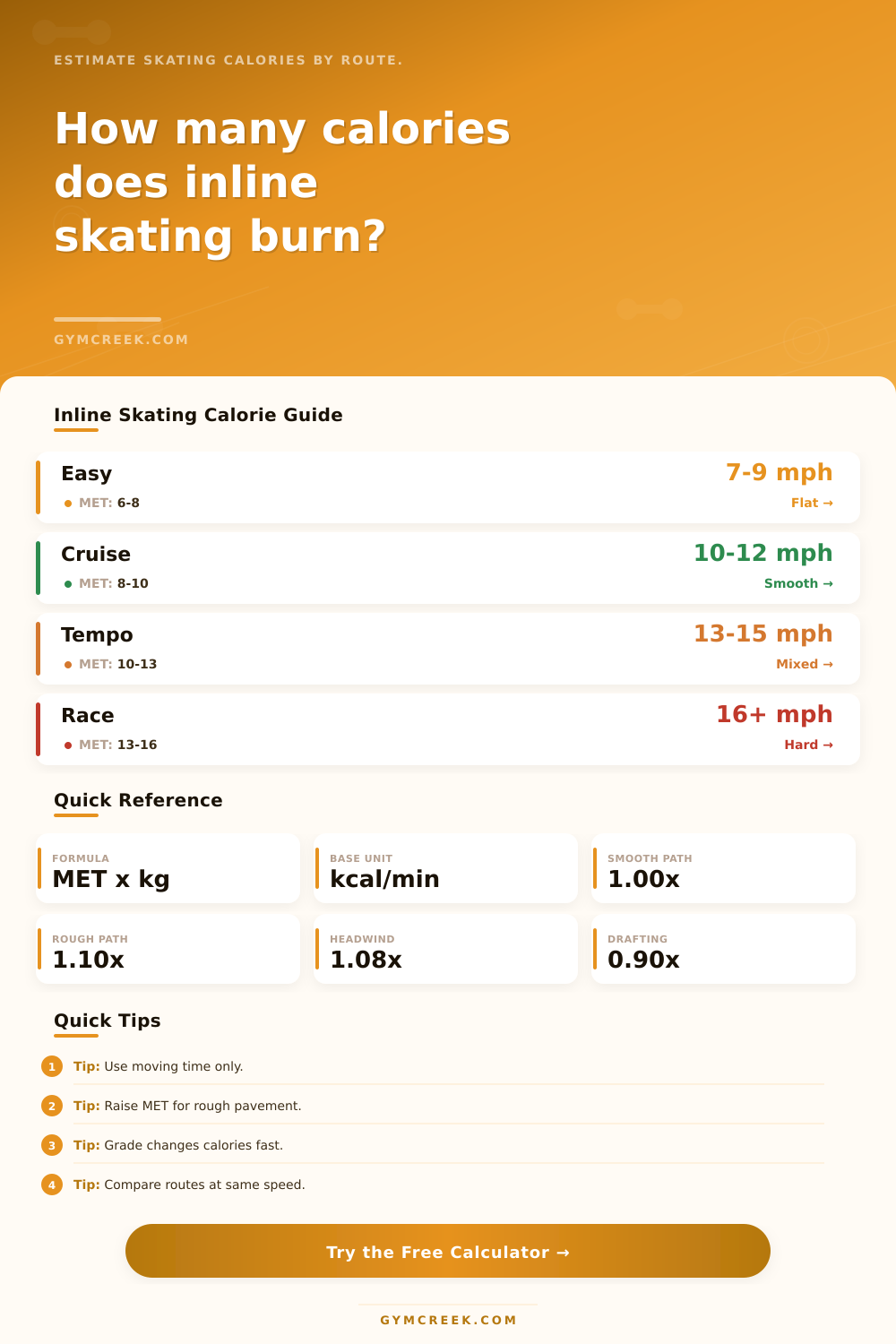
Average route speed selects the base inline skating MET, with faster cruising and race speeds starting higher.
Pavement, grade, wind or drafting, cadence, skating style, and stop-start load multiply the base MET.
Mifflin-St Jeor estimates BMR, then your activity multiplier estimates TDEE for session share comparison.
📑Reference Tables
| Route Speed | Imperial | Metric | Base MET |
|---|---|---|---|
| Easy roll | 6-8 mph | 10-13 km/h | 6.0-7.2 |
| Recreational | 8-10 mph | 13-16 km/h | 7.2-8.5 |
| Fitness cruise | 10-12 mph | 16-19 km/h | 8.5-10.0 |
| Tempo skate | 12-15 mph | 19-24 km/h | 10.0-12.8 |
| Fast pack | 15+ mph | 24+ km/h | 12.8-15.5 |
| Pavement | Modifier | Route Feel | Use Case |
|---|---|---|---|
| Perfect asphalt | 0.96x | Fast glide | Rink or track |
| Smooth path | 1.00x | Baseline | Bike path |
| Mixed pavement | 1.05x | More drag | Shared trail |
| Rough asphalt | 1.10x | Choppy | Old path |
| Chip seal | 1.16x | High drag | Rough road |
| Route Factor | Low | Typical | High |
|---|---|---|---|
| Hill grade | -2% | 0-2% | 4%+ |
| Cadence | 32/min | 45-55/min | 65+/min |
| Wind | Tailwind | Calm | Headwind |
| Stops | Trail | Crossings | Urban |
| Formula | Variables | Output | When Used |
|---|---|---|---|
| MET kcal | MET, kg, min | Calories | Main estimate |
| Distance | Speed, time | Route length | Per-mile burn |
| Grade climb | Distance, grade | Vertical gain | Route context |
| Mifflin BMR | kg, cm, age | Baseline | Daily share |
💡Tips
Skating sometimes is effortless, but that’s deceptive. Maybe your heart rate stay up on a smooth surface and you feel like you’re not even working hard. That’s why many inline skater tend to under-report calories burned. It seems so effortless, yet your body is burning through plenty of energy.
Without a degree in exercise science (and it does get into some complicated math involving both physiology and physics), the online calculator will do work for you. Check out what that gliding realy costs you.
How to Count Calories When Inline Skating
METs stand for Metabolic Equivalents and they’re a way of measuring activity intensity in comparison to sitting still. The main variable is speed but there are others too. While you may think that hiking twenty miles would be more tiring then hiking ten, a long descent could actualy prove easier even though you burned fewer calories during that time, gravity did all the heavy lifting for you! The same goes for inline skating.
It will give you a set intensity (base) value based off your average speed. So if you’re pushing fifteen miles per hour, you’ll burn a lot more then someone who’s just cruising along at ten. But that’s only half the equation, and this is where people goes wrong.
The surface matters. A dedicated path with nice smooth asphalt makes skating seem effortless because the wheels don’t roll around much (the resistance of small wheels rolling on a flat surface). However, change to a rougher surface (cracky pavement or even chip seal), and suddenly you’re pushing harder and more often just to keep up speed. That’s where the calculator applies “drag coefficient” to your baseline effort level. If road is rough, your lower-body muscles is working harder to achieve same speed. You may not perceive the extra work at the time, but it adds up during an hour of skating.
Wind does the same thing. A constant headwind creates equivalent of an invisible uphill grade, making your leg-load go up without changing your actual terrain. Being able to draft other skaters cuts down on that load and that’s why group rides can feel easier then they actually are.
Body weight also matters. A heavier-skating person will burns more calories skating the same distance at the same speed. To account for this, the calculator increases the calorie calculation based off mass. This seems like a fair trade-off since you’re working harder to push yourself around (and to move more weight uphill) against both friction and gravity.
The tool also includes impact of hill grades. Even just a one percent increase raise the metabolic cost a lot. The average grade input further refines the estimate if you’ve got some serious climbing ahead. However, that doesn’t mean you can get away with fibbing about your moving time. Time spent stopping at stoplights or socializing with pals isn’t exercise time so only enter the time that you are, in fact, rolling along.
Another dimension comes from cadence. Sometimes taking shorter, quicker steps (high cadence skating) feel easier on the legs but doesn’t reduce total heart rate load. The calculator uses your stride rate to further improve the intensity estimate. In other words, it helps differentiate between a lazy, long glide and a sharp, efficient push. This is good when you want to compare two different sessions or routes. For example, you may discover that even though distance covered was equal on two different loops, the shorter, faster route burned more total energy than the longer, slower cruise.
Finally, what do you get out of the output? You get a total number of calories for that workout, as well as your calories burned by mile and at an adjusted intensity level. That’s where it gets interesting; instead of just knowing how many calories you burned in session, you have a way to compare. For instance, if you took two routes but one burns more calories per mile, then it was probably harder. And here you can plan your workouts accordingly. Do you want a long lower intensity day, or a quick high intensity workout to help boost your metabolism?
The page has a chart with the intensity levels mapped against speed. So you can see what level and pace to shoot for.
In the end, calorie counting is a matter of awareness. Not obsession. It make you a better skater by teaching you to train smarter. Now you know what’s really going on inside your body. Is a half hour skate a workout, or a leisurely stroll? Do you feel different when you’re pushing hard versus skating easy? What difference does pace make? How do surface and wind affects it? The numbers tell a story about what is really happening under the surface (and once you’ve seen that price tag), you’ll value it all the more. Which is precisely why we count ‘em, isn’t it?