Inchworm Calorie Calculator
Estimate calories burned from inchworm reps, walkout length, pushup option, hamstring mobility, bodyweight, tempo, sets, rest, shoulder load, core load, adjusted MET, and weekly frequency.
📌Inchworm Presets
Each preset loads a realistic inchworm session and recalculates active calories, total calories, MET, movement distance, shoulder time, and weekly burn.
⚙Calculator
Inchworm calorie snapshot
Enter reps, walkout length, pushup option, mobility, tempo, sets, rest, and bodyweight to estimate the session.
📊Inchworm Metrics
🧮MET And Load Logic
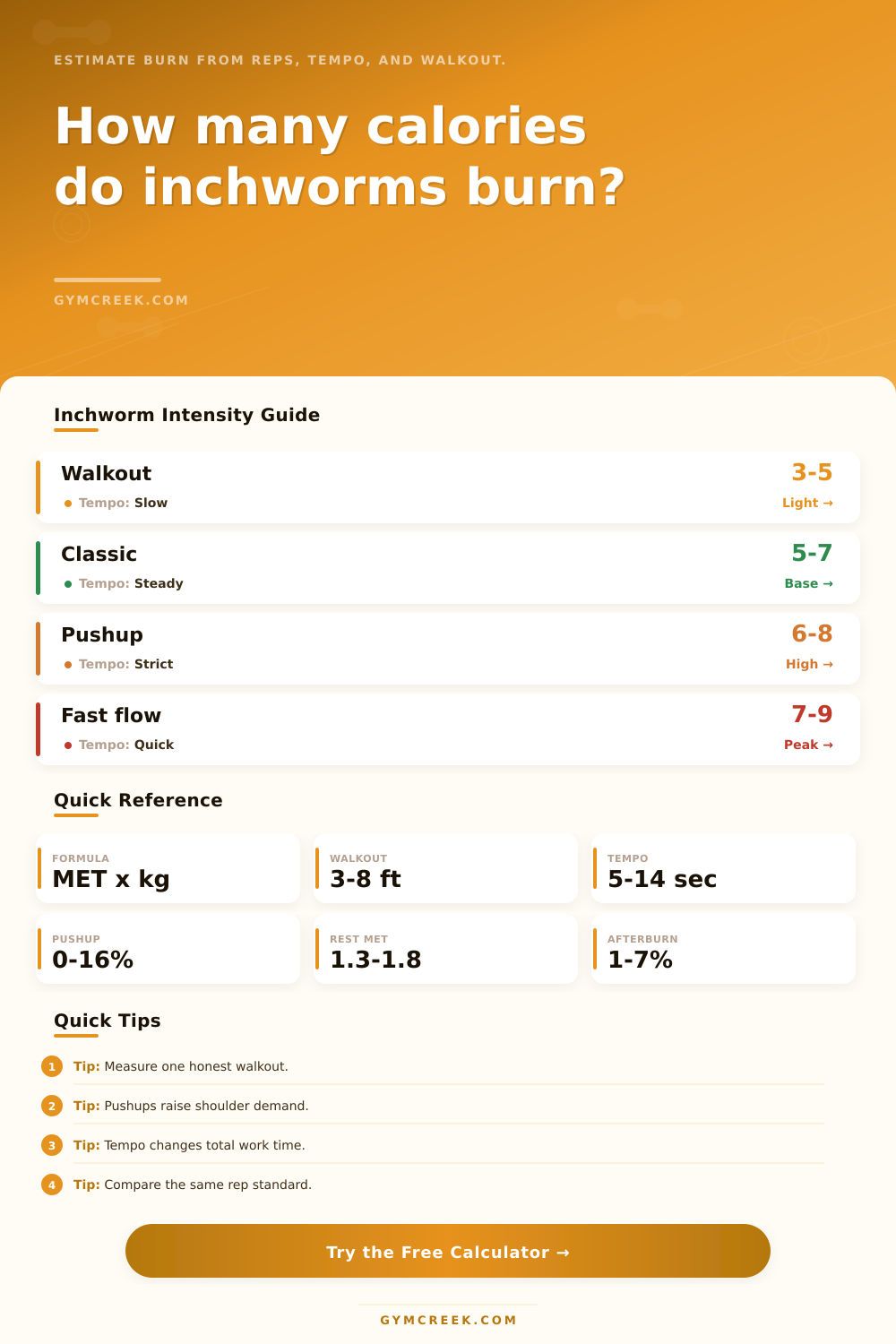
Calories per minute = MET x 3.5 x body weight in kg / 200. The calculator applies this to active inchworm time.
Longer walkouts and faster rep cycles raise adjusted MET because the hands travel farther in the same working time.
Pushup depth, plank support, and long-lever positions increase the upper-body share of the estimate and shoulder time.
Mobility and trunk control change range quality, brace demand, and how much of each rep is counted as productive active work.
📑Reference Tables
| Inchworm Style | Base MET | Typical Tempo | Best Use |
|---|---|---|---|
| Walkout only | 4.2 MET | 7-12 sec/rep | Warmups and mobility sets |
| Classic inchworm | 5.7 MET | 6-10 sec/rep | General conditioning |
| Pushup inchworm | 6.8 MET | 7-12 sec/rep | Upper-body circuit work |
| Fast flow inchworm | 7.4 MET | 4-7 sec/rep | Short conditioning finishers |
| Loaded inchworm | 7.8 MET | 8-14 sec/rep | Advanced strength endurance |
| Walkout Length | Range | Demand | Tracking Note |
|---|---|---|---|
| Short | 3-4 ft | Low | Often bent-knee or elevated |
| Standard | 4-6 ft | Moderate | Most bodyweight circuits |
| Long | 6-8 ft | High | Longer lever and shoulder time |
| Extra long | 8+ ft | Very high | Use only with clean control |
| Form Input | Low Setting | High Setting | Calculator Effect |
|---|---|---|---|
| Hamstring mobility | Bent knees | Straight-leg pike | Changes range and effort |
| Pushup option | No pushup | Double pushup | Raises MET and shoulder work |
| Shoulder load | Hands elevated | Vest or sliders | Raises support demand |
| Core load | Hip pike | Anti-rotation | Raises brace demand |
| Formula Piece | Variables | Output | Used For |
|---|---|---|---|
| MET calories | MET, kg, min | Calories | Main burn estimate |
| Rest calories | Rest MET, min | Calories | Set breaks |
| Duty cycle | Work, rest | Percent | Session density |
| Hand travel | Length, reps | Distance | Movement volume |
💡Tips
At first glance, it looks easy: Do ten reps of this inchworm exercise. But try doing all ten with proper form. It’s tougher than you think. Stand up, hinge down at the hips, reach your hands forward until they’re on the ground (plank position), and crawl your hands backwards to starting position. One rep is complete.
Input your weight and desired pace into calculator (above) and let it do the math. No need for calorie coefficient guesses or energy use estimates here. But what really matters are learning why that number changes when you perform the same workout on Friday compared to Tuesday.
Why Calories Burn Differently
For the majority of us, the inchworm work as an active stretch. We go through the motions with slow care, give some attention to our hamstrings and don’t get overly sweaty. That means a moddern caloric expenditure. This is where the calculator pegs you. Slow and steady does not equal high-intensity conditioning, which incurs a greater metabolic cost. You’re probably closer to bottom of that scale if you’re warming up for an intense squat workout with inchworms. That’s clear from the chart on the page. Here it plots base metabolic equivalent across different exercises, ranging from a relaxed walkout to a strict pushup variation.
When you add in a pushup, energy expenditure shifts. A standard pushup added to the plank position changes what was once a mobility drill into a strength endurance circuit. Instead of simply stabilizing, now your chest and shoulders is doing some serious heavy lifting. The calculator takes this into account with its intensity multipliers.
It’s not simply about moving your body through space. It’s about resisting gravity while moving your body based off space. If you’re finding that you can’t quite hit your targeted rep count, it’s most likely due to upper body fatigue setting in well before the hamstrings start complaining. This is a common trap. You focus too much on the stretch and ignore the press.
The thing that messes up most people’s guesses are tempo. Four seconds of a repetition is not equal to eight seconds. The former will spike your heart rate higher and demand greater power output. But the former may seem easier per rep but keep your muscles under tension for twice as long. They both burn calories, but they do so different than before. This is why being able to plug this timing into the tool is important because metabolic cost is not only a matter of how far you go but also how fast.
A fast, explosive inchworm will burn more calories per minute then a slow, grinding inchworm, even though over all they may take an equal amount of time. Don’t sleep on the length of your walkout. A three-foot walkout is basically a bend-knee shuffle. A six-foot walkout demand straight-leg control and some serious hip hinge movement. The longer that lever, the more your shoulders and core has to work to maintain posture and prevent your body from sagging.
And if it’s a weighted vest or slider? That adds dramatically to the load. This isn’t extra weight; this is extra instability. To avoid wobble, your body have to call on additional stabilizer muscles, increasing the energy cost.
What about rest? Rest is also included in the overall estimate on the calculator, but it’s treated as a recovery phase. It’s considered to be a recovery phase. Short rest keeps the metabolic engine going and long rest let the system cool down. That’s important if you’re trying to understand exactly how much work you’re doing. If you’re doing this as a mobility tool, then you can go longer; if you’re doing this as a HIIT finisher, you’d should of used short rest.
The inchworm is realy just a mirror. It reflects back your level of bodyweight control. If you do it with strict form, walk out far, and do fast pushups, you’re well conditioned. If you bend your knees trying to walk out six feet, you’ve got some work to do on your hinge mechanics. Let the calories be your feedback. Remember, the point isn’t calories, it’s movement quality. Keep the tempo honest. Start where you can control something and let the numbers take care of themselves.
The math is simple. The movement is not.