Ideal Climbing Weight Calculator
Estimate a practical climbing weight range from body size, body composition, hang strength, pull strength, climbing style, target grade, and safe weekly change pace.
📌Climbing Presets
Presets load realistic climbing profiles and auto-calculate. The result is a range because the best climbing weight depends on power-to-weight, composition, and recovery, not weight alone.
⚙Body And Climbing Inputs
Climbing weight snapshot
Enter your body size, composition, strength, style, and target grade to estimate a practical range.
📊Power-To-Weight Grid
📑Reference Tables
| Style | BMI Band | Power Priority | Range Note |
|---|---|---|---|
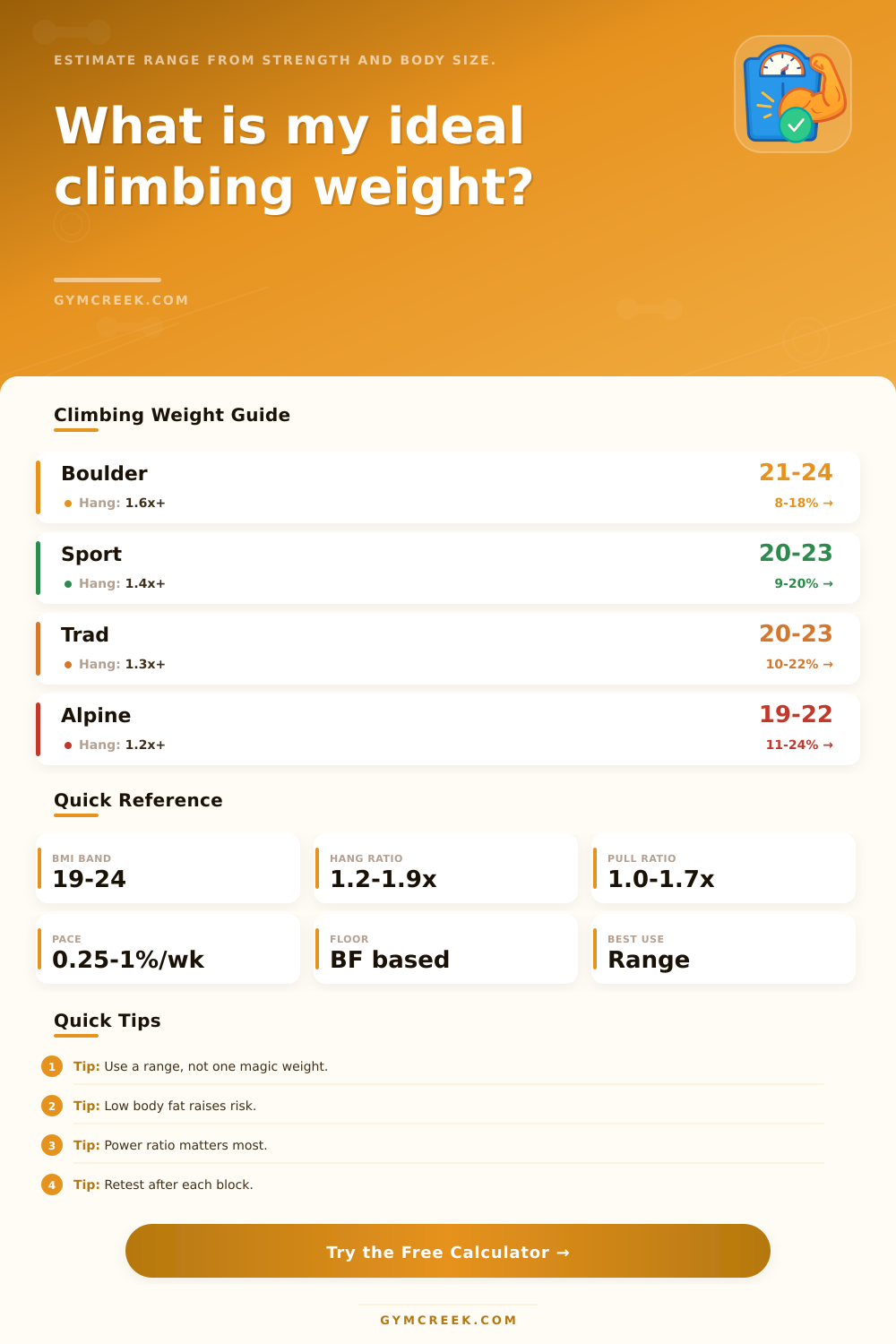
| Bouldering | 21.0-24.0 | Max force | Allows more muscle |
| Sport | 20.0-23.0 | Strength endurance | Balanced range |
| Trad | 20.0-23.5 | Durability | More reserve |
| Alpine | 19.5-22.5 | Long duration | Light but fueled |
| Grade Band | Hang Ratio | Pull Ratio | Weight Bias |
|---|---|---|---|
| VB-V2 / 5.6-5.9 | 1.05-1.25x | 0.80-1.05x | Technique first |
| V3-V4 / 5.10-5.11 | 1.25-1.45x | 1.00-1.20x | Build capacity |
| V5-V7 / 5.12 | 1.45-1.70x | 1.15-1.40x | Power matters |
| V8-V10 / 5.13 | 1.70-1.95x | 1.35-1.60x | Lean precision |
| V11+ / 5.14+ | 1.95x+ | 1.55x+ | Elite context |
| Formula | Variables | Purpose | Output |
|---|---|---|---|
| Frame range | BMI x height | Size context | Weight band |
| Lean floor | Lean mass / BF | Safety floor | Min weight |
| Hang ratio | (body + load) / body | Finger strength | Power ratio |
| Pull ratio | (body + load) / body | Pull strength | Power ratio |
| Composite | Frame + lean + power | Range blend | Target range |
| Scenario | Common Signal | Range Response | Training Focus |
|---|---|---|---|
| Strong but heavy | High absolute load | Slow recomposition | Keep strength |
| Light but weak | Low ratios | Do not cut first | Build force |
| Lean and tired | Low body fat | Hold or gain | Recovery |
| Route climber | Good endurance | Moderate range | Fuel volume |
| Power boulderer | High hang ratio | Muscle allowed | Quality tries |
💡Tips
Eventually every climber wonders: am I too big for this wall? This quiet worry begins in the gym locker room and then trails us out to crags all over. As you fail at a V2, you observe someone petite breezing through V5s, and your brain naturaly connects weight to performance.
Plug your stats into the calculator above, and it will do the math for you, and save you the trouble of speculating about how much harder you should of train, or how much more or less you should eat. It is a convenient method of distinguishing between feeling fat and being lugged around by dead weight.
Is Weight Your Biggest Problem?
First, though, let’s see what happens when we take weight as our only measuring stick. Yet, as we all know, the weight obsession overlooks the engine (i.e., the climber) moving the body up the rock. If the engine sucks (technique) or has weak tendons, you might weigh ninety pounds but won’t be hanging on some little edge. On the other hand, maybe you’re a heavy dude with insane overall strength who can annihilate a problem that eats smaller fingers alive. That’s why the tool isn’t just about body mass. Instead, it considers the ratio of extra load you can hang relative to body mass. And here’s the kicker: this distinction turns diet culture into performance biology. Your goal isn’t a number on a scale; its maximizing your power-to-weight ratio.
In reality, though, that perfect range depends entirely on how you climb. For example, someone who boulders might need explosive power, and thus more total weight (usually) mean more muscle mass. Someone who climbs traditional routes or does longer multipitch days would benefit hugely from less weight. However, they must be able to make long moves with enough endurance to haul their gear up all day (six hours!).
The reference table on the page lays this out by style. It shows, for instance, that an alpine climber’s optimal body mass index should be different then an athlete’s suited for bouldering in the gym. So if you’re a weekend sport climber who’s shooting for 5.12, your goal body composition would fall somewhere in-between two extremes. Training for endurance while trying to look like an elite boulderer will lead to nothing but frustration and injury.
The safety guardrail here is body fat percentage. Your estimated body fat determines the algorithm’s definition of “lean mass”, the lower limit at which it won’t recommend weights that are beyond what your body can safely handle. Below-minimal body fat mean compromised bone density, hormone production, and recovery ability. So sure, you can drop a few pounds… but only at the cost of getting weaker, slower, and more injury-prone (hello, tendonitis). If a proposed weight contradicts your existing body composition info, the tool alerts you, warning that further dietary restriction isn’t the right way; strength training is. It protects you from chasing looks instead of real climbing performance.
The story gets more clear when we look at strength ratios instead of weight trends. A good hang ratio mean you have high relative strength compared to your own body mass, even if you’re still struggling with grade performance. In this case, it’s probably due to endurance or technique rather than mass. Focusing on building more muscle through increased protein while decreasing calories may have the counter-intuitive effect of allowing you to project harder grades. This happens because you don’t lose as much muscle during intensive training block.
The calculator takes into account where you currently are in your training (i.e., whether it’s a bulk/maintenance/cut phase) and how frequently you climb each week. It will adjust recommendations accordingly so you’re getting the right type of nutrition for the right time. That way it won’t destroy your specific periodization plan with generic advice.
In my experience, this is by far the biggest mistake. People think of the value as a fixed goal instead of a target range. There’s no perfect body type because there are no two humans who are exactly alike. Set goals within the range and monitor your results monthly, not daily. On steep terrain, small shifts in body composition result in huge gains, but only if you allow enough time for them to be safe. Build your strength first; dial down your weight if needed. As long as you can move effectively while on the wall, the wall won’t give a shit about your weight. One way to increase that ratio is indeed to get lighter, but it will usually be the least fun option you have.