⚖️ Ideal Body Weight Calculator
Calculate your ideal weight using Devine, Robinson, Hamwi & Miller formulas — get a personalized healthy range instantly
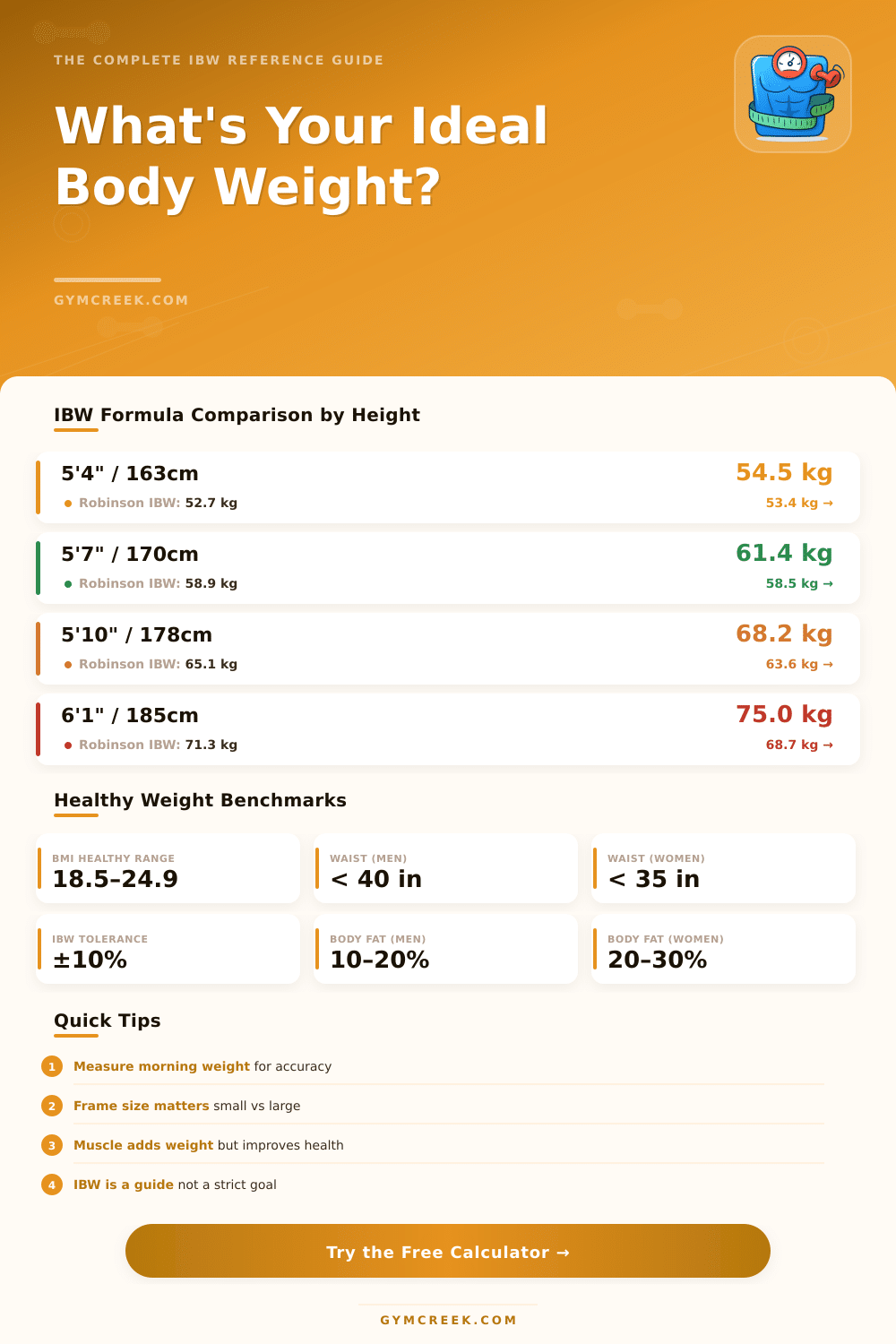
| Height | Devine (kg) | Robinson (kg) | Hamwi (kg) | Miller (kg) |
|---|---|---|---|---|
| 5’0" / 152 cm | 50.0 | 52.0 | 48.1 | 56.2 |
| 5’2" / 157 cm | 54.6 | 56.0 | 52.7 | 59.9 |
| 5’4" / 163 cm | 59.2 | 60.1 | 57.3 | 63.5 |
| 5’6" / 168 cm | 63.8 | 64.1 | 61.9 | 67.2 |
| 5’8" / 173 cm | 68.4 | 68.2 | 66.5 | 70.8 |
| 5’10" / 178 cm | 73.0 | 72.2 | 71.1 | 74.5 |
| 6’0" / 183 cm | 77.6 | 76.3 | 75.7 | 78.1 |
| 6’2" / 188 cm | 82.2 | 80.3 | 80.3 | 81.8 |
| Height | Devine (kg) | Robinson (kg) | Hamwi (kg) | Miller (kg) |
|---|---|---|---|---|
| 4’10" / 147 cm | 45.5 | 49.0 | 45.4 | 53.1 |
| 5’0" / 152 cm | 49.9 | 52.4 | 49.9 | 56.2 |
| 5’2" / 157 cm | 54.3 | 55.8 | 54.4 | 59.4 |
| 5’4" / 163 cm | 58.7 | 59.2 | 59.0 | 62.5 |
| 5’6" / 168 cm | 63.2 | 62.7 | 63.5 | 65.7 |
| 5’8" / 173 cm | 67.6 | 66.1 | 68.0 | 68.8 |
| 5’10" / 178 cm | 72.0 | 69.5 | 72.6 | 72.0 |
| 6’0" / 183 cm | 76.5 | 73.0 | 77.1 | 75.1 |
| Category | BMI Range | Health Risk | Notes |
|---|---|---|---|
| Underweight | < 18.5 | Elevated | May indicate malnutrition |
| Normal Weight | 18.5 – 24.9 | Low | Generally healthy range |
| Overweight | 25.0 – 29.9 | Moderate | Lifestyle changes advised |
| Obese Class I | 30.0 – 34.9 | High | Medical review recommended |
| Obese Class II | 35.0 – 39.9 | Very High | Consult physician |
| Obese Class III | ≥ 40.0 | Extreme | Medical supervision needed |
| Height | Min Weight (kg) | Max Weight (kg) | Min Weight (lbs) | Max Weight (lbs) |
|---|---|---|---|---|
| 5’0" / 152 cm | 42.7 | 57.7 | 94 | 127 |
| 5’2" / 157 cm | 45.6 | 61.7 | 101 | 136 |
| 5’4" / 163 cm | 49.2 | 66.5 | 108 | 147 |
| 5’6" / 168 cm | 52.2 | 70.5 | 115 | 155 |
| 5’8" / 173 cm | 55.3 | 74.7 | 122 | 165 |
| 5’10" / 178 cm | 58.6 | 79.2 | 129 | 175 |
| 6’0" / 183 cm | 62.0 | 83.8 | 137 | 185 |
| 6’2" / 188 cm | 65.5 | 88.5 | 144 | 195 |
The ideal Body Weight is that weight that relates to the minimal risk of death for particular height, age, gene and physical fitness. That idea bases on more than a century of scientific study about the tie between Body Weight and good health. Usually one estimates it according to the tables about height and weight of the Metropolitan Life Insurance Corporation that first published in the starts of the 1940s.
Between the most used methods for estimate ideal Body Weight stands the Devine-formula from 1974. At men it works thus: one starts at 50 kilos and adds each 2,3 kilos for every inches above five feet. For instance, a man of five feet and ten inches height would add 2,3 times ten to 50, what results in around 73 kilos or almost 161 pounds.
How to Find Your Ideal Body Weight
For men another way imagine that you start at 110 puonds and add each 5 pounds for every inches above five feet.
Although the Devine-formula does not have firm scientific foundations, one uses it a lot in medicine. Doctors use it for dosing medicines, show mechanical fans, estimate nutritional needs and control renal activity. There are other methods, as the Robinson-formula of 1983, the Miller-formula of 1983 and the Hamwi-formula of 1964.
Such calculations commonly give different values for the same folk, what can create confusion.
The Index of Body Mass, or BMI, forms another common resource. It estimates the body fat according to height and weight at adults of both sexes. Even so BMI does not consider muscular volume, bone density nor body makeup.
Hear is an important disadvantage.
For estimate, how far folk weigh, it does not suffice to simply look at a chart. You need to think about bones, muscles and fat in the body. Also the frame size plays a role.
Different body types, as ectomorph, mesomorph and endomorph, require separate approaches to weight management. The beam of shoulders, the size of hips and the ribcage all affect that. No alone calculation can exactly set the right weight for every individual.
As fast rating, the ideal Body Weight helps to set risk targets fast. But it does not attend to genetics nor to other healthy circumstances. The main attention should go to the whole body fat percentage instead of to one precise value on the weight.
At men healthy fat ranges are about 15 until 20 percentages, while at women it is around 20 until 25 percentages.
The targets for body fat percentage can differ. Ranges of 8 until 15 percentages commonly count as good for folks that commit to training. Forcing fat to around 15 percentages while you get muscles to reach good BMI forms a niceway for general sporting fitness.
After that, the training, the rest and the genetics will decide about the weight levels.