⚖️ Ideal & Adjusted Body Weight Calculator
Calculate your IBW and ABW using Devine, Robinson, Miller & Hamwi formulas
| Height | IBW (kg) | IBW (lbs) | Healthy Range (lbs) |
|---|---|---|---|
| 5'0" (152 cm) | 50.0 kg | 110 lbs | 99–121 lbs |
| 5'4" (163 cm) | 59.1 kg | 130 lbs | 117–143 lbs |
| 5'7" (170 cm) | 65.8 kg | 145 lbs | 130–159 lbs |
| 5'10" (178 cm) | 72.7 kg | 160 lbs | 144–176 lbs |
| 6'0" (183 cm) | 77.3 kg | 170 lbs | 153–187 lbs |
| 6'2" (188 cm) | 82.0 kg | 181 lbs | 163–199 lbs |
| Height | IBW (kg) | IBW (lbs) | Healthy Range (lbs) |
|---|---|---|---|
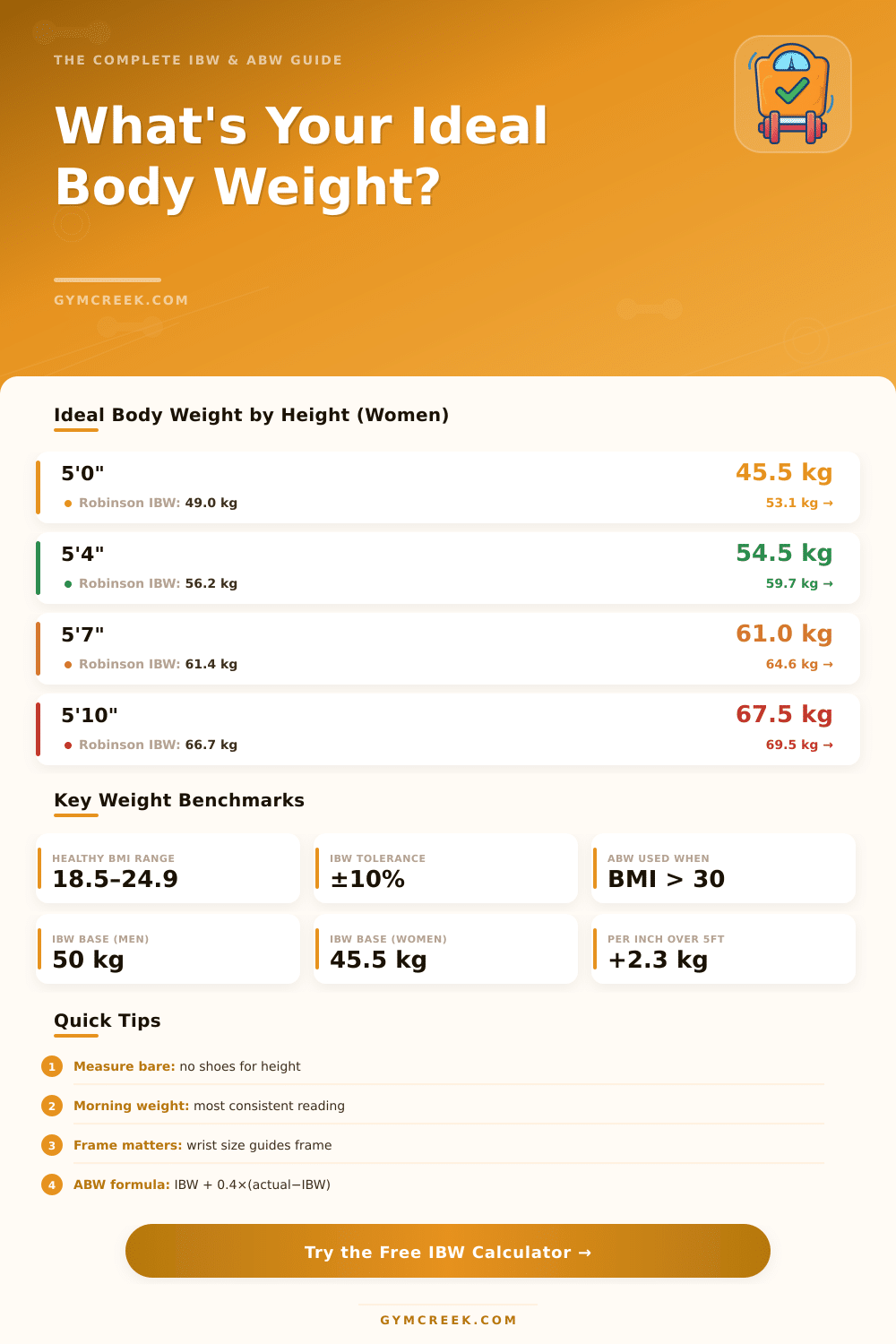
| 5'0" (152 cm) | 45.5 kg | 100 lbs | 90–110 lbs |
| 5'2" (157 cm) | 50.0 kg | 110 lbs | 99–121 lbs |
| 5'4" (163 cm) | 54.5 kg | 120 lbs | 108–132 lbs |
| 5'7" (170 cm) | 61.3 kg | 135 lbs | 121–148 lbs |
| 5'10" (178 cm) | 68.0 kg | 150 lbs | 135–165 lbs |
| 6'0" (183 cm) | 72.7 kg | 160 lbs | 144–176 lbs |
| Formula | IBW (kg) | IBW (lbs) | Notes |
|---|---|---|---|
| Devine (1974) | 72.7 kg | 160 lbs | Most used in clinical settings |
| Robinson (1983) | 71.4 kg | 157 lbs | Slightly lower estimate |
| Miller (1983) | 72.0 kg | 159 lbs | Intermediate estimate |
| Hamwi (1964) | 75.0 kg | 165 lbs | Higher estimate, large-frame bias |
| Peterson (2016) | 71.2 kg | 157 lbs | BMI-based, newer method |
| Gender | Small Frame | Medium Frame | Large Frame |
|---|---|---|---|
| Men (wrist circ.) | < 6.5 in / 16.5 cm | 6.5–7.5 in / 16.5–19 cm | > 7.5 in / 19 cm |
| Women (wrist circ.) | < 5.5 in / 14 cm | 5.5–6.5 in / 14–16.5 cm | > 6.5 in / 16.5 cm |
| IBW Adjustment | −10% | No adjustment | +10% |
do not exist magic number for the ideal Body Weight. In reality it is about a range, that goes according to your height, age, gender and the kind of physical build, that you have. Also the makeup of the body matters, and genetics play a big role in the whole thing.
DISCLOSURE: This post may contain affiliate links, meaning when you click the links and make a purchase, I receive a commission. As an Amazon Associate I earn from qualifying purchases.

Basically: there is no single weight, that works for all folks.
There Is No One Perfect Weight for Everyone
During years, people created many different formulas to guess, what would that range look like. The Devine-formula probably is the most known of them. For males, one starts at around 110 pounds and adds 5 pounds for every inch above five feet of height.
So, if a person is ten inches higher than five feet, he would weigh around 160 pounds or like this. That is based also on the metric version, starting at around 50 kilos and adding 2,3 kilos for every inch above five feet.
Later comes the Robinson-formula, the Miller-formula and the Hamwi-formula, each of them gives a bit different results. I noticed, that for same height, folks get numbers of around 138 pounds until 177 pounds, according to the used method. That shows quite a big differnce, honestly.
Really, it explains, why any single formula can give a precise number for each.
One commonly mentions the BMI also. The idea is made up of a rating of the relation between weight and height. Most folks in a healthy range fall between 20 and 25.
But hear the catch; BMI does not consider muscle mass, bone density or the real makeup of your body. A person with a lot of muscles could have high BMI, yet be in good shape.
The percentage of body fat is where things become more interesting. Most men do well at around 15 until 20 percent of body fat. Women usually fall in the range of 20 until 25 percent.
If you want a more athletic body, you could aim for a lower level, between 8 and 15 percent. Really better to follow that percentage instead of stressing about the scale.
The lean body mass also matters. One useful method is count your lean body mass first, later use a target percentage of body fat to find the total Body Weight. Your body frame plays a role for folks, because folks have different builds, whether thin, medium or large frames.
Already in the 1940s, the tables of Metropolitan Life Insurance were between the first, that tied height and weight to healthy results.
And here the point. Ideal weight is not fixed. It changes from year to year, according to whether you gain muscles, deal with health issues or simply adapt to your own goals.
Talking with your doctor and building good habits around healthy food andregular movement is really the best way forward.