Ice Skating Calorie Calculator
Estimate calories burned from public skating, figure practice, hockey drills, speed sessions, rink laps, skating speed, jump and spin blocks, rest time, skill level, and body weight.
📌Presets
Each preset loads a realistic rink session and recalculates the calorie estimate.
⚙Calculator
Ice skating calorie snapshot
Enter rink time, laps, speed, practice blocks, jumps, drills, rest, and body weight to estimate skating calories.
📊Fitness Metrics
🧮Formula Cards
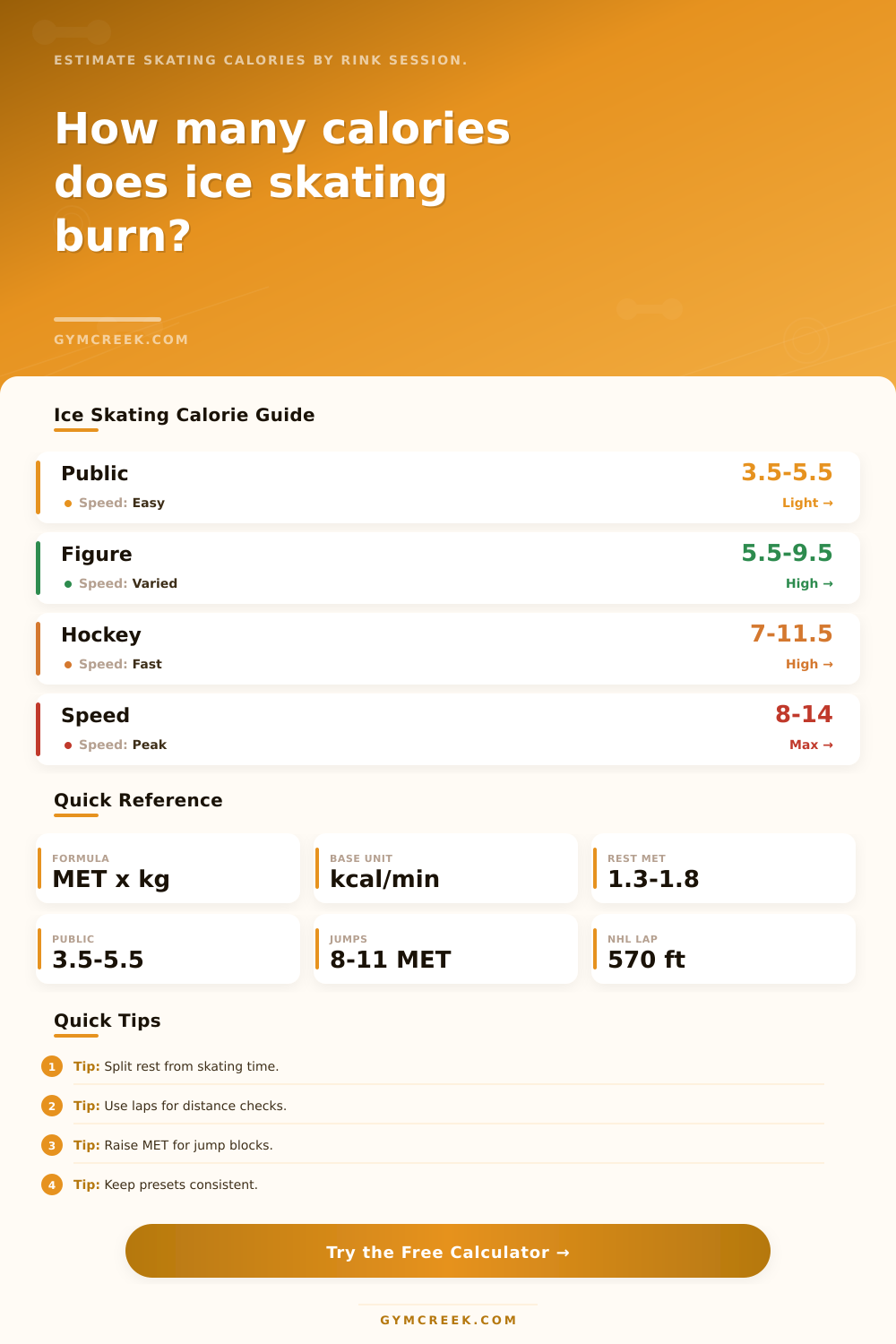
Calories per minute = MET x 3.5 x body weight in kg / 200. The calculator applies it separately to skating, jumps or spins, drills, and rest.
Lap distance comes from the selected rink perimeter, then laps convert to miles or kilometers and cross-check the entered skating speed.
Active time is divided into glide time, edge or drill time, and jump or spin time so figure and hockey sessions can be modeled more realistically.
Mifflin-St Jeor estimates BMR from body size, age, and gender, then the activity multiplier estimates TDEE for session comparison.
📑Reference Tables
| Session Style | Base MET | Typical Speed | Best Match |
|---|---|---|---|
| Public recreational skating | 4.2 MET | 3-7 mph | Open skate |
| Learn-to-skate lesson | 4.8 MET | 2-6 mph | Class skills |
| Figure skating practice | 6.3 MET | 4-10 mph | Edges and jumps |
| Hockey skills or scrimmage | 8.0 MET | 7-16 mph | Stops and shifts |
| Speed skating intervals | 9.5 MET | 12-25 mph | Hard laps |
| Outdoor pond or trail skate | 5.5 MET | 4-12 mph | Rough ice |
| Rink Type | Lap Length | 10 Laps | Notes |
|---|---|---|---|
| NHL rink perimeter | 570 ft | 1.08 mi | Common in US |
| Olympic rink perimeter | 654 ft | 1.24 mi | Wider sheet |
| Small studio rink | 390 ft | 0.74 mi | Compact turns |
| Outdoor loop | 820 ft | 1.55 mi | Trail or pond |
| Practice Block | MET Range | Share Guide | Use Case |
|---|---|---|---|
| Easy gliding laps | 3.5-5.5 | 40-90% | Public skate |
| Edges and stops | 5.5-8.5 | 10-45% | Skills |
| Jumps and spins | 8.0-11.0 | 5-35% | Figure work |
| Hockey shifts | 8.0-12.5 | 25-70% | Game pace |
| Speed intervals | 9.0-14.0 | 20-60% | Race prep |
| Formula | Variables | Output | When Used |
|---|---|---|---|
| MET kcal | MET, kg, min | Calories | Main burn |
| Lap distance | Laps, rink | Distance | Rink work |
| Speed check | Distance, min | Pace gap | Validation |
| Mifflin BMR | kg, cm, age | Baseline | Daily burn |
💡Tips
Everyone thinks that because their body is out on the ice, all activities must be high-intensity exercise. Then they get off the rink floor and feel tired. They think it’s from being in the cold or just trying not to fall over while wearing skates, so they believe they’ve been burning tons of calories the whole time. But truth is usually more complex.
While some calorie burn on the ice relates to physics of what you’re actually doing with your legs, it doesn’t correlate as much to how cold the air is around them. A figure skating jump block are very different from a casual glide during family hours. There is a huge range in how many calories you burn depending on whether you’re actively skating or recovering. To know your calorie burn, the first piece of the puzzle is knowing the difference.
How to Know How Many Calories You Burn While Skating
Once you enter your data on what happens in each session, the calculator do all the complicated math for you (above). You no longer have to fiddle with body mass coefficients or MET values yourself. It recognizes that when you’re standing there on the board waiting for your turn, you aren’t expending much energy, versus the bursty high energy of jumping around. And here’s why this is important, you’re still burning calories while resting. They just won’t be burned at the same rate as sprints vs. Sitting. By separating active playing time from rest, the tool lets you be accurate. Standing around at boards waiting for a line change isn’t the same thing as being on a fast break, right?
Surprisingly, these numbers is dependent on your skill level. Novice skaters tend to use fewer calories than intermediates even though they feel more fatigued. Why? Because novices coast around saving energy (or, alternatively, they’re so slow their metabolism doesn’t kick into high gear). Intermediates has sharper edges, turn with more muscle control and generally engage more muscles during skating. To reflect that, the calculator allows you to choose your skill level, changing base metabolic equivalent. An experienced intermediate pushing off his/her crossovers with confidence will do more work then a beginner clinging tightly to the wall.
With its focus on practice blocks, the tool seeks to capture varying demands placed upon figure skaters and hockey players. Figure practices involve significant vertical displacement during jumps, plus core work while spinning. Hockey requires explosive sprints with fast starts and stops and lateral moves at a fast clip. You can indicate how much time you spend at each activity level. For example, if you’re spending half your practice on slap shots or triple axels, it’s going to record this as an intense workout. It is moderate if your footwork drills take up most of the time. It’s a far more detailed system than the generic averages found in most fitness apps.
The other thing that chisels away at efficiency are environmental factors… These all impact overall energy spent. For example, rough ice will be more difficult; whether at a public rink or an outdoor pond on a busy Saturday night, you’ll be pushing harder to get the same speed. That’s where you use the ice condition setting in the tool. Soft ice? Or maybe a layer of snow has accumulated, in which case the blades dig in a bit and require more work to get forward momentum. A little tweak, but it compounds over time if you’re out there for 40 minutes of skating. Finally, if you’re wearing bulkier clothes or thick pads, you’re going to add some weight, so your legs is doing more work (versus light clothing). This also adds up and increases the calories burned a bit.
The calculations also are backed up by distance and pace. For example, if you report skating 40 laps at a slow speed, the calculator cross-checks these numbers to ensure they make sense physically. It knows how big the rink is (NHL size vs. It also know the difference between an NHL size rink and a typical studio loop and uses that to calculate the distance covered. That way, it can catch mistakes in what you typed in, because it’s checking internally for sanity. The combination of lap count and speed should match up roughly with amount of time you spent on the ice. You have to trust the input in order to trust the output.
Ice skating is a total-body workout that activates muscle groups you don’t exercise on solid ground. A calculator can put a number on that for you, but it can’t capture the feeling of burning in your abs or fatiguing in your calves. Yes, it is a number, but it is one you fill with meaning. Don’t get hung up on calculating the precise amount of kilocalories burned per session; instead, use this as a tool to see how your body responds to the ice over time. The ice will respond to your weight, but it’s more important to know how your body responds to the ice. And that’s where true fitness lies: In the interplay of data and feeling.