HYROX Time Calculator
Estimate a realistic HYROX finish from run pace, station execution, transitions, division loads, fatigue drift, and athlete profile context.
📌Race Presets
Presets load different athlete profiles, run speeds, station strengths, transition habits, and fatigue patterns, then recalculate the full HYROX race clock.
⚙Race Inputs
⏱Station Time Inputs
Enter your expected working time for each station before transition time. The calculator applies sled difficulty, doubles sharing, and late-race fatigue drift where relevant.
Estimated finish time
Enter your race profile to estimate the full HYROX clock.
📊Race Metrics
📘Reference Tables
| Finish range | Typical run pace | Station pattern | Race read |
|---|---|---|---|
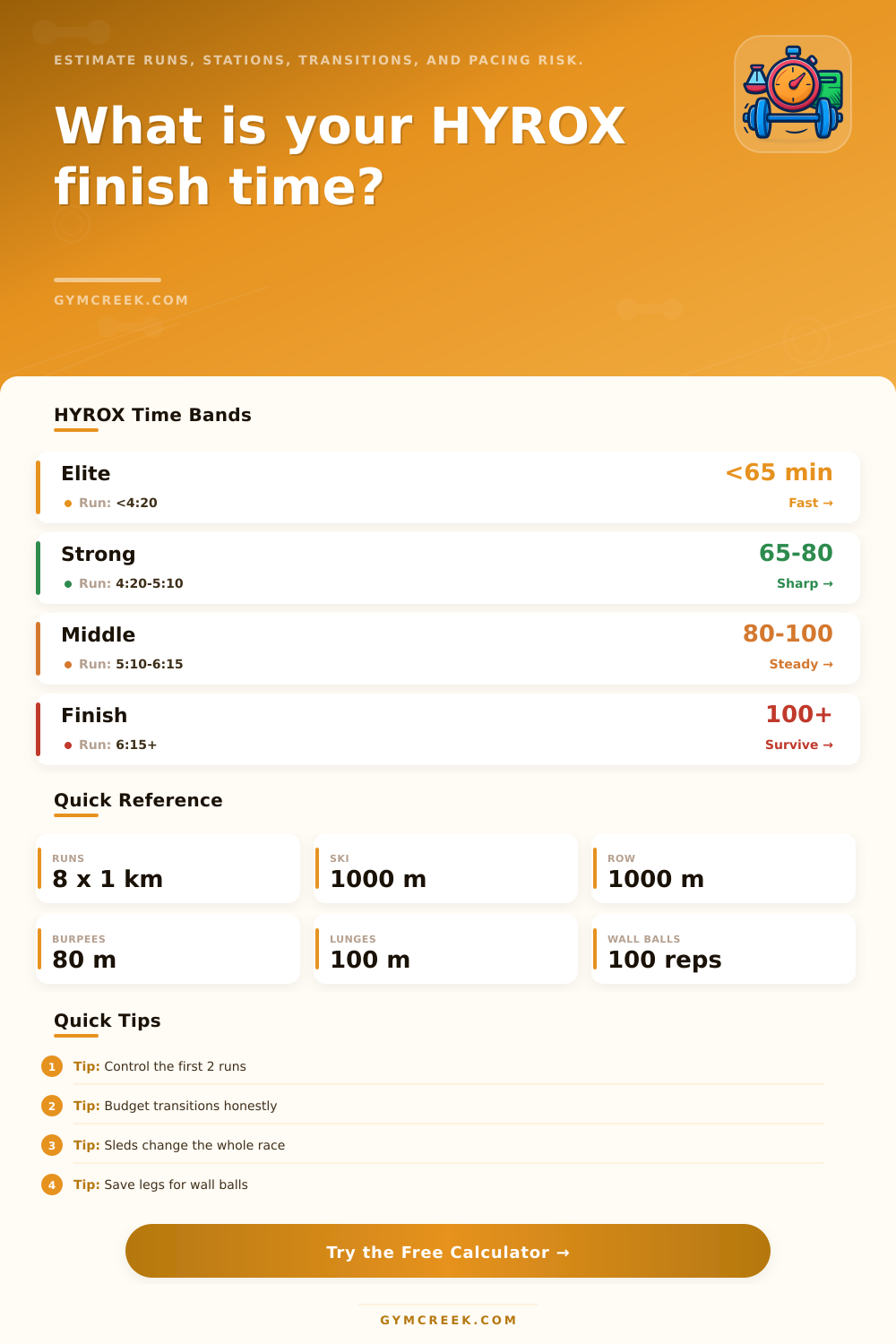
| Under 65 minutes | Under 4:20 per km | Clean, very short breaks | Elite field or podium-level age group |
| 65 to 80 minutes | 4:20 to 5:10 per km | Sleds controlled, late reps intact | Strong competitive HYROX execution |
| 80 to 100 minutes | 5:10 to 6:15 per km | Some station breaks but steady moving | Common prepared open athlete range |
| 100 minutes plus | 6:15 plus per km | Longer recovery inside stations | Finish-focused or first-race pacing |
| Station | Distance or reps | Main limiter | Time signal |
|---|---|---|---|
| SkiErg | 1000 m | Upper-body pacing and breathing | Going too hard here raises early run cost |
| Sled push and pull | 50 m each | Leg force, footwear, turf friction | The biggest venue-to-venue swing |
| Burpee broad jumps | 80 m | Rhythm, hip fatigue, no-pauses | A slow station can leak several minutes |
| Wall balls | 100 reps | Squat tolerance and shoulder endurance | Late breaks decide many PR attempts |
| Profile | Likely strength | Likely risk | Calculator cue |
|---|---|---|---|
| Runner entering HYROX | Low run total | Sled push, pull, and wall balls | Raise sled difficulty and station drift |
| Strength athlete | Sleds and carries | Run fade after burpees | Use slower 1 km pace and higher fade |
| Doubles team | Shared station work | Transition coordination | Reduce station times but budget transitions |
| Experienced open racer | Balanced blocks | Last lunge and wall-ball fatigue | Track late block percentage carefully |
| Model piece | Inputs used | Formula style | When it matters |
|---|---|---|---|
| Run total | Fresh pace and fade | Eight progressive 1 km splits | Predicts whether pacing holds after stations |
| Station total | Eight station times | Early-to-late drift multiplier | Shows where race execution slows |
| Body context | Age, gender, weight, height | Mifflin-St Jeor BMR | Provides energy context, not a diagnosis |
| Risk score | Fade, sled factor, transitions | Weighted pacing flags | Highlights if the estimate is fragile |
💡Practical Notes
A HYROX race consist of eight runs and eight stations. The interaction between the eight runs and the eight stations create the time for each competitor in the race. Because the plan that many peoples create for a HYROX race is rarely followed perfectly during the event, individuals must use an estimate to understand how a HYROX race will occur.
The estimate for a HYROX race accounts for the fade that occurs during the race, the friction that occurs during the stations, and the time that occurs between the stations. The HYROX calculator account for the interactions between these component of a HYROX race, as it allows individuals to input their running and station profiles into the calculator instead of estimating these components of a race. One of the important factor to account for in a HYROX race is the fade that occurs during the race.
How to Use the HYROX Calculator
Run fade occurs because each of the eight stations between each run are not recovery periods. Individuals start each race with their fresh running pace, but their running pace will fade during the later kilometer of each run. Even a small amount of fade can create many minutes of difference in time between two runners with the same fresh running pace.
Additionally, the HYROX calculator asks for the percentage of fade that an individual will experience in their run, as this fade between the first and eighth run will impact their overall time for the race. Each of the stations in a HYROX race have different physical demand of the runners. For instance, the ski and row stations require the runners to use controlled breathing to complete the stations, but the type of surface that is used during the race as well as the weight of the sled also impact the sled push and sled pull stations.
Additionally, the burpee broad jumps may punish those with poor rhythm during the jumps, and the wall balls may punish individuals with tired leg after they complete each of the stations. Each of these times can be entered into the calculator, as they are not fixed times for each station. For instance, the division that is used for the race will change the times for each station based upon the weight of the sleds and the fatigue for each runner.
In addition to the times for each of the stations in a HYROX race, there are also the transitions between the runs and the stations that can impact the time for each runner. The time for each transition between the running components and the station components can add several minute to each individuals time for the race. The time for each transition includes time for setting up for each station, as well as the time for chalk and judge checks for each station.
Each of these components of a transition can be easily underestimted by each individual. Depending upon which division is chosen for a participant during a HYROX race, the math for the race will change. For instance, the Open division for singles requires that each individual carries their full load for each station during the race, but divisions like the Pro division will increase the difficulty of each of the stations.
For divisions like Doubles and Relays, each individual will spend less time completing each station, but there will be cost associated with coordination between individuals during transitions. The context of an individual’s body will also impact the amount of energy that they have during the race. For instance, younger individuals may have more energy during each race than individuals of an older age, and individuals with more body weight may have more energy than those with less body weight.
The HYROX calculator uses a standard equation for resting metabolism to provide individuals with a sense of scale for their energy during the race. Although not a prediction of energy during the race, this number can help to provide individuals with an understanding of the fatigue that may impact there performance during the race. Each of the reference tables on the calculator can help individuals to understand the different component of a HYROX race.
Each of the reference tables will help individuals to understand if their inputs for the calculator will produce a believable time for the race. For instance, each of the reference tables will show the number of minutes that each individual may expect to finish the race based off the inputs for each component of a race. These tables are not rules for setting times for each component, but they may help to allow each individual to compare their estimate to the estimates of other athletes who are prepared for a race.
Individuals must treat each of the inputs for the calculator as observations of their capabilities rather than as their wishes for those components of a race. For instance, if each individual enters the time for each station as the time that they can complete each station with their best effort during each round of running, that time will produce an estimate that is more fast than their actual time for the race. Any honest input for each of the components will result in a useful estimate for the individual for planning their race.
Finally, the calculator may be most useful if each individual runs the calculator more than once. For instance, the individual might change the difficulty of the sleds, the amount of fade for each run, or the time for the transitions to understand which components of the race are the most important. For some individuals, the time for the sled block will most impact their time for the race, while other athletes may find that the time for each of the late stations will have more of an impact.
For each individual, the calculator allows them to understand these tradeoffs without having to re-estimate each component of their race.