Hypertrophy Volume Calculator
Plan weekly hard sets for one target muscle using volume landmarks, rep quality, RIR, exercise stability, range of motion, session split, recovery, and goal phase.
📌Hypertrophy Volume Presets
Each preset loads a complete hypertrophy scenario with real muscle landmarks, set quality, split structure, and recovery context.
⚙Calculator Inputs
Hypertrophy volume snapshot
Enter your set plan and training context to estimate productive stimulus.
📊Fitness Metrics Comparison Grid
📑Reference Tables
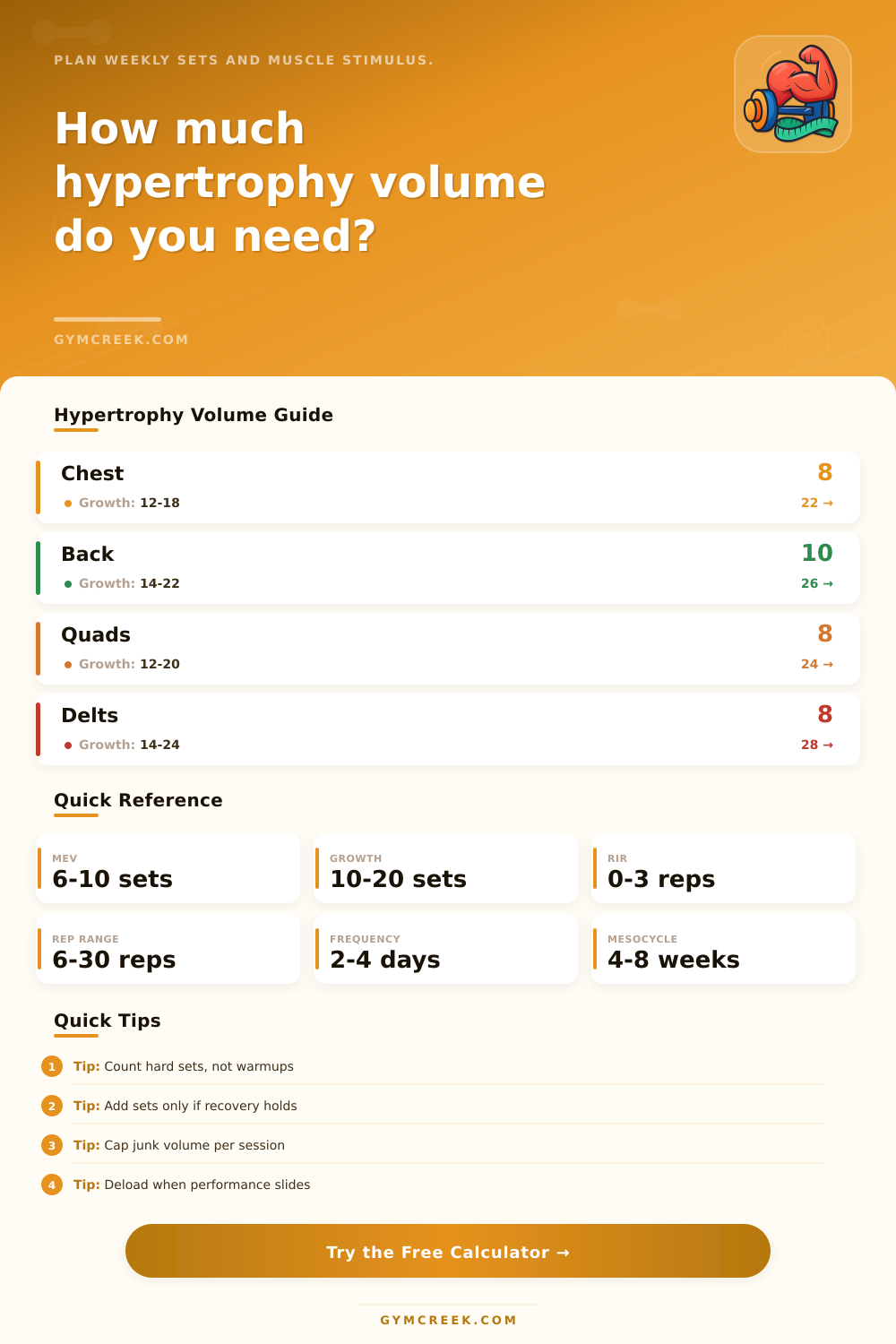
| Target muscle | MEV floor | Productive range | Typical MRV |
|---|---|---|---|
| Chest | 8 sets | 12-18 sets | 20-22 sets |
| Back or lats | 10 sets | 14-22 sets | 24-26 sets |
| Quadriceps | 8 sets | 12-20 sets | 22-24 sets |
| Hamstrings | 6 sets | 10-16 sets | 18-20 sets |
| Glutes | 8 sets | 12-22 sets | 24-28 sets |
| Side or rear delts | 8 sets | 14-24 sets | 26-30 sets |
| Arms | 6 sets | 10-18 sets | 20-24 sets |
| Calves | 8 sets | 12-22 sets | 24-30 sets |
| Factor | High stimulus | Middle | Low stimulus |
|---|---|---|---|
| RIR proximity | 0-2 RIR | 3 RIR | 4-6 RIR |
| Rep zone | 6-20 reps | 21-30 reps | Under 5 or 31+ |
| Exercise stability | Supported | Stable compound | Skill-limited |
| Range of motion | Loaded stretch | Full controlled | Short partial |
| Fatigue overlap | Low systemic cost | Moderate cost | High carryover |
| Frequency | Best weekly volume | Per-session aim | Watch for |
|---|---|---|---|
| 1 day | 6-10 sets | All direct work | Late-session quality drop |
| 2 days | 10-18 sets | 5-9 sets | Balanced recovery |
| 3 days | 14-24 sets | 5-8 sets | Overlap with compounds |
| 4 days | 18-28 sets | 4-7 sets | Joint irritation |
| 5+ days | Specialization only | 3-6 sets | Performance trend |
| Phase | Volume target | Progression cue | Exit signal |
|---|---|---|---|
| Intro | MEV to low range | Add slowly | Stable soreness |
| Accumulation | Middle range | Add 1-2 sets | Stalled reps |
| Specialization | High range | Prioritize muscle | Joint stress |
| Maintenance | About one-third to half | Hold loads | Lost pump |
| Overreach | Near MRV | Short duration | Deload needed |
💡Tips
A hypertrophy volume calculator determine the amount of training volume that an individual need in order to encourage muscle growth. For many lifter, increasing the weight that is lifted with a barbell dont lead to increased muscle growth. Therefore, lifters must increase the number of hard set that they perform each week.
A hypertrophy volume calculator allow lifters to manage their number of hard sets for there muscle because a hypertrophy volume calculator can help to avoid increasing the number of sets performed to develop muscular endurance, and because a hypertrophy volume calculator can also help to avoid developing recovery problem with their muscles. To calculate the amount of training volume that an individual needs to achieve muscular hypertrophy, there are several different input that can be made into the calculator. Each of the inputs for a hypertrophy volume calculator must reflect the findings of scientific research regarding muscular hypertrophy.
How a Muscle Growth Volume Calculator Works
One of the primary input is the number of hard sets that an individual performs each week. Additional input include the number of repetitions that are performed per set, as well as the number of reps that are performed in reserve. These two inputs help the calculator to understand how close the reps for each set were to the point of failure for each exercise set.
The point of failure for each set of exercises produces the signal that encourage the body to grow muscle. The stability and range of motion for each exercise is also enter into the calculator. Exercises that utilize machine strength, such as a machine chest press have more stability than exercises that are more likely to produce joint instability, such as a single-arm landmine press.
Finally, two additional inputs ask for the recovery status of the individual and the level of local fatigue that they feel in the muscles that are to be trained. The output of a hypertrophy volume calculator is an estimate of the number of effective set for the muscles being trained. The estimation of the number of effective sets for each muscle group is helpful in that it can help to eliminate “junk” volume for that muscle group, and it can take into account the number of sets performed with indirect work for those muscles.
An effective-set estimate will reveal if an individual is training within the productive range for that particular muscle. If the estimated number is within the productive range for that individual’s muscle, they can increase the weight or the reps for each exercise. However, if the estimated number of effective sets for each muscle is below the minimum effective volume, the number of sets can only be