Hydration Sodium Ratio Calculator
Estimate sodium concentration per liter, hourly fluid targets, sweat sodium match, carbohydrate drink concentration, body-mass change, and training context from one hydration plan.
◎Hydration Presets
Presets load complete real-world scenarios with fluid volume, sodium amount, sweat rate, sweat sodium estimate, weather, effort, carbohydrate, caffeine, and body-size context.
⚙Ratio Inputs
Hydration sodium ratio plan
Enter your drink and sweat details to estimate sodium concentration and replacement match.
▦Fitness Metrics
▣Reference Tables
| Ratio | Signal | Common setting | Watch point |
|---|---|---|---|
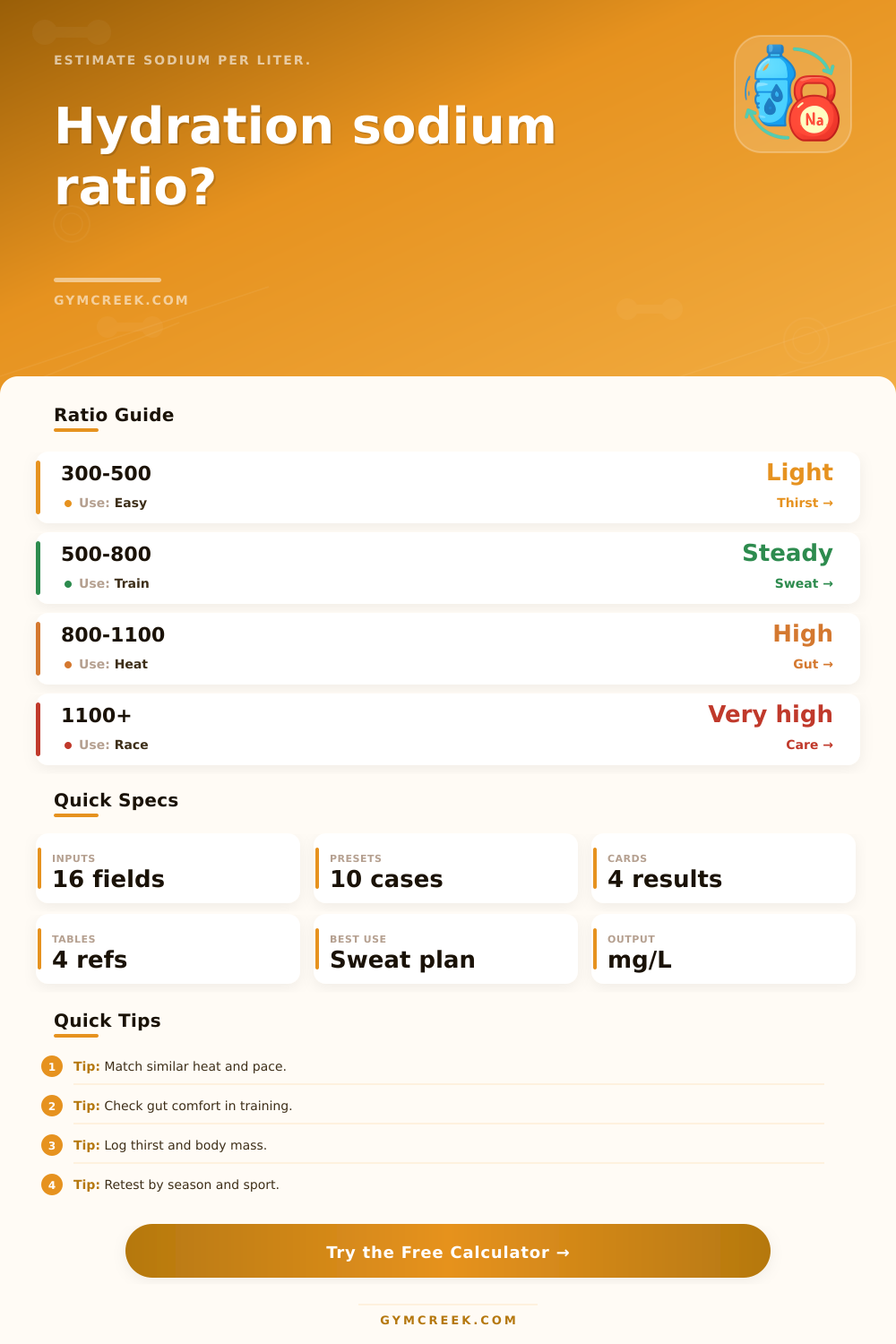
| 300-500 mg/L | Light | Short easy training | May undershoot salty sweat |
| 500-800 mg/L | Moderate | Most steady sessions | Check thirst and gut comfort |
| 800-1100 mg/L | High | Heat, long runs, court play | Practice before racing |
| 1100+ mg/L | Very high | Salty sweaters or long heat | Use measured data when possible |
| Profile | Fluid/hr | Na mg/L | Focus |
|---|---|---|---|
| Cool gym lift | 0.2-0.5 L | 300-600 | Thirst and comfort |
| Steady run | 0.4-0.8 L | 500-900 | Sweat trend |
| Hot court play | 0.6-1.2 L | 700-1100 | Repeat efforts |
| Long race prep | 0.5-1.0 L | 700-1200 | Practice plan |
| Output | Formula | Inputs | Purpose |
|---|---|---|---|
| Sodium ratio | Sodium mg / drink L | mg, L | Main concentration |
| Fluid match | Drink L/hr / sweat L/hr | L/hr | Hydration coverage |
| Sodium match | Drink Na/hr / sweat Na/hr | mg/hr | Electrolyte coverage |
| BMR context | Mifflin-St Jeor | kg, cm, age | Fitness context |
| Measure | Value | Per Hour | Training Use |
|---|---|---|---|
| Sodium ratio | --- | --- | Enter values above. |
◉Hydration Ratio Tips
A heart rate zone and/or pace split will be something most athletes is tuned into. Hydration? Nah, not so much until the cramping starts.
Water, sodium, chloride and magnesium gets lost through sweat. How much? That depends on the individual. If you drink only plain water during extreme heat, you dilute your blood electrolyte level. This cause an imbalance that impacts nerve function and fluid retention. Training beyond just a stroll around the block require understanding the fluid/sodium ratio.
How to Drink Water Correctly When You Sweat
The tool above calculate concentration. It considers variables such as drink volume, temperature and sweat rate. Because we incorrectly assume that all our sweat is equal, most individual will get this wrong. Some athletes loses grams of sodium an hour, while others lose hardly anything. This adjust based off intensity and heat strain. Enter your estimate of how much sodium was in the fluid you lost and it tells you if you replaced what you lost.
For various situations, the reference table nicely show the range. For a low-sweat day where you want to recover easy, use something around 300 to 500 milligrams per liter. In hot weather, though, that will not cut it. When you are sweating hard, pushing yourself and the sun is beating down, bump your intake to approximately 800 or as high as 1,100 milligrams per liter.
Why? Because sodium encourages thirst and allow water to be absorbed more quickly into the stomach. If you don’t have adequate salt, the fluid simply passes on through without properly hydrating your cell. It’s not all about carbohydrates, either. “The carb concentration gets factored into the equation as well; sugar helps your body absorb sodium, so if your drink has too many carbs and not enough salt, it will stay heavy in your stomach,” says the calculator. “That leads to that dreaded ‘sloshing’ feeling during an event. Ideally, you want something that pulls sugar and water into your system efficient, while salt pulls them both out. This matters when it comes down to that last mile of a race.
The only way to nail down these figures is by testing your own sweat rate. To do so, weigh yourself before and after a workout, recording water intake along the way. For every pound you’ve dropped, assume that’s about a liter of fluid lost. Add back what you consumed. Now you know your actual sweat rate. Plug it into the calculator and create a hydration plan that suits your body.
Follow generic social-media recommendations at your peril: everyone’s different, and your body changes with the season. Training days is practice for race day. It’s not so much that your body can’t go farther than it is finding something that sits well in your gut. Try various drinks with different concentrations and sip more slowly if higher sodium content doesn’t agree with you on longer runs. Find your sweet spot. Know what works for you BEFORE race day comes along.
So many folks experiment with new products come race time versus practicing on their long run. The calculator gives you a starting point but real world experience verify whether or not it’ll work for you.
Then there’s heat. When it is hot, our bodies has a hard time cooling themselves because sweat can’t evaporate as much due to higher humidity. Our bodies then crank out even more in order to do so which results in a much larger loss of sodium. The tool takes that into account by also requesting you input your environment (i.e., temperature and humidity). Based off those numbers, it will adjust the ratio recommendations. If you ignore the environment, you’ll end up under-replacing. Everything seems great for an hour and then boom, you’re crashing because you ran out of electrolytes.
Hydration requires practice and patience. Use the calculator as a starting point, it’s not gospel. Experiment. Feel out what suits your taste buds and your body. Some folks require salty water to hit their hydration goals. Others have a hard time stomaching robust flavors. Experiment until you land on something that fits your tastes and your performance level. Your gut should of stayed happy while you remain energized.
You’ll take the guesswork out of this equation when you can match your fluid consumption to your individual losses. If you think of hydration as fuel rather than a chore, and get your fluids right, your body will run smoothly when the miles and temps goes up. Salt isn’t all bad; plain old water has its time and place too, but it’s the salt that keeps you in the game.