Hydration Loss Calculator
Estimate net fluid loss, sweat rate, dehydration percentage, replacement volume, and sodium loss from body weight change, fluid intake, urine loss, duration, temperature, sweat rate, sodium concentration, and sport.
📌Hydration Loss Presets
Presets load realistic training sessions so you can compare body-mass change, intake, urine output, heat, sport demand, sodium concentration, and known sweat-rate scenarios.
⚙Calculator Inputs
Fluid loss snapshot
Enter your session data to calculate sweat loss, dehydration percentage, replacement fluid, and sodium loss.
📊Hydration Metrics Grid
📑Hydration Reference Tables
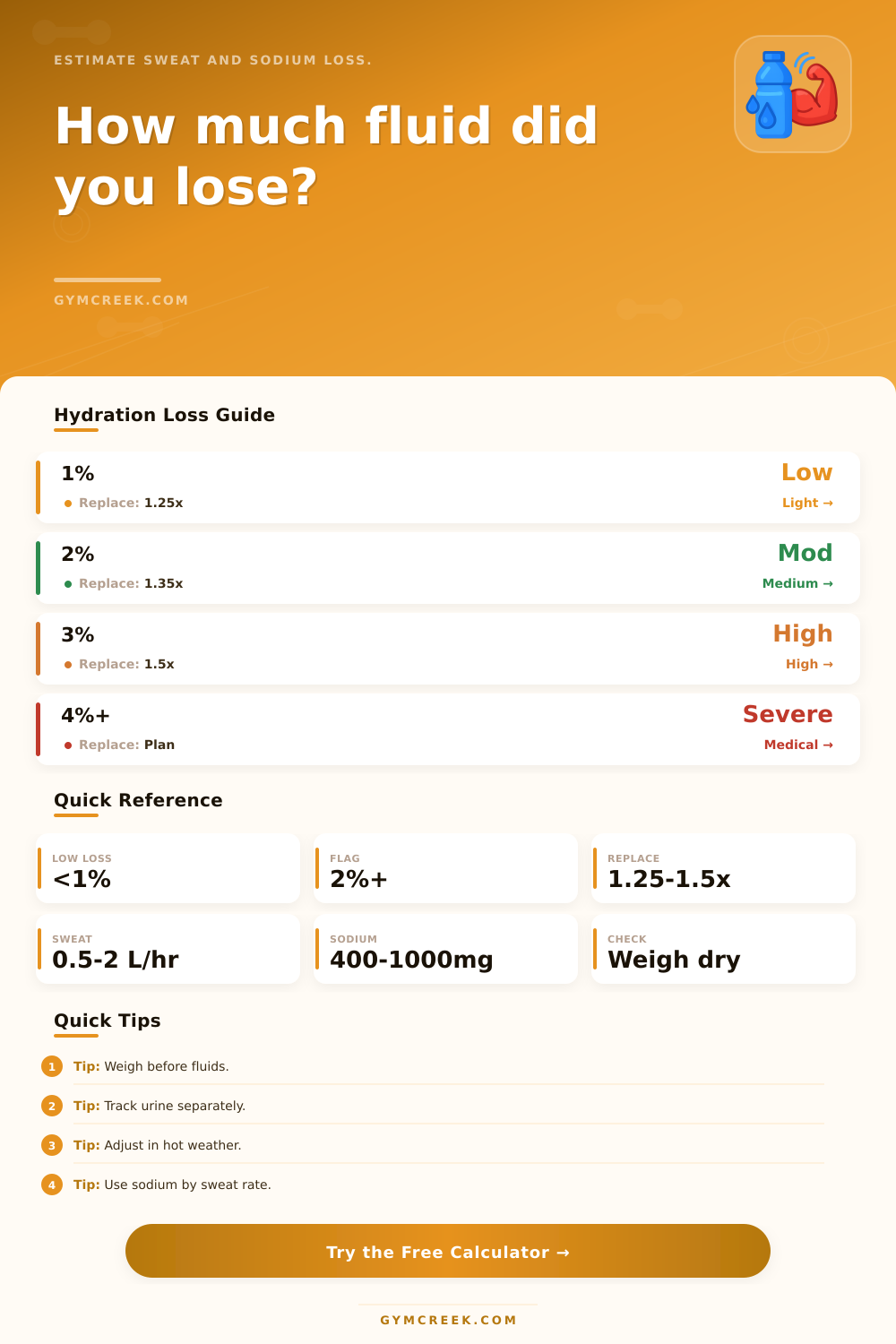
| Body weight loss | Common meaning | Replacement cue | Training action |
|---|---|---|---|
| 0% to 1% | Low fluid deficit for most healthy athletes | Normal meals and thirst may cover it | Keep weighing method consistent |
| 1% to 2% | Meaningful loss, especially in heat | Replace about 125% of the deficit | Review intake timing next session |
| 2% to 3% | Performance and heat-stress risk can rise | Replace about 135% to 150% | Build a fluid plan before repeat sessions |
| 3%+ | High loss; recovery may be compromised | Use careful rehydration and monitoring | Consider medical guidance if symptoms occur |
| Sweat rate | Typical context | Hydration cue | Sodium cue |
|---|---|---|---|
| Under 0.5 L/hr | Cool, short, or low intensity | Avoid over-drinking | Usually modest sodium loss |
| 0.5 to 1.0 L/hr | Common moderate training range | Small regular drinks often work | Use food or electrolyte as needed |
| 1.0 to 1.5 L/hr | Hard, hot, humid, or larger athlete | Plan intake before training | Sodium can matter in long sessions |
| 1.5+ L/hr | Very heavy sweating or heat load | Test repeat sessions carefully | Individual sodium testing may help |
| Sodium concentration | Category | Total-loss effect | Practical note |
|---|---|---|---|
| 300 to 600 mg/L | Lower sodium sweat | Lower replacement pressure | Regular salty foods may be enough |
| 600 to 900 mg/L | Moderate sodium sweat | Common athlete planning range | Long hot sessions need attention |
| 900 to 1200 mg/L | Higher sodium sweat | Total loss climbs quickly | Use measured intake targets |
| 1200+ mg/L | Very high sodium sweat | Large losses in endurance heat | Consider professional testing |
| Sport context | Main variable | Measurement issue | Planning cue |
|---|---|---|---|
| Running and field sports | High air flow and body heat | Sweat trapped in clothing can skew weight | Use dry towel and same scale |
| Cycling and indoor trainer | Airflow changes sweat evaporation | Bottle intake is easy to track | Record fan, room temp, and kit |
| Court sports and football | Stop-start intensity and gear | Breaks can change intake pattern | Weigh before and after each practice |
| Swimming and triathlon | Fluid access varies by segment | Body water on suit affects scale | Dry consistently before weighing |
💡Hydration Loss Tips
Maintaining fluid balance is a necessary process for individuals during training. Maintaining fluid balance become important for individuals who notice that there clothing is becoming heavy or their running pace slows with time. The body loses water through the process of sweating, but the rate at which the body loses water is different for each individual due to factors like heat, effort, the type of clothing worn, and the amount of time that the individual is performing there activities.
For many individuals, it is only after there performance with decline or there recovery from training declines that they become aware of the loss of fluids from the body. By tracking the amount of fluid that an individual loses, that individual can create a plan to manage such fluid loss. The fluid loss calculator is a tool that can help individuals to determine fluid loss from the body.
How to Track Fluid Loss and Replace Fluids
The calculator asks for the weight of the individual both before and after the session that is to be tracked, the amount of fluid that was consumed during that session, the amount of fluid that was urinated during that session, the amount of time for which the individual was performing the activity, the fluid temperature of the environment in which the activity was performed, and the saltiness of the individuals sweat. Based off these measurements, the calculator can determine net fluid loss, fluid loss due to sweating, the percentage of the bodys weight that the individual lost during the activity, and the amount of sodium that the individual lost in the fluid that was lost. By using the same process to determine fluid loss for each training session, an individual can understand the bodys patterns in relation to fluid loss.
The measurement of the body weight before and after the performance of an activity is the most reliable means of measuring fluid loss. The body weight before and after the activity is reliable because each kilogram of body weight that an individual loses indicates that the individual lost that amount of fluid from the body. True fluid loss can be calculated by adding the amount of fluid that the individual consumed during the activity, but subtracting the amount of urine that was produced.
If an individuals weight after the activity is less than the weight before the activity, then the individual has lost fluid through the process of sweating. If the weight after the activity is more than the weight before the activity, then there is an error in the measurement of the individuals weight. Sweat rate can vary based on a variety of factors.
For instance, the same athlete may lose different amounts of fluid in hot weather than in cool weather. In this case, the individual can input the individuals known sweat rate into the calculator to ensure that the fluid loss calculations is accurate. Additionally, there are reference tables for different levels of sweat rates, which indicates whether the individuals sweat rate falls into a common range or a high range.
Similar to fluid loss, the amount of sodium that an individual loses with fluid loss can vary. For instance, some athletes may lose small amounts of sodium with the fluid that they sweat, while other athletes may lose large amounts. The amount of sodium that an athlete loses can indicate how quickly they feel flat or develop cramps.
By measuring the sodium concentration of the fluid that is lost, the calculator can accurately determine the total amount of sodium that the athlete loses with their fluid loss. Additionally, by performing the same process for a variety of activity sessions, an athlete can recognize whether they need to consume additional salt with the fluids that they consume during their activities. The volume of fluid that an athlete must replace is not the same as the amount of fluid that the athlete loses.
Fluid replacement is necessary because an individual cannot recover from an activity with only water and a normal meal. For instance, losing 2% of an individuals body weight is considered to be a significant loss. Losing 2% of an individuals body weight indicates that an individual needs to consume a replacement fluid plan.
The fluid loss calculator requires the input of a multiplier for the replacement volume to account for the fluid that is lost in urine after the activity and the inability of the body to absorb all of the fluid that is consumed. By using a multiplier for the fluid that is to be replaced, the plan for fluid replacement is both practical and realistic rather than overly optimistic. Both heat weather and the type of sport that is performed can impact the risk of dehydration.
Additionally, each of these factors can impact how the numbers are interpreted. For instance, football players who wear protective gear may experience more strain from the heat of the environment in which they play. Additionally, individual who perform court sports may experience periods in which they are resting and sweating less than during their performance of running activities.
These factors are accounted for in the fluid loss calculator with additional clues that lead to the determination of a risk in dehydration from the activity. Many individuals make mistakes when tracking fluid loss. For instance, an individual who weighs themselves after performing an activity may be wearing their wet clothing, which will lead to inaccurate measurements of fluid loss.
Additionally, individuals may forget to measure the amount of fluid that is urinated after performing an activity. An outlier result due to a hot training day may be alarming, but is not indicative of dehydration. The goal is not to perfectly measure fluid loss every training day, but to establish a baseline for an individual.
Establishing a baseline for fluid loss allows an individual to recognize when their body is deviating from their normal losses of fluid. After a variety of training weeks, an individual will experience the benefit of using the fluid loss calculator. For instance, an individual will know how much fluid to consume prior to beginning to train.
The individual will know if additional sodium needs to be consumed prior to beginning the activity, and will be able to adjust their training plan prior to the development of a fluid deficit in their body.