Hydration Calculator
Estimate daily fluid needs, workout bottle planning, sweat loss, and sodium range from your body size, training, climate, and weigh-in data.
📌Presets
Presets load realistic body sizes, training durations, climates, sweat rates, and weigh-in values, then calculate automatically.
⚙Calculator
Hydration snapshot
Enter your training and weigh-in details to estimate a practical fluid plan.
📊Metrics Comparison Grid
📈Hydration Benchmarks
📑Reference Tables
| Baseline | Total Water | Beverage Share | Use |
|---|---|---|---|
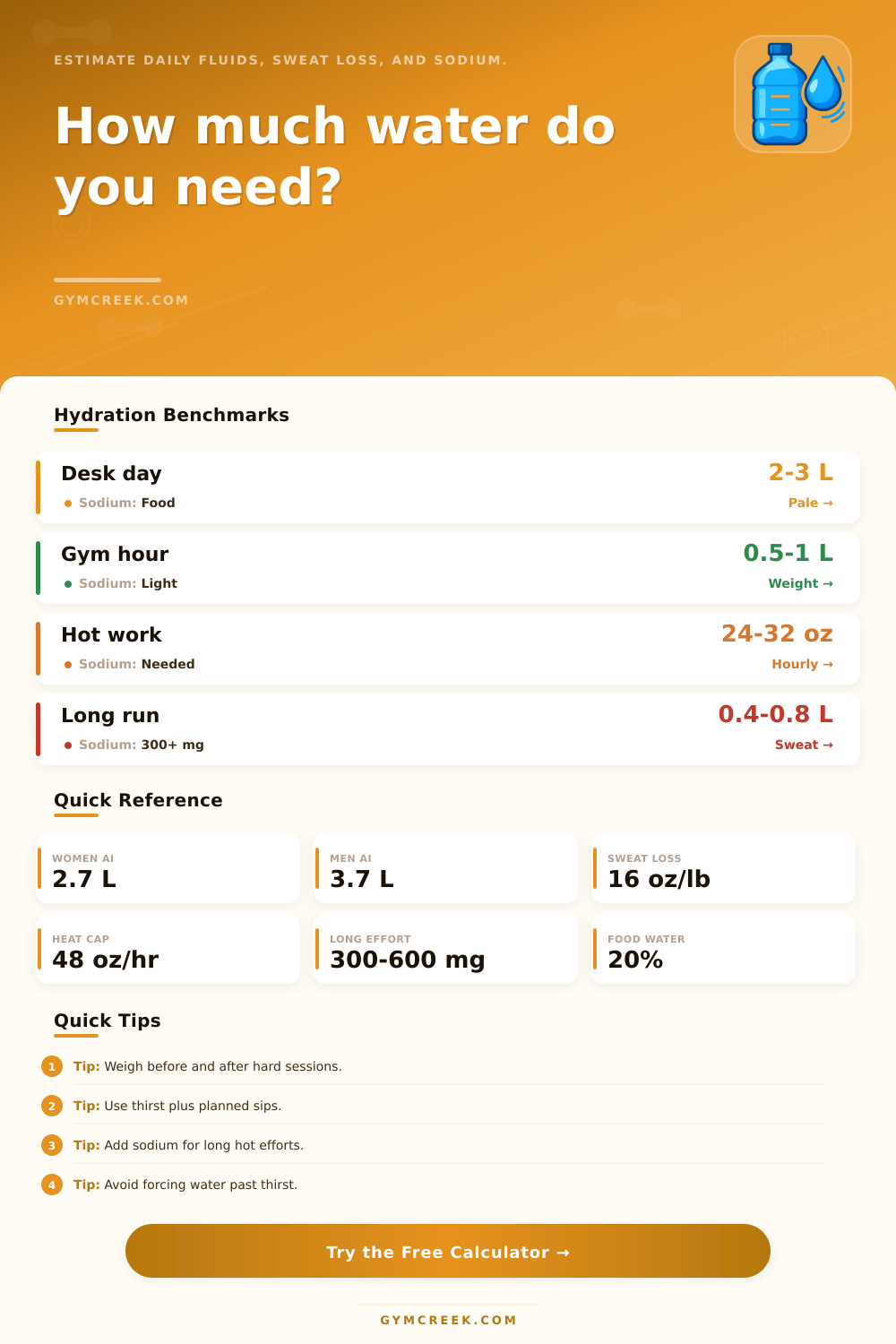
| Female adult AI | 2.7 L/day | About 2.2 L | Daily anchor |
| Male adult AI | 3.7 L/day | About 3.0 L | Daily anchor |
| Weight method | 35 mL/kg | Varies | Size check |
| Food estimate | About 20% | Subtract from total | Bottle target |
| Session Type | Drink During | Sodium Cue | Watch |
|---|---|---|---|
| Lift under 60 min | Thirst plus sips | Usually food | Dry mouth |
| Steady cardio | 0.4-0.8 L/hr | Light if hot | Body weight |
| Long hot effort | 0.6-1.0 L/hr | 300-600 mg/hr | GI comfort |
| Heat work | 24-32 oz/hr | Meals or drink | 48 oz/hr cap |
| Sweat Loss | Body Mass | After Session | Meaning |
|---|---|---|---|
| Under 1% | Small drop | Normal meals | Well matched |
| 1-2% | Moderate drop | Replace gradually | Common in sport |
| Over 2% | Large drop | Plan earlier | Performance risk |
| Weight gain | Above start | Back off fluids | Overdrinking risk |
| Formula | Variables | Output | Best Use |
|---|---|---|---|
| AI blend | Sex, weight | Daily total | Base day |
| Sweat rate | L/hr, minutes | Session loss | No scale |
| Weigh-in | Pre, post, fluid | True loss | Sport testing |
| Sodium range | Duration, salt | mg/hr | Long heat |
💡Hydration Tips
If you’re hungry, you eat; if you’re thirsty, you drink water; if you feel full, you stop eating and drinking. Great if you have a desk job. Not-so-great once you go outside in hot, sweaty conditions or start any long-duration effort where you’ll be sweating buckets for hours at a time. In those instances, the line between an uncomfortable afternoon and optimum performance hinges largely on replacing lost fluids… Not simply drinking because you think you “should.”
Most of us grossly underestimate our hourly sweat rate. We all believe we lose same amount of fluid no matter how hard we work or how warm it is. Enter your body weight, the length of your workout, and a few other environmental details, and the calculator above will do the math for you, eliminating all guesswork from your daily planning.
How to Drink the Right Amount of Water for Exercise
Dietary reference intakes for water are used as a starting point for baseline values. For average person, this is about 3.7 liters for guys and 2.7 for women. This intake includes all water (from foods and drinks), although roughly one-fifth typically originates in food: cooking, fruits, veggies, etc. That leaves the rest to be consumed via drink alone.
That’s important, because if you only count the amount of liquid water you consume, say, from bottles, then it’s easy to forget how much water you ingest from other sources: a bowl of soup, a large salad. When you use just drinks to reach these levels, you could end up overhydrating yourself or feeling puffy without knowing that half of what you needed was absorbed during lunch.
For planning workouts, it’s another story altogether. When you’re exercising, the idea is to only lose two percent of your body mass or less. Beyond that, you’ll see negative effects in terms of cognition, strength, and stamina. In order to properly measure it, go ahead and step on the scale in nothing but your workout clothes before your session, and then again after. For each pound you lose, replace about sixteen ounces with water/electrolytes. Be sure to factor in any water/electrolytes you took in throughout the workout as well.
Say you lost three pounds and drank thirty-two ounces while exercising, you actually lost eighty ounces total. The difference between those two figures is what you really need to make up. Without a scale at the gym, that’s where the tool comes in, it estimates how much you might’ve sweated off depending on how long and hard you worked out.
Intensity matters The environment matters. Running around in sweltering summer heat feels totally different than sweating it out in a climate-controlled gym while on a treadmill or lifting weights indoors. The main way our body cools off is through evaporation of sweat. Because humidity slows this process down, your body will have to work even harder to maintain cool temperatures. You work harder to stay cool, which means you sweat more profusely and lose more sodium. This is one reason why the factors of intensity and environment are so important.
What may be a tiny amount of sodium needed during an easy jogging run could mean needing to pay close attention to electrolyte replenishment when doing hard intervals training in the heat. Don’t ignore what happens to your body if you’re drinking a lot of plain water without any mineral replacement: You get cramps, feel sick, experience nausea, and develop hyponatremia.
Individuals’ sodium requirements are all over the map. You might be one who sweats buckets during workouts, leaving white salt rings across his chest at the end of each training session. Or maybe you’re the type that only breaks a light sweat in the most oppressive conditions. Adding anywhere from three-hundred to six-hundred milligrams of sodium per hour will keep you in balance if you find your gear is coated in salt or if your workouts exceed an hour. In the case of shorter workouts less than an hour, regular meals and water should suffice. No need for fancy sports drinks for every little thing you do.
The chart on the page spells this out in detail based off the type of session. This helps determine when supplements beyond water and food might actualy help and when such products are merely marketing hype. And don’t overdo fluids; even in relaxed settings, do not force them past the point of thirst. There’s also such a thing as too much water, especially among those who aimlessly pursue some arbitrary number of hours per day without accounting for their personal sweat rate.
Pay attention to cues in your body (for example, is my mouth dry?). What color is my pee? Good hydration status will produce pale yellow urine, while darker amber means it’s time to top up. So use the math as guidance, but make it a habit, and tweak it according to how you feel out there.
Generic formulas will always improve over time, via your personal experience. Mostly it’s about knowing what you’re measuring. It’s not a fill-a-quothism challenge, but rather one of balance and maintaining volume. Begin with the numbers. Confirm with self-weighs. Tinker until you find the rhythm that keeps you alert and performing at your best from coffee till recovery time.