Hydration Before Exercise Calculator
Estimate pre-workout fluid, sodium, and timing from body weight, sweat profile, workout length, heat, humidity, and how soon training starts.
📌Presets
Presets load realistic body weights, timing windows, weather, sweat profiles, sodium needs, and urine-color checks. You can edit every field after loading one.
⚙Calculator
Pre-exercise hydration plan
Enter your session details to estimate fluid and sodium before training.
📊Hydration Metrics
📑Reference Tables
| Step | When | Fluid | Purpose |
|---|---|---|---|
| Main drink | --- | --- | Build reserve |
| Recheck | --- | --- | Urine cue |
| Final sips | --- | --- | Gut comfort |
| Start | --- | --- | Ready check |
| Window | Fluid target | Best use | Watch for |
|---|---|---|---|
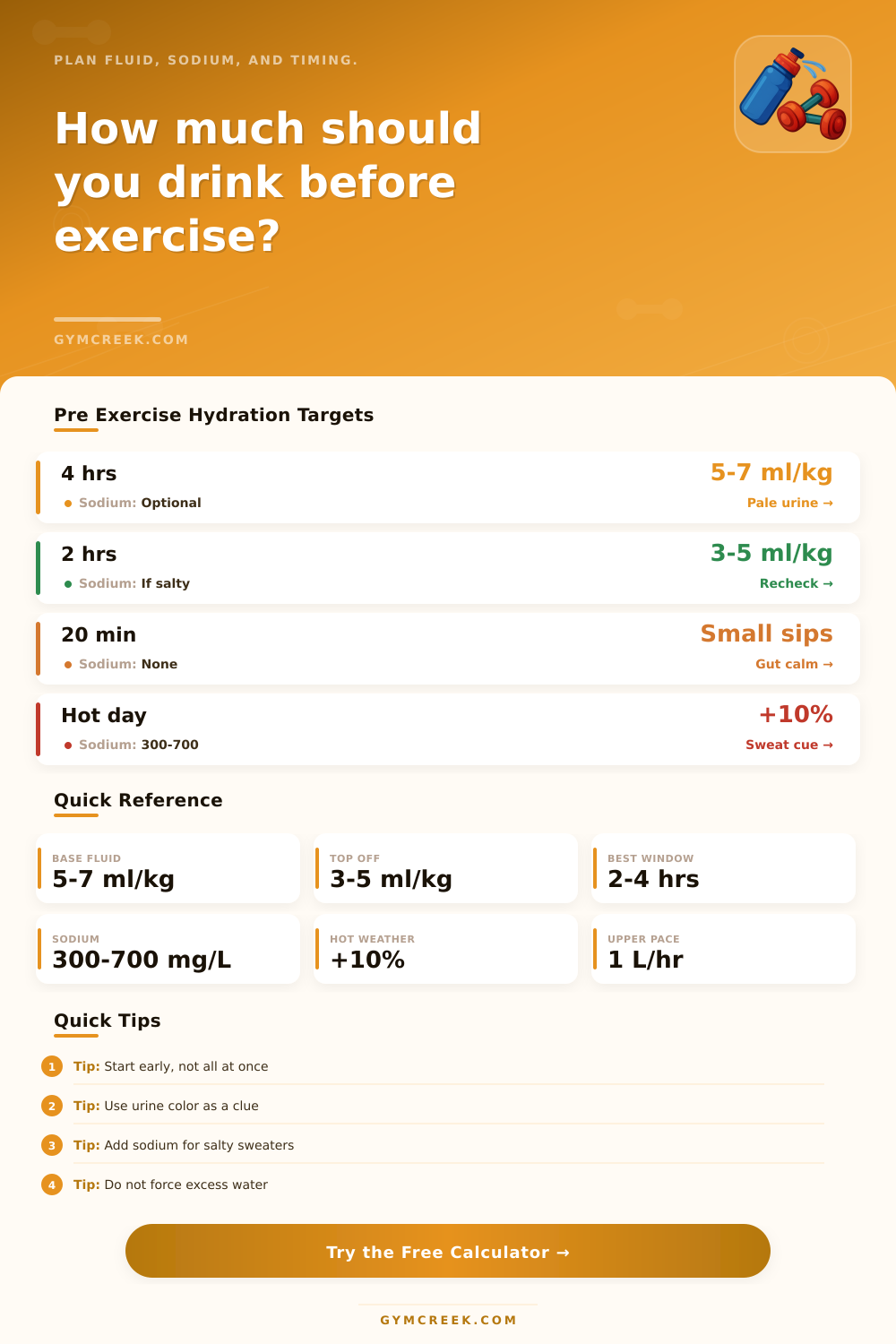
| 4 hours | 5 to 7 ml/kg | Main preload | Bathroom time |
| 2 hours | 3 to 5 ml/kg | Top-off | Dark urine |
| 20 minutes | Small sips | Mouth feel | Sloshy gut |
| Hot starts | Add 5 to 15% | Heat buffer | Sweat rate |
| Condition | Trigger | Fluid change | Sodium cue |
|---|---|---|---|
| Cool | Under 50°F | Slight lower | Usually low |
| Mild | 50 to 74°F | Baseline | Optional |
| Warm | 75 to 85°F | Small add | Consider |
| Hot | Over 85°F | Higher add | Often useful |
| Humid | Over 70% | Extra add | Often useful |
| Sweat cue | Sodium range | Fluid cue | Planning note |
|---|---|---|---|
| Light | 200 to 400 mg/L | Lower end | Avoid forcing |
| Average | 300 to 600 mg/L | Baseline | Most sessions |
| Heavy | 500 to 800 mg/L | Higher end | Heat caution |
| Salty | 700 to 1000 mg/L | Higher end | Salt marks |
💡Hydration Tips
Before exercise, the thought of being dehydrated strike fear in your heart. “I don’t want to go pee, so I’m going to wait three hours without drinking anything.”
Ten minutes into exercise, though, your heart is pounding. You’re not even tired, and you’re getting slower. Too much water? Too little water? How do you know which one is right?
How to Stay Hydrated for Exercise
Use hydration calculator. Plug in your weight and the weather conditions. Let the calculator figure out how much to drink. That way, there’s no guessing whether you need more electrolytes or whether you’re just thirsty. You will have no more questions about when to prepare, and you will have more time to focus on exercise itself.
Hydration isn’t an event, it’s a timeline. Your body can’t take in that much water all at once (especially if you’re drinking two liters just prior to lacing up), so it would of probably make your stomach feel funny while warming up. Picture a bucket with a small hole in the bottom: the goal is to fill that bucket. That’s why the calculator split the intake over windows of time. Suggesting a main load several hours out and a smaller top-off closer to the start. It models what happens inside your kidneys. If you show up to exercise with a full bladder, they can’t handle the workload, so there’s no time for them to filter extra water and send it out the door.
Why do people mess this up? They jam it all down their throats at one time, it doesn’t work well. It makes you all sloshy but doesn’t hydrate cells.
“People don’t understand how big an effect weather can have on their performance.” Because “in warmer temperatures your body prioritizes cooling itself off by sweating, which siphons some of that water from getting into your muscles and helping cognitive function.” To account for this, the tool will tack onto your base need a little bit more (if you’re exercising outdoors), factoring in things like higher humidity or warmer temps.
“It’s not just because you feel warmer, it’s also about blood volume. If you’ve lost all that fluid before you start working out, your heart has to pump more blood to get the same amount of oxygen in there. This makes everything feel extra heavy. You’ll think you’re out-of-shape but actualy you were just unfueled with H2O.
Finally, prepping for sodium is commonly neglected; most folks think “salt = bad” when it comes to running due to dehydrating effects of acute overload. Sodium assist in retaining hydration by allowing the fluid you consume to move into your cells (rather than right through and out the other end). Some people are heavier sweaters than others, which accounts for the option to select a specific sweat profile in the calculator. If you frequently get leg cramps even while consuming adequate water, and/or notice white streaking on clothing following exercise, chances are you’re a salty dog. Not heeding this advice will result in hyponatremia, an unsafe state where your body’s level of sodium becomes dangerously low due to excessive intake of plain water without replenishing lost electrolytes. It is a quiet trap that feels fine until, all at once, it does not.
No algorithm will ever trump the feedback loop in your bladder: your urine color. If it’s light yellow, you’re good; if it’s dark amber, drink up now and slow down your fluid intake. A handy reference table is provided on page along with time cues for when to check. Checking your urine and seeing pale yellow four hours before training could help you drink a little less during your last refill. Twenty minutes after guzzling water and seeing the dark stuff? Well, too late, you gotta start early. That biofeedback closes the gap between calculation and dynamics.
Hydration is about removing things that change. It’s about getting yourself to a point where performance isn’t in question. If I know exactly what water to drink, how much sodium to eat during the run, and how to adjust based off the elements, then my headspace doesn’t have to wonder about any of that. Instead, it gets to focus on my form and pace.
I step onto the track with all those concerns removed, feeling neither too light nor too heavy, just right, and ready to go hard while my body doesn’t fight me along the way. Settled going into the starting line, and when the gun fires, the only thing going up is my effort.