Hula Hoop Calorie Calculator
Estimate calories burned from waist hooping, dance flows, power intervals, weighted hoops, cadence, step movement, arm add-ons, rest ratio, duration, and adjusted MET logic.
📌Presets
Each preset loads a realistic hula hoop session and recalculates calories from body mass, hoop load, cadence, style, added movement, and planned rest.
⚙Calculator
Hula hoop calorie snapshot
Enter your session structure to estimate hula hoop calories.
📊Fitness Metrics
🧮Formula Cards
Calories per minute = MET x 3.5 x body weight in kg / 200. This is applied separately to active hooping and rest time.
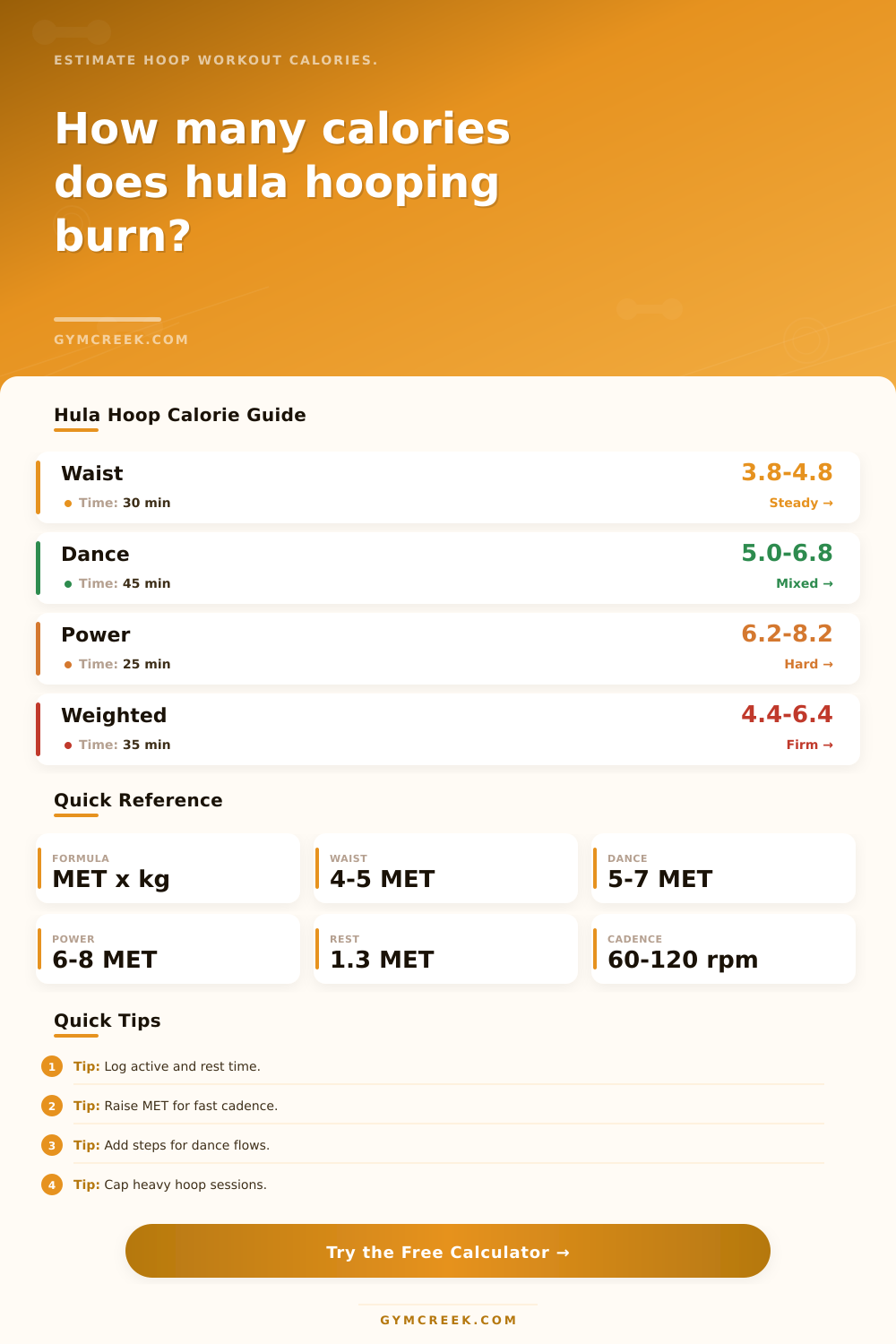
Waist hooping, dance hooping, weighted sessions, flow practice, and power intervals start from separate MET bands before modifiers.
Hoop weight, cadence, arm work, stepping, direction changes, and continuous hooping share adjust the active MET within a capped range.
Mifflin-St Jeor estimates BMR from age, body size, and gender, then activity level estimates TDEE for daily share comparison.
📑Reference Tables
| Hoop Style | Easy | Steady | Hard |
|---|---|---|---|
| Waist hooping | 3.8 MET | 4.5 MET | 5.4 MET |
| Dance hooping | 4.8 MET | 5.8 MET | 7.0 MET |
| Weighted waist | 4.4 MET | 5.3 MET | 6.4 MET |
| Power intervals | 5.6 MET | 6.8 MET | 8.4 MET |
| Flow practice | 4.2 MET | 5.4 MET | 6.8 MET |
| Hoop Weight | Range | Modifier | Best Fit |
|---|---|---|---|
| Light dance | 0.5 to 1 lb | 0.98x | Tricks |
| Standard fitness | 1 to 2 lb | 1.00x | Cardio |
| Weighted | 2 to 4 lb | 1.06x | Waist work |
| Very heavy | 4 to 6 lb | 1.10x | Short bouts |
| Cadence | RPM | Modifier | Feel |
|---|---|---|---|
| Learning pace | 35 to 55 | 0.90x | Easy |
| Steady rhythm | 56 to 85 | 1.00x | Moderate |
| Fast cardio | 86 to 120 | 1.10x | Brisk |
| Interval pace | 121 plus | 1.18x | Hard |
| Formula | Variables | Output | When Used |
|---|---|---|---|
| MET kcal | MET, kg, min | Calories | Main burn |
| Active split | Time, rest % | Work min | Session split |
| Hoop load | Weight, rpm | MET factor | Intensity |
| TDEE share | kcal, TDEE | Percent | Daily context |
💡Tips
When you think of hula hoops, you probably remember them being a easygoing summer pastime, pretending like you threw it on purpose when the ring fell down.
Hoop fitness these days are a real thing: a full-body calorie-burning cardio routine that targets the core while strengthening posture and stabilizing muscle. Problem? How can you tell how intense you’re working? Enter the calculator above. Input some information about your session and let it do math. This way, you will know if you just had a warmup or if you realy got in a metabolic workout for those twenty minutes.
How to Calculate Your Hula Hoop Calories
So what’s the key? Well, that’s where the metabolic equivalent of task, or MET come in. It’s a measure of how much oxygen your body use relative to sitting still. A typical waist hooping workout clocks in between 3-4 METS (think: a brisk walk). If you’re using a heavier hoop or dancing along to more complex moves, it’ll be higher. You can choose from different styles and intensities with the tool, so it will adjust your base-level energy use based off what you actualy do.
That’s something most people overlook. They think any hooping are the same. You burn fewer calories spinning a lightweight plastic hoop slowly then you do bouncing around the room to a fast beat with a heavy hoop.
Hoop weight is another important variable: more weight doesn’t always equal more burn. Go too heavy, and you’ll slow your rotation down and break flow. This can strangly reduce your overall heart rate. To account for this, there’s a limit on hoop weight modifications in the calculator. Fitness hoops typically weighs between one and two pounds, light enough so that you can keep up a fast pace, yet with enough heft for your core muscle to get some real feedback.
The real calorie burn come when you’re going really fast, when the ring is spinning anywhere from eighty to one hundred twenty times a minute. It takes a lot of small adjustments from the abdomen and hips to keep it aloft like that. This transforms a still standing pose into something that uses your entire body.
Adding lower body and upper body motion will also make it harder. But it’s not “just” that. Step patterns and arm motions adds input that makes this workout go beyond a core isolation drill to a complete body cardio session. Traveling around with dance steps or moving your arms in a series of flows use bigger muscles. That requires more fuel and oxygen. Relaxing your hands while staying relatively still gets you a good core workout. Moving your arms overhead, stepping, and pivoting turn this into a dance fitness class. The impact on energy use is large. And the tool accounts for that change by recalculating the final total based on those layers of movement.
Perhaps the most truthful input into the whole process is the rest ratio. Rest is when you’re doing something other than actively spinning like learning a new trick or recovering from a drop, and you aren’t burning calories the same way then as you do when you are actively spinning. You should estimate what percentage of your session involved resting, taking a drink, adjusting the hoop or otherwise not actively spinning. Overstating your effort here would of being dishonest to yourself. A session with twenty percent rest and continuous flow is entirely different than the other. One is a great practice session. The other is a high intensity interval workout. Knowing which one it is will help you know your position.
It’s not about the specific calorie count, but rather the correlation between input and output. When you can see how stepping it up a notch (or breaking into a run); increases your burn, you have the motivation to push harder. It’s like looking in the mirror of numbers.
You begin with a gentle turn here and there, just rotating in your livig room. After awhile, it transforms into an intricate, heart-pumping flow that has you gasping for air. Your ring remains up. And so does your fitness.