
The barbell bench press is something most gym goers reach a wall with. If your right shoulder are tighter then your left, you compensate on every single rep as the iron bar take you down its path. That imbalance will stall your progress over time, and it’ll create pain to.
Ditch the bar and pick up some dumbbells and you change dynamic entirely. The benefit is much greater than the loss of bar stability. Without the bar there, each side have to be stable by itself.
Step By Step Dumbbell Bench Press Guide
Why Dumbbells Fix Imbalance
This little tweak forces those smaller stabilizer muscles to fire with increased effort and allows for even development on both sides of your chest. A very small equipment change result in a huge difference in body symmetry. One of the greatest errors I see from people moving over to dumbbells is lifting too heavy.
Avoiding Ego Lifting Mistakes
Lifting 45 pound dumbbells doesn’t mean your dumbbell bench press are going to be the same as the 45 pounds on a barbell. Odds are it’s going to be much less. It is not because you’re weak, but rather because there is different stability requirements now.
Go and ego-lift heavy dumbbells and odds are high that you’ll end up with a sore shoulder rather than a larger chest.
Proper Body Positioning Setup
Lie down on flat bench, legs on the ground and feet on the floor. Keep a natural arch in your lower back without arching it too high off the bench or flattening it out.
This is considered neutral spine. Position the dumbbells perpendicular to the bench, at shoulder level. Keep them close to body to protect your joints.
To set the shoulder blades, engage the lat muscles by bringing your elbows down and back towards your hips. That pulling back of the shoulder blades establish a good shelf from which you can press. Rounded shoulders result from many lifters skipping this action; it also negative affects force transfer.
Executing the Press and Descent
After setting your shoulder blades, drive weights upwards with your palms (not your wrists). It should be a controlled, non-chaotic action. Now it’s time for the descent.
Let the dumbbells down gradually and let your elbows drop slightly below shoulder height. Don’t get a pinch between your shoulders; instead, focus on a good stretch throughout the chest muscle. Avoid flaring your elbows out at right angles because that put too much stress on the rotator cuff.
Try to keep them at around forty five degrees from your torso. The tuck also keep tension in the chest fibers and lessens the shearing force of the joint. If you’re used to wide flared elbows, it will feel awkward.
Hang with it. As your body learns the movement, you will feel discomfort, but it will go away. Your press should be a smooth deliberate move, not a frenzied battle to regain balance.
There’s no negotiating range of motion. Dumbbell partials don’t count. If you can’t control weight during the bottom of the movement, then it’s too heavy for you.
Back off a notch by cutting 10 pounds from your total and concentrate on achieving full stretch. Full-range repetitions performed consistently will build you more muscle than half-reps executed with to much weight. The breathing is not so much about pumping iron, but rather it’s a subtle yet critical component for stability.
Breathing and Eccentric Control
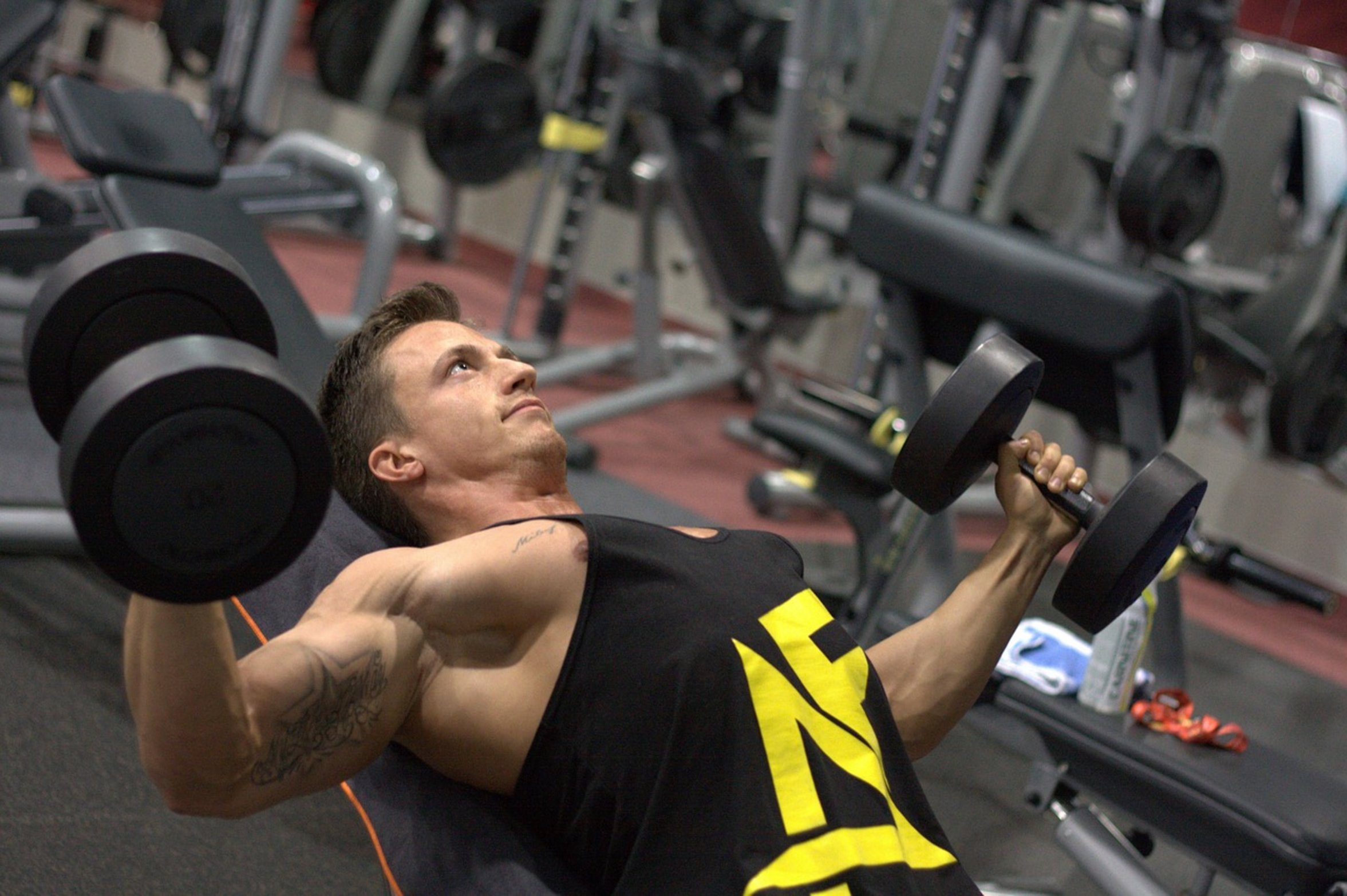
When you’re lowering the weights, inhale deeply. Then as you’re driving up hold your breath or exhale slow. That belly pressure help you keep your upper back tight and protects your spine.
If you blow out too soon, you’ll lose connection to your core and your ribs will flare out. Lastly, complete each set with control. Don’t drop the weights out of hands on the top.
Bring them down to the start position just as carefully as you pressed them up. A lot of the muscle damage. And thus a lot of the growth, takes place during this eccentric phase.
Skimping on the lowering phase will reduce efficiency of this exercise. The dumbbell bench press is not something that gets mastered overnight. It requires patience as you’re retraining your body to work with free weights, without the safety net of fixed bar.
You should of trusted the process. Go light and focus on form. Pay attention to how you feel in your shoulders and chest; they’ll be thanking you for all the attention to detail.
You’re building symmetry now that will benefit you years from now.
