Calories Burned Housework Calculator
Estimate housework calories from body weight, task mix, duration, intensity, stairs, carried loads, vacuum or mop time, breaks, and weekly frequency.
📌Housework Presets
Presets load realistic cleaning sessions and recalculate automatically.
⚙Calculator Inputs
Housework calorie snapshot
Enter your session details to estimate calories, active minutes, weighted MET mix, weekly burn, and step equivalent.
📊Housework Metrics
📑Reference Tables
| Task | Typical MET | Effort cue | Use in calculator |
|---|---|---|---|
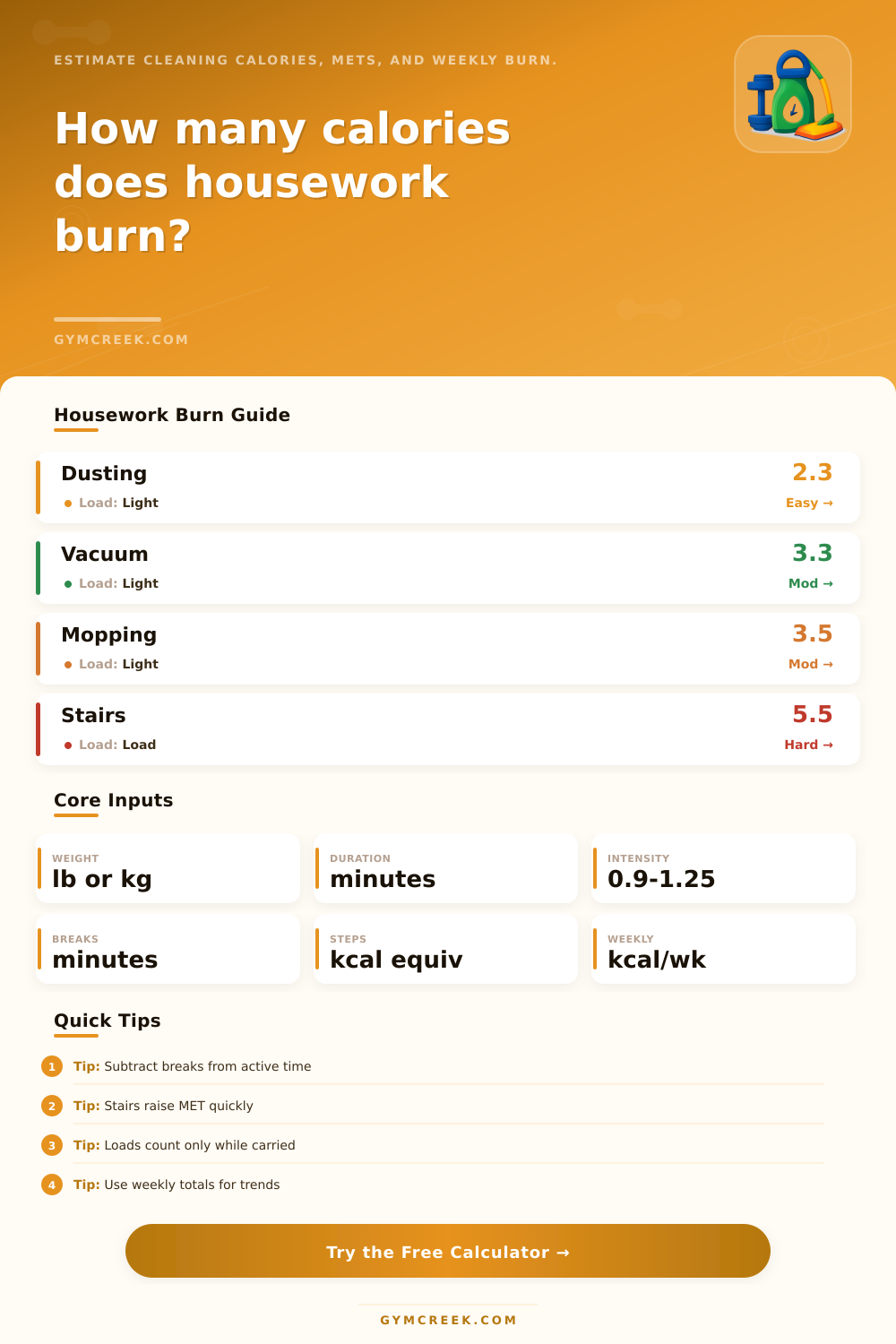
| Dusting, light tidying | 2.3 | Easy | Light household movement. |
| Dishes and kitchen surfaces | 2.5 | Easy to moderate | Standing work with reach and wipe cycles. |
| Making beds and changing linens | 3.0 | Moderate | Repeated bending and lifting. |
| Vacuuming or sweeping | 3.3 | Moderate | Continuous floor movement. |
| Mopping or scrubbing floors | 3.5 | Moderate | Higher upper-body effort. |
| Heavy cleaning or moving items | 4.8 | Hard | Hauling, bins, boxes, or furniture shifts. |
| Stairs with housework | 5.5 | Hard | Climbing between floors or carrying laundry. |
| Mix | Base MET | Main tasks | Best for |
|---|---|---|---|
| Light tidying | 2.4 | Dust, pick up, dishes | Short tidy sessions. |
| General cleaning | 3.0 | Surfaces, floors, laundry | Routine home cleaning. |
| Floor focus | 3.4 | Vacuum, sweep, mop | Apartment or whole-floor reset. |
| Deep clean | 3.7 | Scrub, bend, reach | Bathroom or kitchen detail work. |
| Heavy clean | 4.2 | Move, haul, carry | Garage, storage, move-out jobs. |
| Input | Low | Middle | High |
|---|---|---|---|
| Intensity factor | 0.90 easy | 1.00 steady | 1.25 hard |
| Carrying load | +0.00 MET | +0.20 MET | +0.45 MET |
| Stairs | 5.5 MET | Weighted by min | Caps at active time |
| Breaks | 1.3 MET | Subtracted active | Included in total |
| Metric | Formula | Output | Notes |
|---|---|---|---|
| Active minutes | Duration - breaks | Minutes | Capped at zero and total duration. |
| Weighted MET | Task minutes x MET | MET mix | Includes stairs and floor-time weighting. |
| Calories | MET x 3.5 x kg / 200 x min | kcal | Standard exercise energy equation. |
| Step equivalent | kcal / kcal per step | Steps | Uses about 0.045 kcal per step at 70 kg. |
| Weekly burn | Session kcal x frequency | kcal/week | Assumes similar sessions each week. |
💡Calculation Tips
Housework is a form of physical work. Furthermore, housework cause the body to burn calories. The types of movement that can be used for housework will burn calories in the same way that light exercise will burn calories for the same amount of time.
Additionally, the number of calorie that can be burned during housework will depend on the tasks that the individual performs, as well as the length of time that they spend on performing those tasks. The amount of energy that the body uses during housework will depend on the weight of the individual that is performing the tasks. For instance, individuals with a higher body weight will have to use more energy during housework than individuals with a lower body weight.
How Housework Burns Calories
Additionally, the energy that is used during housework will also change depending upon the type of task that are performed during housework. For instance, tasks such as dusting and laundry folding are considered to be light tasks, but tasks that include mopping floors or heavy boxes will require more energy to be performed. For instance, if an individual is required to climb stairs during there housework, more energy will be used than if they were to remain on only one floor within the house.
Thus, the energy that will be used during tasks like carrying laundry up and down the stairs will be more different than if they remained on only one floor and performed the housework. The duration of the housework can also impact the amount of energy that is used. For instance, if an individual calculates the total amount of time that they spent on housework during a particular time period, the total amount of time will include tasks like walking into the room to perform the task, as well as tasks like taking a text message or waiting for a machine to perform its task.
Thus, the total amount of time for housework will be more than the amount of actual time performing tasks, so the amount of energy used can only be calculated if that idle time is subtracted from the total time. Thus, the calculator can provide an estimate for these variables, including the weight of the individual, the type of tasks that they perform, and the length of time that they perform those tasks. Another variable that can impact the energy used during housework is the intensity of the tasks that are performed.
For instance, housework that is performed at a steady pace will require less energy than if the individual is performing the tasks at a highly rate of intensity. For instance, if the individual is required to carry heavy loads of laundry, it will require more energy than if they were to perform the tasks without moving any load. Additionally, tasks that are performed on the floor, such as vacuuming, will require more energy than tasks like folding laundry.
Thus, any estimates of energy use should separate floor task from light housework tasks. In addition to considering the various tasks that is performed individually, it is also possible to calculate the total amount of housework that is performed during a week. For instance, if an individual performs thorough housework twice a week, they will use more energy during a week than if they perform short task daily.
Additionally, it is also possible to compare the energy use to a step equivalent for the housework tasks. Thus, it is also possible to determine if the energy used during housework can be considered a daily goal or target for the individual. The calculations for energy use during housework tasks will involve the use of MET (metabolic equivalent of task) value.
MET values relate the amount of energy required for a specific type of housework to the amount of energy that is required by an individual while they are sitting still. Thus, tasks like light dusting will have a lower MET value than tasks like climbing stairs with a load. Thus, MET values allow the calculations to account for differences in body weight for each individual, as well as account for the length of time that they perform those tasks.
Floor tasks will also impact the energy that is used. For instance, if an individual performs their housework, they may perform tasks in the kitchen, they may clean the bathrooms, they may fold laundry, and they may move the folded laundry to the basement on a laundry cart. Thus, there are a variety of task that can be performed during the housework.
Task mix options allow for the individual to account for the amount of time that they spend on each of these tasks, allowing for a calculation to determine how much energy was used for each task during the period of time that the tasks were performed. The housework calculator can provide a baseline measurement of energy use during housework. However, it is also possible to measure the amount of effort that is required of an individual’s body during housework.
For instance, if an individual feels as if they are tired or rushing, it is likely that they will find the task to be more difficult than if they were to feel rested or take a break from their tasks. Thus, the calculator can provide a baseline for energy use, but individual effort will be different during different states of the individuals body. Thus, the calorie calculation is a baseline estimate, but individual effort should of also be considered in relationship to their goal for housework.
The main value of using the housework calculator is that individuals can begin to notice the patterns in their physical activity. For instance, if they find that the amount of energy that is burned during housework is higher than that which they expected, they may change their thoughts about other physical activities. In contrast, if the amount of energy that is burned during housework is lower than expected, they may change their plans to incorporate more housework into their goals for that week.
Thus, this calculator can help individuals to gain a better understanding of there body energy use during a typical week.