Horseback Riding Calorie Calculator
Estimate calories burned from rider weight, gait split, arena or trail setting, posting trot time, grooming, tacking, leading, terrain, and session intensity.
📌Presets
Each preset loads a realistic riding profile and recalculates calories from mounted work plus barn handling time.
⚙Calculator
Horseback riding calorie snapshot
Enter gait split, barn work, setting, terrain, and rider details to estimate total calories.
📊Fitness Metrics
🧮Formula Cards
Calories per minute = MET x 3.5 x body weight in kg / 200. Every mounted and barn segment uses this equation.
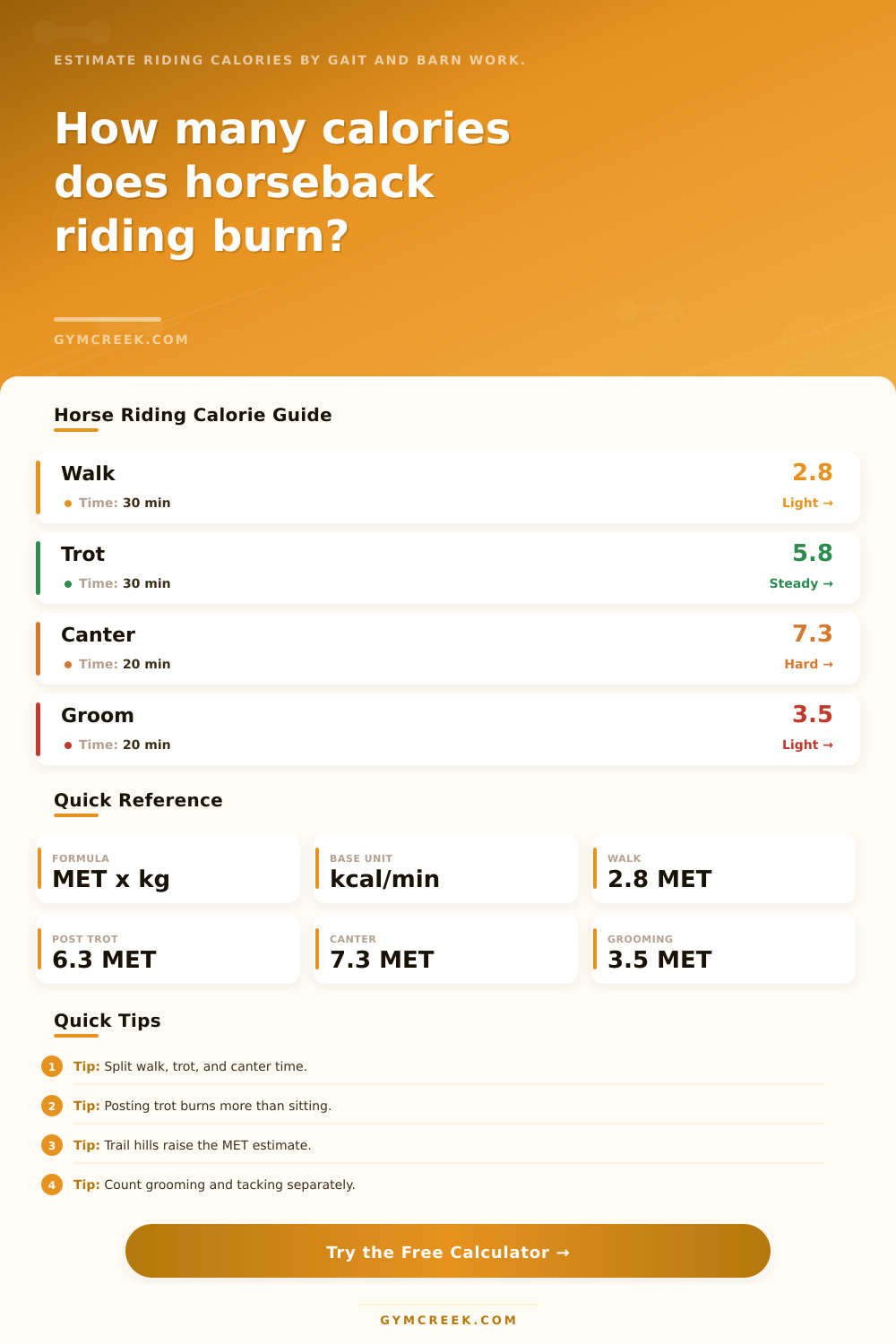
Walk, sitting trot, posting trot, canter, gallop, and mounted standing each receive a separate MET before modifiers.
Setting, footing, hills, rider level, and horse responsiveness adjust the weighted mounted MET for realistic workload differences.
Mifflin-St Jeor estimates BMR from weight, height, age, and gender, then activity level estimates TDEE for session share.
📑Reference Tables
| Riding Segment | Base MET | Typical Use | Effort |
|---|---|---|---|
| Mounted standing | 1.8 MET | Waiting or halt work | Very light |
| Walking horse | 2.8 MET | Warmup and trail walk | Light |
| Sitting trot or jog | 5.5 MET | Schooling and jog work | Moderate |
| Posting trot | 6.3 MET | Flatwork and lessons | Moderate |
| Canter or lope | 7.3 MET | Fitness and transitions | Hard |
| Gallop or fast work | 8.8 MET | Sprints and barrels | Hard |
| Barn Segment | Base MET | Includes | Calories Effect |
|---|---|---|---|
| Grooming | 3.5 MET | Brush, curry, hooves | Steady add-on |
| Tacking | 3.0 MET | Saddle and bridle | Light add-on |
| Leading | 3.2 MET | Hand walk or lead | Light add-on |
| Untacking | 3.0 MET | Post-ride gear | Light add-on |
| Setting | Modifier | Best Match | Notes |
|---|---|---|---|
| Arena schooling | 1.00x | Flat lessons | Baseline |
| Structured lesson | 1.06x | Coach-led sets | More transitions |
| Flat trail ride | 0.96x | Easy trail | More walking |
| Hilly trail ride | 1.12x | Climbs and descents | Core work |
| Ranch work | 1.10x | Stock work | Stop and turn |
| Competition | 1.14x | Warmup or pattern | High focus |
| Formula | Variables | Output | When Used |
|---|---|---|---|
| MET kcal | MET, kg, min | Calories | Main estimate |
| Weighted MET | Gait split | Ride MET | Mounted work |
| Barn calories | Task MET, min | Extra burn | Ground work |
| Mifflin BMR | kg, cm, age | Baseline | Daily context |
💡Tips
Riding is an activity of continuous small changes, requiring whole body engagement. In 30 min., your legs are weak & your core is quivering when you thought you were just going for a leisurely ride in saddle. Most rider don’t realize how many calories they’re burning (it’s not apparent on the ground).
Because standard fitness tracking devices can’t distinguish between sitting vs. Posting, we wanted to break down the ride by task & gait. To use it: The calculator up top crunches the numbers based off your ride profile. And here is where we get into small details: the calculator tells the difference between barn chores (work done while standing) and mounted work (which gets more credit). Leading, tacking up and grooming are all active tasks that contribute time to your day, even though you’re not on the horse. Getting the saddle on or currying that coat take time and energy in your upper body. Add in some ground tasks and you’ll get an accurate idea of your time spent with animal.
Why Riding Burns More Calories Than You Think
The difference depend on how you spent those mounted minutes. A quiet, light walk doesn’t do much more then move your energy along; it’s when we trot that we really get to work. Posting trot is exercise: it works your core, glutes, and quadriceps rhythmically. Sitting trot is no slouch either since it relies heavily on deep core stability to absorb shock. The tool takes into account this difference, knowing that a riding style dominated by posting will give different result than one that’s heavy on sitting trot. So the emphasis becomes not so much time as it does quality of movement.
The calculations also factor in terrain. If you ride on an arena with flat footing, the terrain is controlled and predictable. But if you’re riding across deep sand or up and down rolling hills, that’s going to change things. The more effort required of your horse, the more effort it will take you to maintain balance. When you go uphill, it really cranks things up a notch and the calculator takes that into account as well. Since real-world rides don’t happen in ideal settings, the number reflect what you’ll feel while riding.
The amount you burn will depend on skill level of the Rider as well. The new Rider has to work harder to keep their bum in the saddle and therefore expend more energy through constant correction. While the experienced Rider may burn fewer calories riding the same distance due to the small aids that flow with the horse, there is still a great cardiovascular effect. So it isn’t all about what we put into our body but how our body respond to that load.
If the number seems low compared to a treadmill workout, don’t be discouraged! Riding has other advantages that straight-up cardio doesn’t (better mental focus, balance, posture). The calories are an estimate, only, so instead of looking at them on any particular day look for how they trend when you start tracking them over time. The more often you ride the more calories per day you should of see yourself burning, a signal that your body is adjusting. This leads me to planning recovery more effectively as I learn what activities expend my energy. A hard canter session followed by intensive grooming will leave you with different fatigue profile than a leisurely trail walk. That way you know to compensate by taking more time resting or eating.
The metabolic equivalents chart on the page (shown in the table below) removes the guessing out of how much effort is equivalent to what gait. It’s easy to see that even just a small amount of consistent work adds up over time… Versus wondering if that short ride was worth it.
After all, it’s not about how many calories we burn, but rather establishing a stronger relationship with our horse. Riding require physical strength and mental clarity. Staying alert, responsive, and strong will improve your ride. Keep in mind that when you see your results, you are improving both your fitness level and your skills. What you invest in the saddle returns in confidence. Whether the number on the screen increases or remains unchanged, the true reward is in the connection.