Hip Thrust Load Calculator
Estimate hip thrust working weight, effective lockout resistance, rep-adjusted 1RM, bodyweight ratio, and weekly thrust volume.
📌Presets
Presets load realistic hip thrust setups with bar weight, plates, band tension, reps, RPE, ROM, bench height, and goal-specific target zones.
⚙Calculator
Hip thrust load snapshot
Enter your setup details to estimate load targets and strength markers.
📊Fitness Metrics Comparison
📑Reference Tables
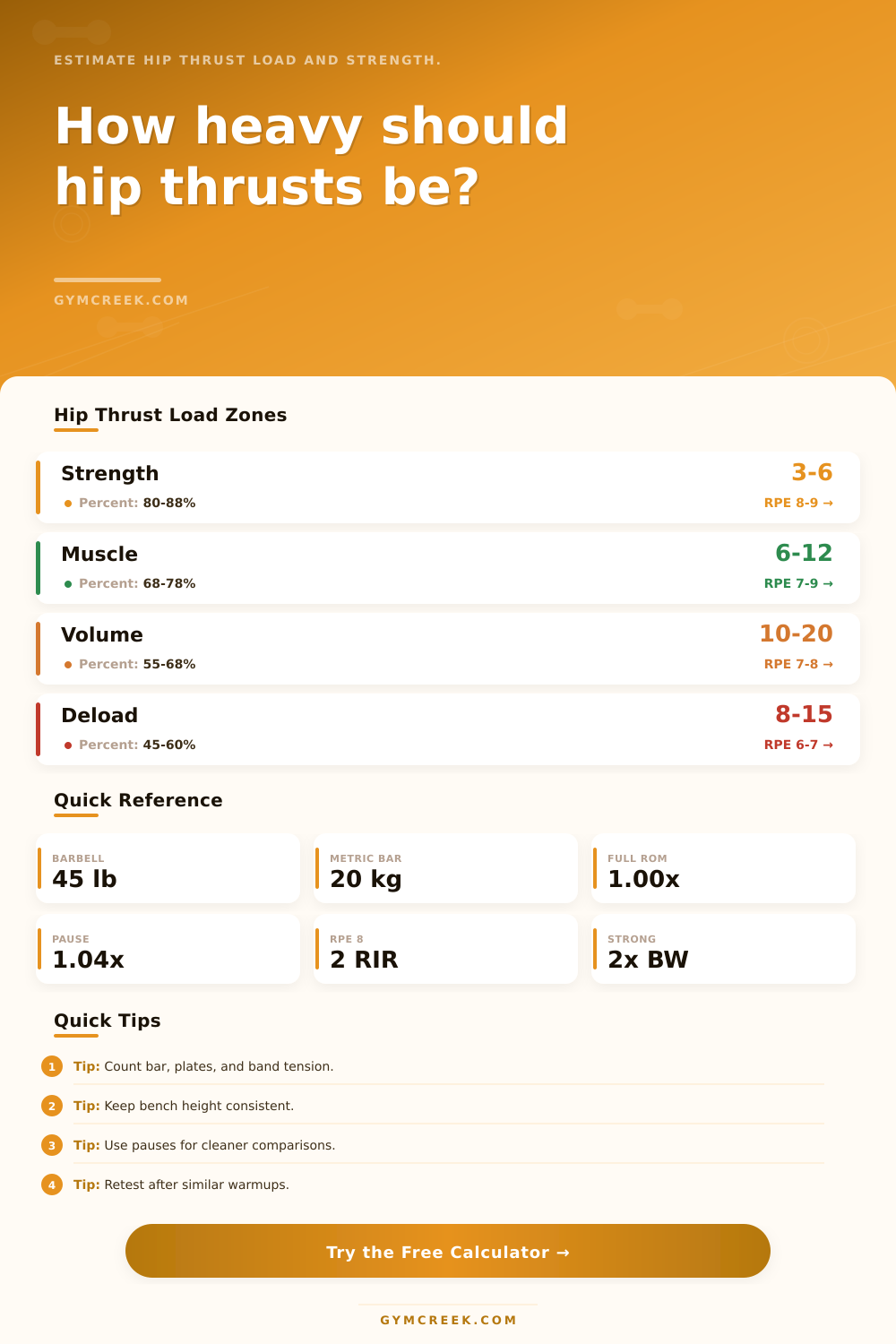
| Goal | Rep Range | 1RM Percent | Effort Guide |
|---|---|---|---|
| Max strength | 3-6 reps | 80-88% | RPE 8-9 |
| Hypertrophy | 6-12 reps | 68-78% | RPE 7-9 |
| Volume pump | 10-20 reps | 55-68% | RPE 7-8 |
| Deload technique | 8-15 reps | 45-60% | RPE 6-7 |
| Bodyweight Ratio | Female Guide | Male Guide | Training Meaning |
|---|---|---|---|
| Under 1.0x | Novice | Novice | Skill and setup phase |
| 1.0-1.5x | Developing | Developing | Consistent work sets |
| 1.5-2.0x | Strong | Intermediate | Productive strength base |
| 2.0x plus | Advanced | Strong | High glute strength |
| Setup Factor | Typical Value | Why It Matters | Use In Calculator |
|---|---|---|---|
| Band tension | 0-120 lb | Changes lockout load | Add to effective load |
| Bench height | 14-18 in | Changes hip path | Fit warning only |
| Full pause | 1.04x | Raises difficulty | Normalizes 1RM |
| Short ROM | 0.93x | Reduces demand | Lowers normalized load |
| Formula | Variables | Purpose | Output |
|---|---|---|---|
| Effective load | Plates + bar + band | True lockout load | Current load |
| Epley 1RM | Load x (1 + reps / 30) | Rep max estimate | Hip thrust max |
| Target load | 1RM x goal percent | Plan next set | Working load |
| Weekly volume | Load x reps x sets | Compare sessions | Total tonnage |
💡Tips
Hip thrusts are more complicated than they look. It’s not necessarily about natural ability, it’s about consistency and leverage. While some people can lift huge amounts of weight, you’re struggling with a empty barbell. Why? Because it’s not about the amount of plates on bar. It’s about real-world resistance.
Understanding how much you’re pulling give you clarity. But it’s not like that with resistance band training. All those variables go into the calculator; which does them for you. You won’t have to guess about coefficients or forget about band tension.
How to Track Your Hip Thrust Strength
You’ll see many people forget they’re using resistance bands or think they weigh 45 lbs, but that isn’t true. When you add resistance bands, the lockout becomes significantly heavier than the bottom of movement. By logging just plate weight, you is under-reporting how strong you are. The tool allows you to include band tension and takes this into account.
It gives you a factor if the peak resistance occurs at the top of movement, or an average across the full range. This matters because you want to track progress over time. Your training logs will also factor in your range of motion. A full range of motion with a one-second pause is harder than short, jerky reps. To account for that differance, the calculator levels it out.
Adjusting your estimated one-rep max according to your pause and tempo setting accounts for effort level and rep count. In other words, you can compare high-rep days to those low-rep sessions with heavy weight. This makes the data feel less skewed. You have a clear picture of how strong you are relative to bodyweight.
But numbers are meaningless without context. Two-hundred pound lifts don’t mean the same thing on 150-pound body as they do on a 220-pound body. Effective loads is measured relative to body weight. That puts you in a category (novice, intermediate, advanced).
That helps set realistic expectations. That lets you know whether you lift your bodyweight once, or two times than your bodyweight. That keeps you from lifting heavy until you build structural integrity.
How Much Volume Are You Accumulating? (Volume) Weekly volume is where the rubber meets the road for muscle growth, provided your setup remain consistent so that the volume acts as productive stress. One-time strength demonstrates the maximum weight lifted. Volume provides an idea of how much work was performed over time.
Tonnage represent the product of set, rep and load. That’s the number that keeps you working at a level that is not too much or to little. Working too hard for weeks will result in form breaking down. Your lower back will round out too much and your ribcage will flare.
Foot position and setup height consistency will create productive stress instead of damage. Be mindful and gradual with progression. There are targets within the tool designed to facilitate gradual increases. Often times, it’s better to add just a few pounds each week instead of trying to cram on ten all at once.
That honors your ligaments and tendons, which don’t stretch quite as fast as muscles does. That will keep you moving for years, not just months. Longevity matters when it comes to good movement quality. Take these numbers as guidance.
Stop if your upper ribs flare out or if your hip position breaks down. These numbers take away any guessing during the planning process. So you can load up confidently, step under and go. When it’s time to move however, rely more on what your body tells you than what the spreadsheet says.
Great programs strikes a balance between planning for what to do and going with what feels right in the moment. At the end of the day you know exactly how much weight was on the bar. That’s where real strength lies. It’s in that balance between feel and data. You should of used these numbers to help your training.