Hip Size Calculator
Estimate a practical hip circumference range from waist size, height, frame width, and fitness goal, then compare it with waist-to-hip and hip-to-height markers.
Presets are examples only. Replace them with your own tape measurements for a more useful hip size estimate.
Your hip size profile
Results will appear after calculation.
| Reference group | Lower range | Moderate range | Higher range |
|---|---|---|---|
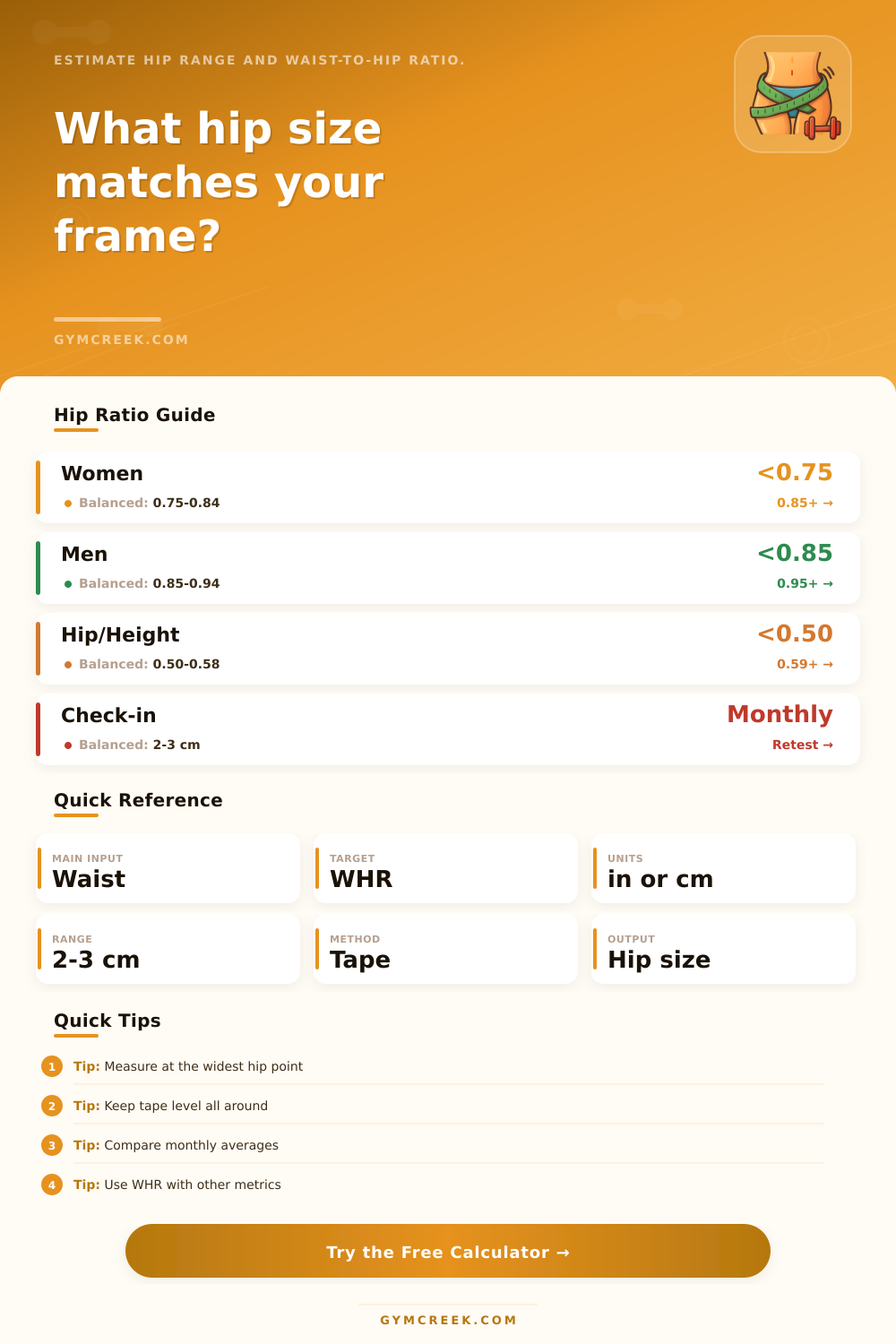
| Female reference | Below 0.75 often indicates narrower waist or wider hips | 0.75 to 0.84 is a common proportional range | 0.85+ is commonly flagged for added health context |
| Male reference | Below 0.85 often indicates narrower waist or wider hips | 0.85 to 0.94 is a common proportional range | 0.95+ is commonly flagged for added health context |
| Hip-to-height | Below 0.50 may reflect a smaller pelvis or leaner build | 0.50 to 0.58 is common across many active adults | 0.59+ may reflect larger glutes, pelvis, or fat distribution |
| Shoulder-to-hip balance | Under 0.90 hip/shoulder ratio looks shoulder-dominant | 0.90 to 1.05 is visually balanced for many frames | Over 1.05 looks hip-dominant relative to shoulders |
| Scenario | Best primary metric | Expected movement | How to read it |
|---|---|---|---|
| Glute hypertrophy phase | Hip circumference and body weight trend | Small increases over 4 to 8 weeks | Hip size rising while waist stays similar suggests productive gain |
| Fat-loss phase | Waist, hip, and WHR together | Waist often changes faster than hips | WHR may improve even when hip size changes slowly |
| Endurance sport block | Hip size and hip-to-height ratio | Often stable or slightly lower | Stable hip size with better performance can be normal |
| General physique check | Hip, waist, shoulder, and height ratios | Slow changes month to month | Use the range as a compass, not a fixed ideal |
| Formula | Variables | Output | Best use |
|---|---|---|---|
| Waist-to-hip ratio | Waist / hip | WHR score | Comparing waist and hip distribution |
| Target hip from WHR | Waist / target WHR | Estimated hip circumference | Finding a hip range that matches a waist goal |
| Hip-to-height ratio | Hip / height | Frame-scaled hip marker | Comparing different body heights more fairly |
| Hip-to-shoulder ratio | Hip / shoulder | Frame balance score | Checking lower-body and upper-frame balance |
A hip size calculator will allow a person to understand there body measurements. A person may often find that the weight that they display on the scale do not necessarily indicate the way that their body will appear to the general public. Consequently, a person may turn to a tool like a hip size calculator to provide context to their body measurement.
These ratios or ranges provided by a hip size calculator can help a person understand in what way their body measurement relate to there individual goal. To calculate their hip size, an individual must provide several different measurement of their body. The measurements that the tool will require include there waist circumference, their hip circumference, and their height.
How to Use a Hip Size Calculator
The person should measure the waist circumference at the narrowest part of they torso, while their hip circumference should be taken at the widest part of they glutes. The individual’s height will also be required for this calculation; height is another way of providing context to their body measurements and ensuring that comparisons between individuals of different height are not made. Additionally, the individual may also be required to provide their shoulder circumference, their activity level and training history, and their body fat percentage.
Using these measurements, the tool will provide an individual with several different measurements of their bodies. These measurements may include their estimated hip range, waist-to-hip ratio, frame balance score, and even a tracking target for they measurements. Each of these measurements can help the individual understand more about their bodies in comparison to others, or even their progress towards achieve there goal.
One of the main measurements that a hip size calculator can provide is the waist-to-hip ratio. However, this ratio is only provided as a reference point for an individual’s body composition, and does not necessarily indicate the target that they should strive to reach for optimal health. For instance, some individuals may have a natural tendency to have a larger waist-to-hip ratio due to the fact that they have a wider pelvis than others, or that they have more muscle in they glutes than others.
Additionally, an individual’s hip-to-height ratio is also only provided as a reference point, and does not necessarily indicate that they have some health related problem. Instead, they can use this value to determine if their body measurement are moving in the same direction as their body goal. An individual’s specific goal for their body will help to determine how they interpret the data from the tool.
For example, if an individual is aiming to gain strength and size in their glutes, then a provided increase in their hip circumference will be positive considered. However, if an individual is attempting to lose fat from their body, then their hip circumference may be less important than other measurement. Thus, the tool does not have a goal for the individual, but it does allow them to view their body measurement through the lens of their individual goal.
Consistency in taking an individual’s measurements is critical to obtaining accurate data. For instance, an individual will want to ensure that they take their measurement at the same time of day, with the same amount of tension in their bodies. An individual’s food and water intake may affect their body measurements, so taking measurements twice or three times a day will help to ensure that the data that is collect from the tool is accurate.
Additionally, any changes in body measurements of at least two to three centimeters will indicate a change that is measurable and important to track. Changes of less than two to three centimeters may simply be random fluctuation in the body. In addition to weight, several other variable can impact an individual’s body measurements.
Variables like sleep, stress, and even menstrual cycles may impact an individual’s body measurements. For instance, poor sleep and high levels of stress can result in the body retaining water, which may lead to changes in an individual’s body measurement. Additionally, the training history of an individual may also have a major impact on their body composition.
An individual that has trained for years will have different result from the body than an individual that is just beginning to participate in strength training exercises. While a body composition calculator may account for an individual’s training history, it cannot account for each individual’s difference in physical capability. Another benefit of using a body composition calculator is that an individual can understand how their hip circumference compares to the circumference of their shoulder.
If an individual has especially wide shoulders in comparison to their hips, their body may appear athletic. However, if their hips are much wider than their shoulders, they may require different types of clothing to allow for comfort and ease of movement. The body composition calculator allow individuals to understand this relationship between their hips and shoulders.
The output from a hip size calculator should not be considered the final verdict on an individual’s body. Furthermore, the calculator should not be a reason for an individual to feel discouraged about their body. Instead, the calculator’s output can help an individual to understand the direction of their body measurements.
If the individual does not expect an individual’s waist-to-hip ratio, they can always review their training, recovery, and nutrition habit to improve their body composition. One benefit of a body composition calculator is that it remove the need for an individual to perform complex mathematics with their body composition measurements. Instead, the calculator allows an individual to use the data provided to make decisions regarding their body composition.
Additionally, as an individual continues to use the calculator for several months, there will be pattern to their body measurements. These patterns will help an individual to understand how their body is change over time. For example, an individual may notice that their hip circumference tends to remain the same throughout fat loss phases, but increases during glute training.
These different patterns will only become visible with the use of the calculator. Finally, hip size is only one data point in an individual’s body composition; it is most helpful when considered in conjunction with other body measurements (waist, height, shoulder width) and training history.