Hip Flexion Range Calculator
Estimate usable hip flexion range from a measured mobility test, pelvic compensation, pain rating, side gap, and the range needed for your sport or lift.
📌Presets
Presets load realistic hip mobility scenarios and recalculate the compensated range immediately.
⚙Calculator
Hip flexion snapshot
Enter your measured range and compensation details to estimate usable hip flexion.
📊Fitness Metrics Grid
📑Reference Tables
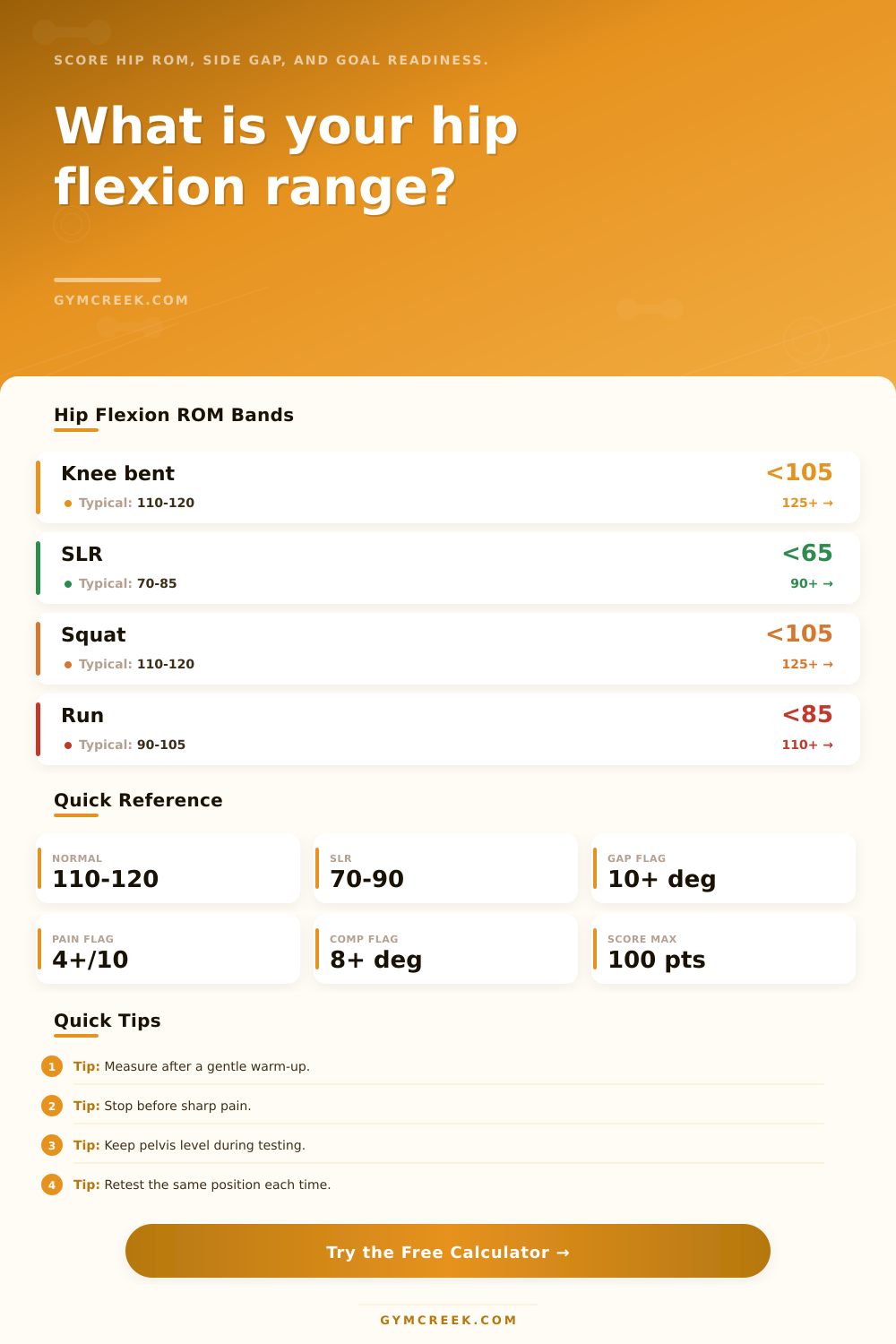
| Test | Limited | Typical | High Mobility |
|---|---|---|---|
| Supine knee-to-chest | Under 105° | 110-120° | 125° or more |
| Active straight-knee lift | Under 65° | 70-85° | 90° or more |
| Deep squat hip angle | Under 105° | 110-120° | 125° or more |
| Sport hip fold | Under 85° | 90-105° | 110° or more |
| Goal | Target | Why It Matters | Common Flag |
|---|---|---|---|
| General fitness | 110° | Basic gait and lifting comfort | Stiff end range |
| Deep squat | 120° | Depth without lumbar tuck | Pelvis rolls early |
| Sprinting | 105° | Front-side mechanics | Pinch in high knee |
| Cycling aero | 100° | Closed hip angle tolerance | Low back rounding |
| Yoga fold | 125° | Large hip hinge demand | Hamstrings dominate |
| Metric | Green | Caution | Review |
|---|---|---|---|
| Side-to-side gap | 0-5° | 6-10° | Over 10° |
| Pelvic compensation | 0-5° | 6-8° | Over 8° |
| Pain rating | 0-2/10 | 3-4/10 | 5+/10 |
| Readiness score | 85-100 | 70-84 | Under 70 |
| Formula | Variables | Output | Use |
|---|---|---|---|
| Usable ROM | Angle, pelvis | Clean flexion | Filters compensation |
| Goal ratio | Usable, target | Readiness | Sport context |
| Symmetry gap | Both hips | Degree gap | Side comparison |
| Arc estimate | Height, angle | Travel range | Mobility context |
💡Tips
What we don’t realize about hip mobility is that it’s not just the distance until our hamstrings shut down; it’s the angle we’re measuring. We think that number reflect our entire functional ability, but that rarely holds true since raw range of motion doesn’t take into account how you got there in the first place.
What is it realy measuring? And how far will I have to sacrifice to get there? If you spend eight hours sitting at a desk, you’re shortening your hip flexors and weakening/lengthening your glutes. In other words, the structure has shifted, which result in feeling tight when you stand up to sprint or squat. And it’s not necessarily a true joint limitation. Rather, it’s a system trying to move through a constrained pathway.
More Than Just the Angle
Looking past the angle, at the side differences and pelvic tilt, our true mobility calculator highlight this difference between pure mobility and savvy compensation. It filters out the noise so you can assess whether you’re truly opening up your hip or merely flexing your lower back to mask the stiffness beneath. Training with borrowed motion doesn’t fix anything; it only reinforces poor habits. You may be able to dump your pelvis forward into a deeper squat, but that will put shear force on your lumbar spine instead of loading your hips properly. Our tool takes this tradeoff into account, subtracts pelvic compensation from your measured flexion value and spits out an actionable score that represents clean movement, not desperate maneuvering.
Another ignored component that most training logs don’t consider is side asymmetry. On paper it may only be 10 degrees off between your right and left hip, but in dynamic movement that’s substantial force imbalance. Your body gets pulled out of alignment because one side work harder and the other lags behind. It creates a cascade of inefficiencies up the kinetic chain into your knees and ankles. The table on this page show if any of those gaps fall into the caution zones. It forces you to recognize not just that total range is a concern, but that symmetry is equally important. If one hip is limited, then it sets the ceiling for your whole movement pattern. You can’t push through discomfort to squat deeper than a stiff hip allow, and that will often lead to injury down the road.
The catch: Mobility achieved through compressive joint positions is temporary and tends to hurt. This throws the entire equation into pain response: A low number for any straight-leg raise is a red flag, but it isn’t necessarily a sign of a broken hip if your hamstring tolerance shows up lower than expected. The calculator uses your pain rating to help adjust your readiness scores. It reminds you not to push past “stop signs,” such as shooting pains or pins-and-needles zings.
Hamstring tolerance tests also provide insight, as a low score here doesn’t necessarily translate to a broken hip; it might simply indicate tight muscles on the back of your body. The bent-knee test will tell you if the bottleneck exists within the joint capsule or the muscle belly itself. If you know where the bottleneck resides, you can better focus your efforts when strengthening or stretching, instead of going blindly along.
There are subtler factors as well… Like age and height, which has an effect on interpreting these numbers. For instance, longer limbs project further through space when moved at any given angle. A taller person’s limbs cover greater distances (in absolute terms) while squatting or sprinting compared to a shorter person whose limbs move through a wider range of motion. Even if those angles appear equal when measured with a goniometer, this is a key piece of geometry and has a big impact on tissue strain.
While aging may result in naturaly less elastic tissues, it doesn’t make mobility work obsolete. It simply changes the desired outcomes: Instead of maximal range, the focus becomes preventing injuries and maintaining comfort during function. The benchmark changes with age because a 25-year-old sprinter is not expected to perform exactly the same way as a 70-year-old.
At the end of the day, this is all about control, not necessarily capacity. Having huge range doesn’t mean anything if you lack stability at the end of your range and thus cannot use that range under load. This isn’t a race to see how high of a number we could of come up with. It’s an attempt to find the most efficient way to reach whatever depth you need for cycling, sprinting, or squatting without letting your lower back arch too much. A good warm-up followed by another retest shows what you’re truly capable of; each time cold tissues lie to us about their capabilities. More important than hitting the exact number in any given test is a steady set up across tests. The number isn’t as important as the process so trust the process and focus on moving well rather than moving a long distance. When it’s time to go fast and pick up some serious weight, your hips will thank you.