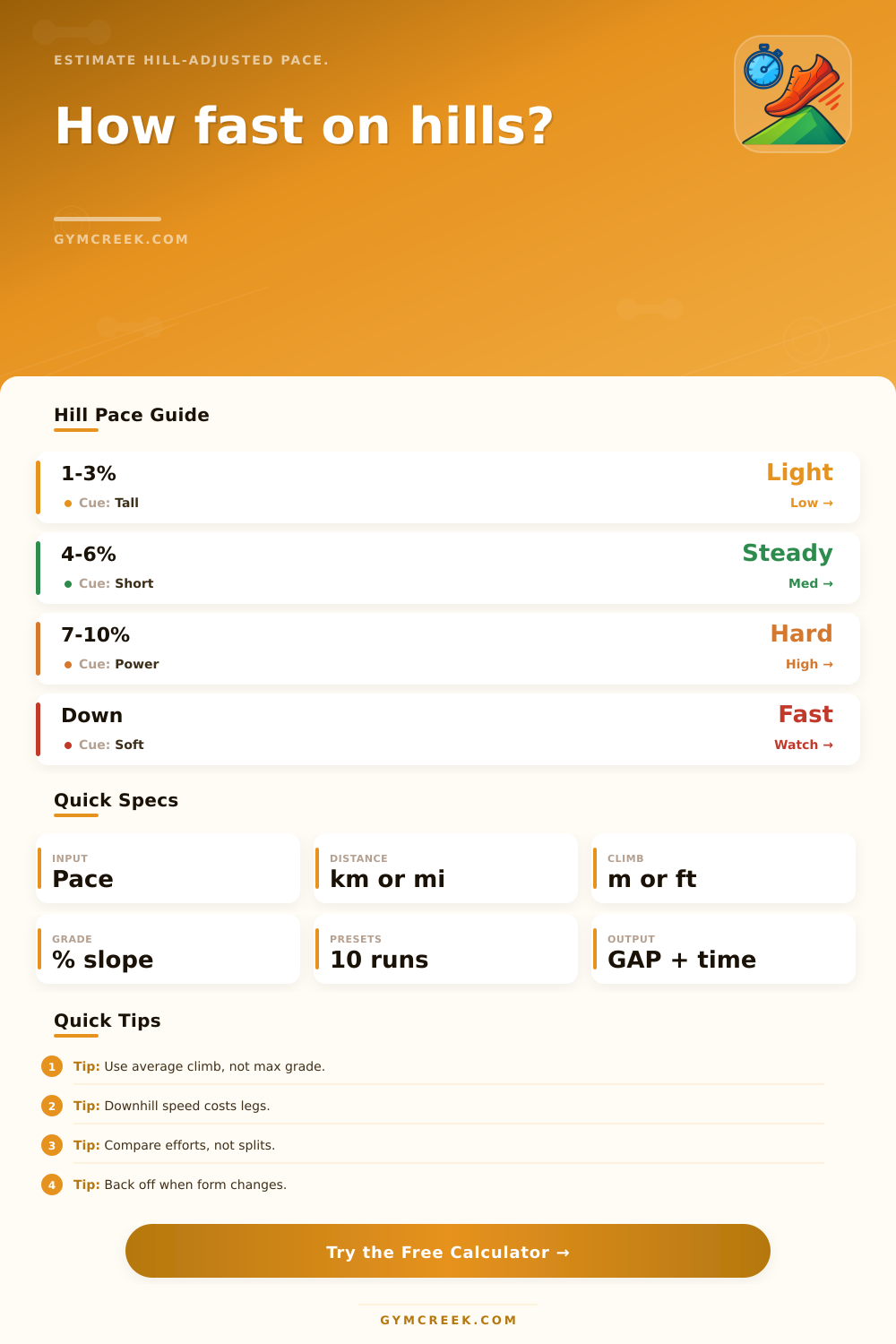
Hill Running Pace Calculator
Estimate hill-adjusted pace, finish time, grade-adjusted flat pace, climb load, descent effect, and pacing risk from your flat pace, course profile, surface, altitude, heat, and fatigue.
📌Hill Run Presets
Presets use realistic combinations of flat ability, distance, vertical gain, descent, grade, footing, altitude, heat, fatigue, and purpose.
⚙Hill Pace Inputs
Hill-adjusted pace
Enter your flat pace, route distance, vertical profile, grade, surface, altitude, heat, and fatigue to estimate a practical hill pace.
📊Hill Metrics
📘Reference Tables
| Average grade | Typical effect | Pacing cue | Watch point |
|---|---|---|---|
| 0-2% | Small pace drift | Run by normal rhythm | Do not overreact to tiny rollers. |
| 3-5% | Moderate climb cost | Shorten stride slightly | Use effort instead of exact split. |
| 6-9% | Large aerobic cost | Keep cadence quick | Power hike may be valid on trails. |
| 10%+ | Very large cost | Protect form first | Steep descents can erase savings. |
| Surface | Uphill effect | Downhill effect | Best use |
|---|---|---|---|
| Road | Low penalty | Fast if controlled | Road races and paved hill repeats. |
| Packed gravel | Small penalty | Stable at moderate grades | Park paths and rail trails. |
| Smooth trail | Moderate penalty | Some braking | Trail tempo and long runs. |
| Technical trail | High penalty | Often slower | Mountain and off-road racing. |
| Mud or snow | Very high penalty | Low confidence | Use effort, not pace targets. |
| Scenario | Inputs that matter | Expected output | Practical read |
|---|---|---|---|
| Rolling road 10K | Gain, loss, road surface | Small to moderate slowdown | Bank effort on climbs, not time. |
| Short hill repeats | Steepest grade, fatigue | High climb load | Compare reps by effort and form. |
| Mountain race | Grade, trail, altitude | Large pace spread | Plan by time-on-feet. |
| Downhill finish | Loss, surface, fatigue | Possible savings or braking | Fast is useful only if controlled. |
| Component | Formula idea | Used for | Limits |
|---|---|---|---|
| Uphill cost | Grade multiplier | Climb slowdown | Best for runnable grades. |
| Descent effect | Loss multiplier | Downhill help or braking | Technical terrain can reverse it. |
| Equivalent distance | Distance plus vertical cost | Finish estimate | Assumes steady effort. |
| GAP | Flat effort proxy | Compare routes | Not a medical or lab measure. |
| Step | Value | Adjustment | Meaning |
|---|---|---|---|
| Waiting | -- | -- | Calculate to populate your route model. |
✅Hill Pace Tips
Your pace calculation will be different when running on hills. What you’ll find, if you’re used to running on flat ground, is that effort required doesn’t increase at the same rate with grade. Any help from a long downhill run can dissapears if the ground gets rough or if your legs get tired.
That’s where a hill-adjusted calculator comes in: it accounts for the difference between perceived effort and actualy pace. Your flat pace is used as starting point for the calculator’s math. From there it adds in factors relevant to hilly courses. These include obvious ones like elevation gain/loss, but it also solicits input on the maximum sustained grade which isn’t equivalent to a long ramp vs. A shorter spike at any given average grade.
How to Use a Hill Running Calculator
It matters what surface you’re running on. There’s a small penalty on packed gravel vs. Roads are easier, but mud or technical trail might mean you has to brake more even when going downhill. Finally, there are sliders for heat, altitude, and fatigue, physiological and environmental factors that don’t appear in straight grade tables.
There is no magic number, but rather a series of numbers that relate to each other. Your average pace on a hill is the output which turns into a probable average speed once the height gets added in. Then there’s the grade-adjusted pace, which shows you the equivalent effort if it were all flat ground and you could compare it to a training run or another route. There’s also the climb load and the pacing-risk score so you know if this will be a solid day or one where little error will add up fast. These outputs should of been taken together, not alone.
If the numbers are abstract, then reference tables will give it some context. They’ll illustrate what each grade generally means in terms of breath and step. Then they’ll translate surface conditions into something you can use: When is it time to shift down to hiking? Or should you shorten your stride? The best thing about these tables is that they’re for before you set out to run. They can tell you if the route you have planned matches the effort level you wish to use.
It also depends on your level of experience. For instance, someone who’s been training on hilly terrain pays less of a price for a given amount of vertical gain than a first-time hill runner. That’s why we have an experience selector in our calculator. Similarly, the purpose selector tweaks the amount of reserve that the model is expecting you to use. You’ll get wildly different recommended pace bands from the same inputs if you’re doing a race effort vs. An easy long run on the same course.
One mistake people make is assuming they will save time downhill automatically. When an analysis shows a positive result for downhill, it only means that downhill saves net time. This benefit decreases and may even become negative if descent is steep, loose, or comes at the end of a hard day’s work. Compare the downhill effect output with how tired you are. Decide whether to go for broke descending or control the damage to the best of your ability.
Here’s the practical part: Instead of making a one-off split target from a course profile, plug it in and get your range of expected efforts using the calculator. Run that range, not the single number. Tweak on-the-fly based off breathing, form, and what you find out on the ground that the sliders weren’t able to account for.